“I regard the brain as a computer which will stop working when its components fail. There is no heaven or afterlife for broken down computers; that is a fairy story for people afraid of the dark.” — Stephen Hawking
“We’ll be alive again in a thousand blades of grass, and a million leaves, we’ll be falling in the raindrops and blowing in the fresh breeze, we’ll be glittering in the dew under the stars and moon out there in the physical world which is our true home and always was.” — His Dark Materials by Phillip Pullman
“You’re a collection of molecules and those molecules are made of smaller bits, and those bits are made of even smaller bits. The smallest bits in the universe are all identical. You are made of the same stuff as the concrete in the floor and the fly on the window. Your basic matter cannot be created or destroyed. All that will survive of what you call you life is the sum of your actions. Some might call the unending ripple effect of those actions a soul, or a spirit.” – The Religion War by Scott Adams
“When you die, it is said you see your whole life. But you don’t see it minute by minute, like a speeded-up film. It’s like everything you ever did in all your days was a brushstroke, and now you see the whole painting all at once.” — Lawrence Block’s Everybody Dies
I wonder how it all got started, this business about seeing your life flash before your eyes while you drown, as if panic, or the act of submergence, could startle time into such compression, crushing decades in the vice of your desperate, final seconds.
From The Art of Drowning by Billy Collins
You’re going to stay here for a week. Everyone gets a private room. Please feel at home. But while you’re here there’s one thing you must do. Out of the __ years of your life, we’d like to ask you to choose one memory, the one you remember and cherish most. There is a time limit. You have three days to decide. After you choose your memory, our staff will recreate it on film as exactly as possible. On Saturday we’ll show the films to everyone. The moment the memory comes back to you most vividly, you’ll go on to the other side, taking only that memory. — From the motion picture After Life
“Imagine that existence is like a sound recording. Listening to an old phonograph doesn’t alter the recording itself, and depending on where the needle is placed, you hear a certain piece of music. This is what we call the present. The music, before and after the song now being heard, is what we call the past and the future. Imagine, in like manner, every moment and day enduring in nature always. The record does not go away. All nows (all the songs on the record) exist simultaneously, although we can only experience the world (or the record) piece by piece. We do not experience time in which “Stardust” often plays, because we experience time linearly.” — Biocentrism by Robert Lanza (with Bob Berman)
“In spiritual terms the cycle of birth and rebirth is a workshop for making creative leaps of the soul. The natural and the supernatural are not doing different things but are involved in transformation on separate levels. At the moment of death the ingredients of your old body and old identity disappear. Your DNA and everything it created devolve back to their simple component parts. Your memories dissolve back into raw information. None of this raw material is simply recombined to produced a slightly altered person. To produce a new body capable of making new memories, the person who emerges must be new. You do not acquire a new soul, because the soul doesn’t have content. It’s not “you” but the center around which “you” coalesces, time after time. It’s your zero point.” — Deepak Chopra, Life After Death

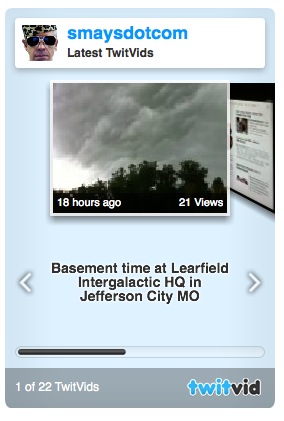 TwitVid is one of the countless apps that spring up around Twitter. I’d used it a time or two and started seeing it show up in tweets immediately after (during?) the tornado that hammered Joplin, MO. People were shooting amazing video with their phones and post directly to Twitter and Facebook via TwitVid.