
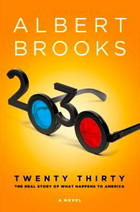
 I’m a big fan of Albert Brooks. Defending Your Life, Lost in America, Taxi Driver, Private Benjamin… pick your favorite. He writes, directs, acts… TV, movies and, now, novels.
I just finished 2030 and found it both depressing and inspiring. Here’s a little taste from a NYT review:
In the future America of “2030,” the national debt has long since surpassed the gross national product. Why anyone would want to be president is “more and more of a mystery.” On the rosy side — well, sort of — a cure for cancer has been found, turning the man who did it, Dr. Sam Mueller, into a billionaire and a guru.
The bad news? Along with a stock of lesser rejuvenating drugs and gadgets, Mueller’s breakthrough has left spry hordes of senior citizens cheerily hogging most of the country’s remaining resources. Seeing their own chance at the good life shrink to zero, young people are forming “resentment gangs” and committing acts of escalating violence against “the olds.” The White House’s first Jewish occupant, the brainy but melancholy Matthew Bernstein, would like to give them a fairer share of the pie, but even he doesn’t dare risk the wrath of AARP.
I have to say that just about everything in this story seemed plausible to me. Brooks fans won’t be disappointed. A few excerpts after the jump…
“There were no trusted sources of newsgathering anymore, no voice of one news organization or one reporter that people believed over another. It was a combination of professionals, amateurs, citizens, gossip, pictures fed to a world from billions of handheld devices; a whole slew of information that people someone how had to slog through and decide from themselves what was true.”
“If we don’t improve our youth’s chances for a better life, we will one day hand this country over to a generation that does not want it.”
“NewsOne was a combination of professional and amateur video capture. It had no commentary, just raw footage from wherever it originated.”
“The ‘last of the true white people,’ as they called themselves, they realized they were never going to get America back, and all they could hope for was to make it really unpleasant for everyone else to live there.”
Perplexity: Albert Brooks’s *2030: The Real Story of What Happens to America* is a satirical yet unexpectedly serious near-future novel that imagines the United States buckling under the combined pressures of longevity, debt, intergenerational resentment, and catastrophe. Its central premise is deceptively hopeful: in 2015, scientist Sam Mueller cures cancer. By 2030, people who would once have died in their sixties or seventies are living far longer, but the country has not redesigned its health care, pensions, housing, or public finances to accommodate them.
The result is a society in which younger Americans feel economically trapped, paying taxes and assuming debt to sustain an immense population of healthy but expensive “olds.” Anti-elderly violence and political radicalism begin to surface. Brooks turns a familiar generational complaint—Boomers have consumed too much—into a dystopian political force, complete with resentful young activists who see the elderly not as people but as an unaffordable class.
The fragile system is shattered when a 9.1 earthquake devastates Los Angeles. The U.S. government, already drowning in debt, cannot finance reconstruction. President Matthew Bernstein—the nation’s first Jewish president—must seek China’s help, leading to an arrangement in which China effectively becomes co-owner and rebuilder of Los Angeles. That idea, which might have read as broad satire in 2011, now feels less far-fetched amid anxieties about public debt, infrastructure vulnerability, geopolitical dependence, and China’s economic influence.
Brooks follows an ensemble: elderly Angelenos abruptly rendered refugees, a young Midwestern woman crushed by medical bills, a wealthy radical who channels generational anger toward extremism, political leaders, financiers, and the scientists whose medical breakthrough has produced unintended social consequences. The plot moves toward an act of terror involving a cruise ship for seniors, turning the novel’s demographic conflict into literal hostage drama.
Its prescience is not that Brooks predicted 2030 exactly. Rather, he recognized how a beneficial innovation—longer, healthier lives—could become socially destabilizing when institutions remain built for an earlier world. *2030* is therefore less a prediction than a dark comic thought experiment about who pays for progress, and what happens when a nation postpones structural choices until crisis makes them unavoidable.