Sony Ericsson has introduced a couple of new Cyber-shot digital camera phones that come with 3.2-megapixel cameras and are designed to work with Blogger. Snap a picture…bada-bing…it’s on your blog. The cameras are equipped with more goodies than most manual cameras, including autofocus, red-eye reduction, digital zoom and a flash. They also come with a music player, video player, FM radio, push e-mail, a memory stick slot and 64MB of internal memory. Google will also be made the standard search engine on all Sony Ericsson phones with Internet access. [Thanks, Morris]
iPod Hi-Fi
Fill your home with sound, not stereo components. Keep your music collection at your fingertips, not in countless CD cases. Change the way you experience digital music. For $349, iPod Hi-Fi delivers crystal-clear, audiophile-quality sound in a clean, compact design.
Might have to have me one of these. We probably turn our stereo on 3 or 4 times a year. I think I read that Apple has sold 10 million iPods. If 1% of them buy one of these… 100,000 at $350?
Rural broadband on the rise
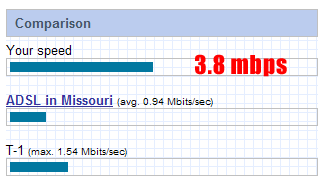
“Rural Americans are less likely to log on to the internet at home with high-speed internet connections than people living in other parts of the country. By the end of 2005, 24% of adult rural Americans went online at home with high-speed internet connections compared with 39% of adults in urban and suburban areas.”
— Pew Internet & American Life Project of high-speed Internet access in rural America
Seven in 10 watching TV news?
That’s one of the findings in a new Harris Poll of about 3,000 U.S. adults.
While broadcast television news appears to be the most popular medium sought, many adults also get their news several times a week or daily by going online to get news (64%), reading a local daily newspaper (63%), listening to radio news broadcasts (54%), listening to talk radio stations (37%), listening to satellite news programming (19%), and reading a national newspaper (18%).
Update: Table on Media Usage from Radio Business Report. The most disturbing stat? Radio news tied with online in the 59+ group. Shudder.

Does public broadcasting need a new name?
“…broadcasters (should) start viewing themselves as multimedia companies, and even changing their names to help spread the message both internally and externally. The internet is NOT broadcasting, and the more we understand that, the quicker we’ll get on with business models that’ll meet our needs in a Media 2.0 world.” – Terry Heaton
A couple of years ago we dropped the “network” from one of our networks because it was felt to be somewhat…limiting. No long reflective of what we are or are becoming.
Dave Winer on blogging
Dave Winer’s simple explanation of blogging and OPML:
First, create a new weblog on one of the free services, like Blogger or MSN Spaces. It takes about five minutes, and is about as hard as creating an email address on Yahoo or Hotmail, and represents less of a commitment. Then make your first post, something like Hello There, or Testing 1-2-3. Once you’ve verified that it works, you can stop there.
Then someday, when you’re in the shower or lying in bed in the morning and get an idea that you wish you could tell everyone, remember that you have a blog, and go to the computer, and write it up and publish it. That actually feels pretty good, even if you think no one will read it, because you got it off your chest.
Then in a few days Google will probably visit your site and index the post, and then when someone searches for that subject, your page will come up, and maybe you’ll pass that idea on to someone who can use it, or meet someone who agrees, or someone who disagrees. And that’s blogging, and that’s all it is.
As for OPML:
Did you ever have an idea you wanted to post on your blog that didn’t seem big enough to be an essay? An idea that could be expressed in a sentence, or less, but still deserved to get out there? In writing school they teach that less is better. If you can say something in three words instead of twenty, say it in three. It communicates better. Well, none of the existing blogging tools can do little sentence or phrase-size blog posts.
Current TV
I finally got a taste of current TV tonight (DirecTV 366). I say “finally” because I’ve heard about the channel but never bothered to find it and take a look. I thought it was interesting, fresh. If you’re not familiar with the idea behind the channel:
“We slice our schedule into short segments that we call “pods” — each just a few minutes long. And much of it comes straight from you. We call it viewer-created content, or VC2. Right now, VC2 makes up about a third of our channel — and that share is growing. Anyone who wants to contribute can upload a video. Then, everyone in the Current online community votes for what should be on TV.”
It was sort of like 60 Minutes for people under the age of 70. Very sharp graphics. And they include a little status bar near the bottom of the screen to let you know where you are in the segment. Nicely integrated with their website. I’ll be going back for another taste.
Living Healthy (18) – Sore Throat, Strep, Mono
Positive thoughts for Sheryl Crow
Sheryl Crow had surgery for breast cancer a few days ago. According to her website, she underwent successful surgery on Wednesday and described the procedure as “minimally invasive.” Doctors said her prognosis was excellent and she would have radiation treatments as a precaution.
“I am joining the more than 200,000 women who will be diagnosed with breast cancer this year,” Crow said. “We are a testament to the importance of early detection and new treatments … I am inspired by the brave women who have faced this battle before me and grateful for the support of family and friends.”
The Dynamic Einstein
If The Dynamic Einstein were the only thing the Web ever achieved, it would be enough. Even the most profound thought (see photo) seems silly when written by a genius.