iPad turns on instantly

I haven’t posted on the iPad for a while because we’re transitioning the little slab of magic from a Steve Device to a Barb Device. I’m sure it will still by lying around the house and I’ll pick it up as needed, but it’ll have her stuff on it.

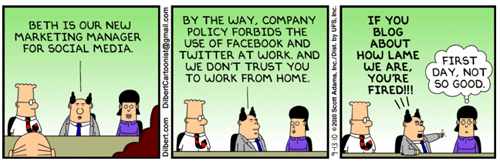
I was pleased to see that Scott Adams appreciates the iPad for some of the same reasons we do:

“By far, the iPad’s most wonderful feature, compared to laptops, is the fact that it turns on instantly. There’s no boot-up sequence. That one advantage makes the iPad an entirely different product from a laptop. Once powered on, the iPad doesn’t start begging me to update things nor force me to make decisions. It doesn’t remind me of all the ways it is protecting me. It doesn’t tell me to order printer ink or ask me to fill out a survey. A regular laptop is like your boss: always making you wait before giving you busy-work assignments. The iPad is more like a punctual lover. It’s always ready for fun. And if you are tempted to do some work on the iPad, its non-keyboard quickly changes your mind. You wouldn’t say a lover is a crippled version of a boss. (Insert your own inappropriate humor here.) So any comparison of an iPad to a laptop simply doesn’t work.”

“Another interesting phenomenon of the iPhone and iPad era is that we are being transformed from producers of content into consumers. With my BlackBerry, I probably created as much data as I consumed. It was easy to thumb-type long explanations, directions, and even jokes and observations. With my iPhone, I try to avoid creating any message that are over one sentence long. But I use the iPhone browser to consume information a hundred times more than I did with the BlackBerry. I wonder if this will change people over time, in some subtle way that isn’t predictable. What happens when people become trained to think of information and entertainment as something they receive and not something they create?”

I believe iPads are among the prizes being offered as incentives in one of the sales contests underway at our company. And our company chairman placed an order after watching some of the Mac heads playing with theirs at the Coffee Zone.

Frankly, I’m a little releived to be handing off our iPad to Barb. I LIKE creating informaiton and with the iPad it was so easy to just lean back in a big stuffed chair and graze.

KBOA photos (high rez scans)

One of my first attempts at a website was KBOA830.com. That was about 13 years ago and I’ve moved it around several times since then. The impetus for the site was a bunch of photos from the late ’40s, given to me by one of the original employees of the station.

When flickr came along, I uploaded the photos there but the scans were low rez because I didn’t know what I was doing. I’ve thought about rescanning but that’s one tedious chore.

A couple of months ago I boxed up 120 of the prints and sent them off to ScanCafe where they were “scanned by hand” for about 29 cents each. It took a while (I think the scanning is done in India) but the prints were safely returned along with a DVD of 300dpi images.

KBOA

Turns out I can’t delete the lorez images yet because I’ve linked to them from the KBOA site. Once I get that all sorted out I can get rid of the duplicates.

If you have a box of prints (or 35m slides or negatives), send them to ScanCafe (or one fo the similar services) and get them digitized. And then put them online, because that is the only hope you have of giving them a life beyond your own.

Footnote: I never tire of looking at these images. The tower and the transmitters and the studios… all of the expensive stuff it took to communicate in 1947. If you had something to say to your community (forget the world) you had to build/buy/go to work for one of these entities (radio station, TV, newspaper). All changed now. And changing. I love it.

Survey of radio newsrooms (1988)

A big part of my job during my early days at Learfield was affiate relations. Periodically, I would survey the stations to learn more about how they used our news and sports. Here’s a snapshot from 1988.

  • 2/3 of stations had a full-time news person (I’ll bet it’s not 1/3 today)
  • I was insensitive or stupid or both in asking about sex. It was a different time.
  • Almost half had a wire service?! Amazing. Can’t be more than 10% now.
  • “Cassette recorders” – Ah, my favorite. A world before digital recording.

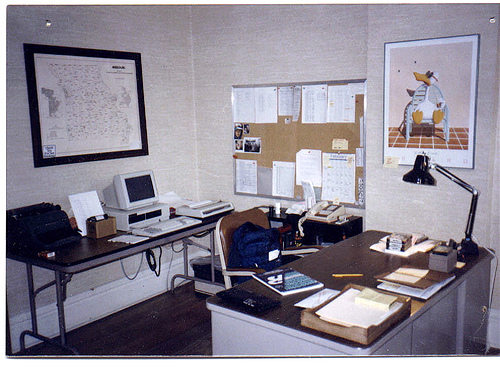
Back in those pre-web days, we also did a newsletter each month. One page, front and back. I typed it on a typewriter, made copies and put them in the mail. Example: Missourinet newsletter – Jan87

The whole process now seems … quaint. Typewriters and envelopes, once a month. But there was a simplicity that seems appealing in retrospect.

“Humanity’s Database”

That’s the title of David Pogue’s review of The Facebook Effect by David Kirkpatrick. A few excerpts:

“(Kirkpatrick) has written what amounts to two books about it: the first and second halves of “The Facebook Effect.” The first part is a fascinating but flawed corporate history, starring Facebook’s reticent creator, the Harvard dropout Mark Zuckerberg; the second is a thoughtful, evenhanded analysis of the Web site’s impact.”

“Not long from now, Facebook will be a frighteningly centralized database containing the information of about a half-billion people. Its advertisers already use this data (“You can show your ad only to married women aged 35 and up who live in northern Ohio,” Kirkpatrick notes), but apart from that, nobody can predict what the company will do with our information.”

“Despite its foibles, “The Facebook Effect” leaves you with a deep under standing of Facebook, its philosophies and, most startlingly, its power. You come away with a creepy new awareness of how a directory of college students is fast becoming a directory of all humanity — one that’s in the hands of a somewhat strange 26-year-old wearing a T-shirt and rubber Adidas sandals.”

Several times while reading Mr. Pogue’s review I found myself saying, “Yeah. I didn’t think of that.”

War by Sebastian Junger

Sebastian Junger was recently a guest on The Daily Show but you really don’t get much of a feel for a book (or the author) from those segments. Not sure why I picked up War but it’s hard to put down.

The war in Afghanistan seems very… abstract to me. I know it’s going on and people are dying (although we see almost no images of that) but it doesn’t seem real. Junger’s book (and the documentary, I assume) makes it seem very real.

I can’t tell if Junger has any views about whether the war is right or wrong or if that’s even a relevant question from the perspective the people fighting it. But his account makes it difficult to imagine anything like “winning.”

“The fact that networks of highly mobile amateurs can confound –even defeat– a professional army is the only thing that has prevented empires from completely determining the course of history. You can’t predict the outcome of a war simply by looking at the numbers.” – page 83

“The moral basis of the war doesn’t seem to interest soldiers much, and its long-term success or failure has a relevance of almost zero. Soldiers worry about those things about as much as farmhands worry about the global economy, which is to say, they recognize stupidity when it’s right in front of them but they generally leave the big picture to others.” – page 25

“…at one mile out (an) aircraft carrier is the size of a pencil eraser held at arm’s length. The plane covers that distance in thirty-six seconds and must land on a section of flight deck measuring seven yards wide and forty-five yards long.” – page 34

“…he joined the Army because he was tired of partying and living at this mother’s house, and now he’s behind sandbags on a hilltop in Afghanistan getting absolutely rocked.” – page 67

“Once while leaning against some sandbags I was surprised to feel some dirt fly in my face. It didn’t make any sense until I heard the gunshots a second later. How close was that round? Six inches? A foot?” – page 71

“It certainly isn’t beautiful up there, but the fact that it might be the last place you’ll ever see does give it a kind of glow.” – page 71

“The problem with fear, though, is that it isn’t any one thing. Fear has a whole taxonomy — anxiety, dread, panic, foreboding — and you could be braced for one form and completely fall apart facing another.” – page 73

“If I had any illusions about personal courage, they dissolved in the days or hours before something big, dread accumulating in my blood like some kind of toxin until I felt too apathetic to even tie my boots properly.” – page 74

“There are different kinds of strength, and containing fear may be the most profound, the one without which armies couldn’t function and wars couldn’t be fought (God forbid).” – page 74

“…an enormous amount of war-fighting simply consists of carrying heavy loads uphill.” – page 75

“If you’re not prepared to walk for someone you’re certainly not prepared to die for them, and that goes to the heart of whether you should even be in the platoon.” – page 77

“(He) had some kind of crazy redneck strength that was more like hydraulics than musculature.” – page 75

“The fact that networks of highly mobile amateurs can confound –even defeat– a professional army is the only thing that has prevented empires from completely determining the course of history. You can’t predict the outcome of a war simply by looking at the numbers.” – page 83

A “Vietnam moment” was one in which you weren’t so much getting misled as getting asked to participate in a kind of collective wishful thinking.” – page 132

“…much of modern military tactics is geared toward maneuvering the enemy into a position where they can essentially be massacred from safety. It sounds dishonorable only if you imagine that modern war is about honor; it’s not. It’s about winning, which means killing the enemy on the most unequal terms possible. Anything less simply results in the loss of more of your own men.” – page 140

“The enemy now had a weapon that unnerved the Americans more than small-arms fire ever could: random luck. Every time you drove down the road you were engaged in a twisted existential exercise where each moment was the only proof you’d ever have that you hadn’t been blown up the moment before.” – page 142

“War is a lot of things and it’s useless to pretend exciting isn’t one of them. It’s insanely exciting. The machinery of war and the sound it makes and the urgency of its use and the consequences of almost everything about it are the most exciting things anyone engaged in war will ever know.”

“War is supposed to feel bad because undeniably bad things happen in it, but for a nineteen-year-old at the working end of a .50 cal during a firefight that everyone comes out of okay, war is life multiplied by some number that no one has ever heard of.” – page 144

“The moral basis of the war doesn’t seem to interest soldiers much, and its long-term success or failure has a relevance of almost zero. Soldiers worry about those things about as much as farmhands worry about the global economy, which is to say, they recognize stupidity when it’s right in front of them but they generally leave the big picture to others.” – page 25

“…at one mile out (an) aircraft carrier is the size of a pencil eraser held at arm’s length. The plane covers that distance in thirty-six seconds and must land on a section of flight deck measuring seven yards wide and forty-five yards long.” – page 34

“…he joined the Army because he was tired of partying and living at this mother’s house, and now he’s behind sandbags on a hilltop in Afghanistan getting absolutely rocked.” – page 67

“Once while leaning against some sandbags I was surprised to feel some dirt fly in my face. It didn’t make any sense until I heard the gunshots a second later. How close was that round? Six inches? A foot?” – page 71

“It certainly isn’t beautiful up there, but the fact that it might be the last place you’ll ever see does give it a kind of glow.” – page 71

“The problem with fear, though, is that it isn’t any one thing. Fear has a whole taxonomy — anxiety, dread, panic, foreboding — and you could be braced for one form and completely fall apart facing another.” – page 73

“If I had any illusions about personal courage, they dissolved in the days or hours before something big, dread accumulating in my blood like some kind of toxin until I felt too apathetic to even tie my boots properly.” – page 74

“There are different kinds of strength, and containing fear may be the most profound, the one without which armies couldn’t function and wars couldn’t be fought (God forbid).” – page 74

“…an enormous amount of war-fighting simply consists of carrying heavy loads uphill.” – page 75

“If you’re not prepared to walk for someone you’re certainly not prepared to die for them, and that goes to the heart of whether you should even be in the platoon.” – page 77

“(He) had some kind of crazy redneck strength that was more like hydraulics than musculature.” – page 75

“The fact that networks of highly mobile amateurs can confound –even defeat– a professional army is the only thing that has prevented empires from completely determining the course of history. You can’t predict the outcome of a war simply by looking at the numbers.” – page 83

A “Vietnam moment” was one in which you weren’t so much getting misled as getting asked to participate in a kind of collective wishful thinking.” – page 132

“…much of modern military tactics is geared toward maneuvering the enemy into a position where they can essentially be massacred from safety. It sounds dishonorable only if you imagine that modern war is about honor; it’s not. It’s about winning, which means killing the enemy on the most unequal terms possible. Anything less simply results in the loss of more of your own men.” – page 140

“The enemy now had a weapon that unnerved the Americans more than small-arms fire ever could: random luck. Every time you drove down the road you were engaged in a twisted existential exercise where each moment was the only proof you’d ever have that you hadn’t been blown up the moment before.” – page 142

“War is a lot of things and it’s useless to pretend exciting isn’t one of them. It’s insanely exciting. The machinery of war and the sound it makes and the urgency of its use and the consequences of almost everything about it are the most exciting things anyone engaged in war will ever know.”

“War is supposed to feel bad because undeniably bad things happen in it, but for a nineteen-year-old at the working end of a .50 cal during a firefight that everyone comes out of okay, war is life multiplied by some number that no one has ever heard of.” – page 144