Scott Adams: Founding Fathers 2.0

“It was designed hundreds of years ago, and it gradually worsened over time, just like everything else that was designed hundreds of years ago. It’s the ultimate legacy system, bloated and hopelessly in need of replacement. And now, thanks to the brainwashing that all American kids get about the magic and wonder of our political system, and the near Godliness of our Founding Fathers, we’re unable to see the system itself as entirely broken. Instead, we assume the problem is that the people within the system are corrupt or incompetent. Or maybe the problem is the Tea Party, or the crazy Liberals, or anything but the system itself. There’s plenty of blame to spread around, but a good system should be excreting the crazies instead of embracing them. Why can’t we have that system?

And he has a solution:

“Suppose, just as a mental exercise, a new set of geniuses, call them the Founding Fathers Version 2.0, hold a convention and come up with a new form of government that fits the challenges of the modern age. Then, after a lengthy public debate, a constitutional vote is held in which every citizen can decide on keeping the old system or moving to the new one. If the new one wins, a transition plan is drawn up, and the move is made over maybe five years, so there is limited shock to the system.


GOP: We’re back! Did you miss us?

I started reading Rolling Stone back in the late ’60’s. I remember it as a different magazine. Or maybe I was just different (sure bet). I loved the pieces by Hunter S. Thompson. I had never read any reporting like that.

I recently subscribed to Rolling Stone, for one reason: Matt Tiabbi. I’ve been following his stuff or a few years now. I trust him and believe his reporting. I remember how disappointed I was when he called out the Obama administration for bringing in a batch of Wall Street crooks. But I didn’t doubt the accuracy of his reporting (or his outrage).

I’ve been trying to wrap my mind around the Tea Party movement (without subjecting myself to being in their presence). Here’s some excerpts from Mr. Taibbi’s piece in the October Rolling Stone: Continue reading

COMDEX 2010

I found this convention badge on a closet shelf this morning and it brought back memories. First, a little background from Wikipedia:

“COMDEX (an abbreviation of Computer Dealers’ Exhibition) was a computer expo held in Las Vegas, Nevada, each November from 1979 to 2003. It was one of the largest computer trade shows in the world, and by many accounts one of the largest trade shows in any industry sector. The first COMDEX was held in 1979 at the MGM Grand, with 167 exhibitors and 3904 attendees.”

I don’t remember what year I first attended COMDEX. Sometime in the lates 80’s or early 90’s if I had to guess. It was my first exposure to geek culture and I loved it. Not sure how I persuaded Clyde to attend (or how I ended up with his badge) but he’s sort of a geek wannabe like me.

The move from the NAB Radio Show to COMDEX marked the beginning of my shift in interest and career path.

The Social Network

A movie is going to be made about an important part of your life. Your only imput is to choose from the following:

  • A great director and screenwriter tell a a really interesting story that has people glued to their seats for 90 minutes, but bends or breaks the the truth whenever necessary to make the story interesting. And millions go to see it.
  • A so-so writer and a second-rate director make an exactly-as-it-happened movie that puts the audience to sleep and it hits cable in week 4.

Maybe it’s just the film buff in me but I’d much rather the be subject of a compelling bit of fiction, even if I came off looking like an asshole.

I really enjoyed The Social Network. I never saw an episode of The West Wing so this was my first (?) exposure to the Mr. Sorkin’s snappy diaglogue and it was sharp as a mouse turd.

I read David Kirkpatrick’s The Facebook Effect this summer (not the boook upon which the movies was based) and it showed Mark Zuckerberg in a more flattering light.

As I watched the story unfold, I found myself hoping Zuckerberg did some of the sleazy things alleged in the movie. It would be pretty shitty to have this really well-made film floating around for the rest of my life portraying stuff I didn’t do.

If Zuckerberg did get the idea for FB from the Winklevoss twins, well, they should have had a lawyer. If he screwed over his friend Eduardo… that’s a weight he’ll have to carry. But all those people on Facebook will never know or care.

Will advertising become obsolete?

What does Seth Godin think of advertising? Is it unnecessary? Here is his answer from a blog post at Real Time Advertising Week

“Not unnecessary. Gradually becoming obsolete, though. The cost of the ads goes up, the impact goes down. How can it not? Once people get a TiVo and a Facebook account, the way they allocate their attention changes. And that means the people you most want to reach don’t necessarily want to be reached.”

His answer has been on my mind since I read it. Advertising is “gradually becoming obsolete?” How does someone who works at a company that runs on advertising revenue react to such a statement? A few possibles:

  • Seth Godin is a smart guy and he’s been right more than he’s been wrong so we’re fucked
  • He’s right but it’s going to take a lot longer than he thinks it will
  • He’s partially right. Some advertising is becoming obsolete, but not the advertising that drives our company
  • Advertising is changing and we might call it something else but companies will always be willng to pay to to reach their customers with selling messages
  • He’s wrong. Advertising is here to stay. Period.

Did I miss any?

Frankly, to even wonder about this feels… heretical. Like questioning the flatness of the earth. I’ve written ads; I’ve voiced and produced ads; I’ve helped sell ads. Always taking it as a matter of faith that they worked. If they didn’t, why are businesses buying all these commercials we air on our (pick your medium)? And that they’d always be around.

Your thoughts?

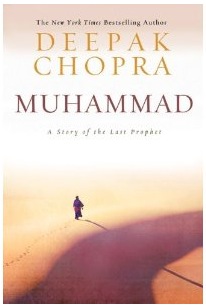
Muhammad: A Story of the last Prophet

I finished the novel Muhammad yesterday and have been pondering what to say about it. I found the story interesting and well-told. I’ve read a number of other books by Deepak Chopra and like the way he writes.

I think I’ll let smarter, more knowledgable folks review the book. No shortage there. So, what can I say about the novel?

If you were a kid, or have a kid, or you’ve been to a kid’s party, you’ve seen those guys that make balloon animals. Before blowing up those long skinny balloons they twist and shape into giraffes and stuff, they usually stretch the balloon. And as they inflate the balloon, they sometimes bend and turn it.

That’s what much of my reading has been like in the last few years. My thinking gets stetched and expanded, often to the breaking point.

One guy makes a hat, the next a horse. I enjoy them all and try to remember it’s all the same air inside the different colored balloons.

I knew almost nothing about the Prophet Muhammad. Now I know more. And maybe a little about the people who follow his teachings.

I fear many of those who would discuss this with me a) haven’t read the book and b) would be intent on explaining why Islam is wrong. (In their world, there is only one balloon and it’s blue and round.)

For that reason, I’ll limit comments to those who have read the book. So be prepared with a specific page reference.

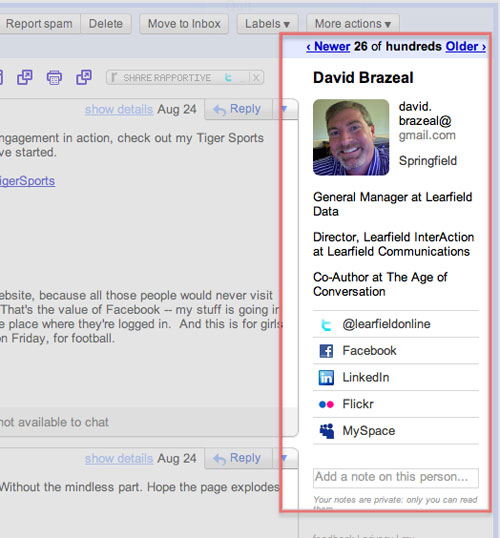
Rapportive. Making Gmail just a little better

Gmail is –and has been for some time– my primary email tool. The reasons for this grow longer every day. The most recent is a little add-on called rapportive.

Once installed, rapportive searches the web for each of your email contacts and displays profile information (if available), links to social networks, even recent tweets. There’s also a place for notes about that contact.

It looks like rapportive replaces the Google Ads but I’m not sure why Google would allow that.

If your first reaction is, “I don’t want the people I email knowing this stuff about me,” well, you need to run out and buy some stamps and envelopes. If you want to get into my in-box, transparancey is the price of admission.

It’ll take a week or two to know if this is as useful as it first appears. If you are a fan of Gmail, give rapportive a try (it’s free) and let me know what you think.

Social media and news

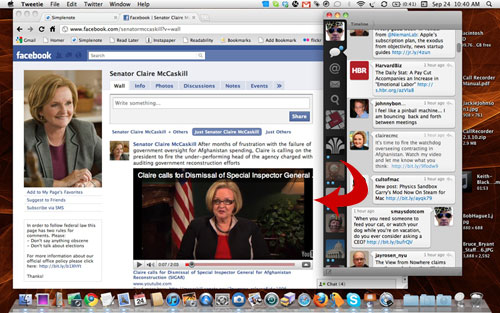
This morning Missouri Senator Claire McCaskill tweeted that it’s time to “fire the watchdog overseeing contracting in Afghanistan.” She included a link and invitation to her Facebook page where she posted a video explaining her positon and asking “what do you think?”

I’m sure this is happening hundreds of times a day but this still feels like something significant is happening. The senator has 40,000+ followers on twitter (not sure about Facebook). I’m sure elections have been won and lost by that many votes, but that’s not my point.

How would the senator have made her position known pre-twitter/facebook? Press release emailed to hundreds of media outlets? Radio interviews with big news stations in St Louis and Kansas City? Maybe a few seconds for a satellite interview with a couple of TV stations (or the networks)?

And for all I know she’s still doing this but in every instance, the media controls the experience. And there would be little or no opportunity for engagement with the people.

It’s not difficult for me to imagine a time in the very near future where Twitter replaces the emailed (faxed?!) news release. That’s probably already happening. And I am seeing more and more YouTube and Facebook video showing up in “newscasts.”

Real Journalists would insist that much is lost by them not having an opportunity to ask the senator “the hard questions.” But the’ll be hard pressed to find many viewers/listeners/readers who agree their questions add much. Not saying they’d be right, just that they don’t agree.

I’m going to go back to Senator McCaskill’s Facebook page and read some of the comments. And if anyone can put me in touch with her social media advisor(s), I’d really like to talk to them because they seem to know what they’re doing.

In Missouri, judges now calculate cost of punishment

Missouri (where I live) isn’t known as a hot bed of technology. Or, perhaps it is and I was just unaware. Always a possibility. Anyway… I came across a fascinating story by Monica Davey (New York Times). Judges in Missouri are the first in the country to use a computer algorithm to compute the cost of the sentence they hand down. From Ms. Davey’s story:

“Months ago, members of the Missouri Sentencing Advisory Commission, a group of lawyers, judges and others established by state lawmakers years ago, voted to begin providing judges with the cost information on individual cases.

The concept is simple: Fill in an offender’s conviction code, criminal history and other background, and the program spits out a range of possible sentences, statistical information about the likelihood of Missouri criminals with similar profiles to commit more crimes, and, most controversially, the various options’ price tags.

For someone convicted of endangering the welfare of a child, for instance, a judge might learn that a three-year prison sentence would run more than $37,000 while probation would cost $6,770. A second-degree robber, a judge could be told, would carry a price tag of less than $9,000 for five years of intensive probation, but more than $50,000 for a comparable prison sentence. The bill for a murderer’s 30-year prison term: $504,690.”

This makes perfect sense to me. Good to see Missouri out in front on something like this.