
Why there is no draft

From a new report called Mission: Readiness, an organization of education and military leaders:

Lean, mean, fighting maching“An alarming 75 percent of Americans ages 17 to 24 would not qualify for military service today because they are physically unfit, failed to finish high school or have criminal records. So says a new report from an organization of education and military leaders calling for immediate action on the early-education front.”

“Military recruiters in Kansas City report turning away prospective recruits “in every office, every hour, every day” for reasons including girths too large and credit ratings too low.”

“Even after signing up, 7 to 15 percent of enlistees return home for not meeting all that basic training demands.”

Scariest quote is from retired Rear Adm. James Barnett:  “Our national security in the year 2030 is absolutely dependent on what’s going on in kindergarten today.”
“A luxury we can no longer afford”

“New Business Models for News” was the title of a conference held by the City University of New York’s Graduate School of Journalism. You can read the full post by Dorian Benkoil at E-Media Tidbits but the goal of the (3rd annual) conference was “…to try to find ways that the news business can survive.”

“The 150 to 200 people there were a diverse audience — local bloggers and independent journalists trying to make a living, reps from big media companies like The New York Times and Gannett, venture capitalists, foundation funders, educators, consultants, students, technologists, advertising salespeople, ad network experts.”

“You’d better take an interest in the spreadsheets that represent your income and expenses, and cash flow statements that will determine if you can meet payroll every week — even if that payroll is just you, working alone. You may even have to consider, in the words of NYU’s Jay Rosen, that “there may be no business model to replace the old business model” — but you’ll still have to find a way to pay for it all.”

“But being unaware of anything having to do with the cash flows that support the news operation is a luxury we can no longer afford.”

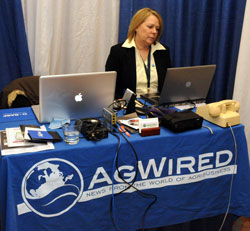
nama-trends-nafb-09-7Reading and thinking about this conference brought to mind my many chats with Chuck Zimmerman, a former Learfield employee who struck out on his own (with wife Cindy) and has created a small but successful business as an ag journalist (specializing in agriculture marketing).

Over the course of the last several years, I’ve heard Chuck talk about dealing with finances, ad sales, server problems, and a bunch of other stuff that had not much to do with reporting a story but a lot to do with putting bread on the table.

“How Twitter is changing the face of media”

This post by Soren Gordhamer (at Mashable.com) resonates for those of us who followed/participated in the “reporting” of “the hostage situation that wasn’t” here in Jefferson City.

“Sure, in the past, you could always email or call a friend to inform him or her of a quality news story or TV show; now, however, in a matter of seconds you can share this information on your broadcasting network via Twitter or Facebook, with tens, hundreds, or even thousands of people. It’s not my or your media anymore; it’s our media, and we can all broadcast it.” [Emphasis mine]

“In the past, what people thought of as “news” was what was reported that day in the New York Times or CNN. In an age where we all possess our own broadcasting network, though, smaller stations have greater power. Of course, a post on Twitter from CNN, which has over two million followers, will get more views than one from Joe Smith who has 20 followers will, but Joe Smith is at least in the game now, where he was not previously.”

“In the new media landscape, the task of defining what is the news that matters to people lies less with a few major media outlets, and much more with the millions of small outlets like you and I who each choose what to talk about. Increasingly, lots of littles, in aggregate, are becoming more powerful than a handful of bigs.” [Emphasis mine]

“Media is also becoming more personal. More and more people expect their broadcasting networks to be people with personalities, not simply sources of news. We want to know as much about the person reporting news as we do the news they are reporting. [Emphais mine] Broadcasting is more a personal act than ever, as users seek to have connections not just to content but to people.”

Mr. Gordhamer is the author of the book, Wisdom 2.0 and the organizer of the Wisdom 2.0 Conference.