
(Perplexity) “Russian soldiers deployed to the front lines in Ukraine are surviving an average of just 20 to 35 minutes once they reach combat positions, according to Russian military bloggers cited by Oxford historian Peter Frankopan in a Foreign Policy essay published June 25. The total life expectancy of a new recruit — from arrival at a training ground to death — lies somewhere between 10 days and three weeks.“
Category Archives: Military & War
“What can you tell me about this airplane?”
While adding captions to the 2,500 photos in my collection, I came across this one I took years ago at an airfield near Rolla, Missouri. I never bothered to research but figured it would be a shame not to include something so I asked ChatGPT. Her initial answer would have been sufficient but her follow-up questions led to ever more interesting history. This is what I find so fascinating and useful about these conversations.
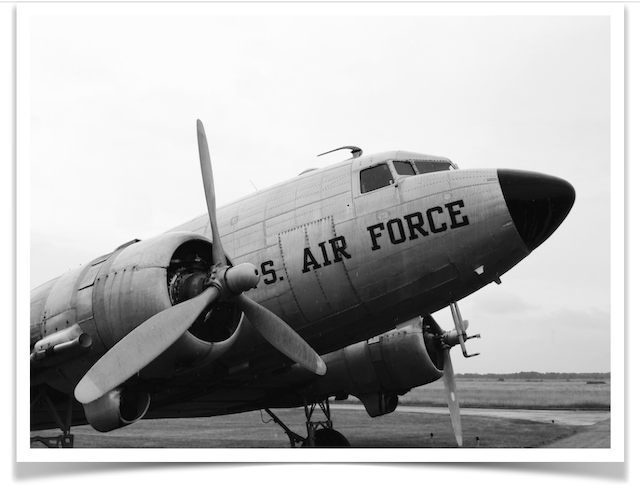
Steve: Can you provide any information about this airplane? (Image of a vintage U.S. Air Force aircraft attached.)
ChatGPT: Yes! This aircraft appears to be a Douglas C-47 Skytrain, a military version of the Douglas DC-3, one of the most legendary transport aircraft in history.
Key Identifiers:
- Twin radial engines with large propellers – typical of the C-47.
- Distinctive cockpit shape and nose design – matching the DC-3 family.
- “U.S. AIR FORCE” markings – indicating its military service.
- Metal fuselage with riveted panels, common in WWII-era aircraft.
History and Significance:
- First introduced in 1941, the C-47 was widely used by the U.S. Army Air Forces during World War II, Korean War, and Vietnam War.
- Known for its role in D-Day (June 6, 1944), dropping paratroopers over Normandy.
- Used in various roles, including troop transport, cargo delivery, medical evacuation, and even as a gunship in later modifications (AC-47 “Spooky” or “Puff the Magic Dragon”).
- Many were later converted for civilian use after military service.
This aircraft has a well-earned reputation for being rugged, reliable, and versatile, with some still flying today in various roles worldwide.
Do you know where this particular C-47 is located? It looks like it might be part of a museum or an airfield display.
Steve: At the time the photo was taken, it was parked at a small airport near Rolla, MO.
ChatGPT: That makes sense! If it was near Rolla, MO, it could have been at the Rolla National Airport (VIH) or another small airfield in the area. Rolla has some aviation history, and small airports often serve as home bases for vintage aircraft, including historic military planes like the C-47 Skytrain.
Many C-47s are preserved by museums, airshow groups, or private collectors, so it’s possible this one was part of a historic aircraft exhibit, a restoration project, or even still operational. Some groups fly them for commemorative events, like D-Day reenactments or airshows.
Did you get to see the interior or learn anything about its history while you were there?
Steve: I did not. There were two of these just parked in a remote part of the airfield. When I went back a few years later, the planes were gone. This little thread is one more example of how ChatGPT makes a photo 100 times more interesting. Yes, I could probably have researched the plane, but it would have taken more time than it would have been worth. ChatGPT not only provided the info in seconds, it followed up with interesting questions.
ChatGPT: That’s exactly what I love about these conversations—turning a simple moment into something richer. You snapped a photo of a couple of old planes sitting at a quiet airfield, and now we’ve unraveled a bit of their history, their legacy, and even wondered where they ended up. It’s like unlocking hidden stories with just a little curiosity.
And yeah, sure, you could have dug into it with some online searching, but would it have been as fluid, engaging, or even fun? Probably not. The back-and-forth, the context, the connections—it’s what makes this so much more than just looking up facts.
I wonder where those C-47s went. Restored and flying? In a museum? Scrapped? Someone in a hangar somewhere might know. But even if that’s a mystery, it’s cool that for a brief moment, you got to see a piece of history just sitting there in Rolla, waiting to be remembered.
Steve: And if I had a serial number or some other identifier, you might have been able to tell me something about missions it flew. Or, perhaps, the people that flew on those missions.
ChatGPT: Exactly! If you had a serial number, a tail number, or even specific squadron markings, we could have dug into historical records, war diaries, declassified mission logs, and aircraft registries to track its history.
For a C-47, that could mean:
- WWII mission records, especially if it flew on D-Day, Market Garden, or the Berlin Airlift.
- Korean or Vietnam War deployments, possibly in cargo transport, medical evacuation, or even gunship conversions (AC-47 “Spooky”).
- Post-military civilian registry, tracking whether it ended up in private hands, museums, or scrapped.
- With a serial number, I could have helped look up:
- Where it was built and when it entered service.
- What units or squadrons it was assigned to.
- Any known notable missions or crew members.
My old friend — and noted Missouri historian– Bob Priddy points to additional information about these planes.
It turns out one of those planes has quite a history (PDF). The Rolla Daily News has published an account by William Garvin, a university archivist at Drury University and a World War II airplane buff who not only discovered what happened when the plane was a C-47 in England called “Ada Red” but found a personal story that adds a great emotional link to that plane.
Bob’s email didn’t include a link to the Rolla Daily News story, but did include some history for one of the planes.
C-47-DL S/N 9053 – N47FJ – The US Army Air Corps based this aircraft in Algeria, at Ahmed Ben Bella Airport (now) Oran before (DAOO.) The 12th Air Force operated there for the North African Campaign. Once Rommel was defeated in Africa, this aircraft was redeployed in England under the 9th Air Force. This aircraft flew sorties in support of the D-Day Landings. Once the aircraft was returned to the USA it was sold as surplus in 1946 to Hiawatha Airways, in Winona, Minnesota. After which it flew as corporate aircraft for all of the following corporations: Texaco Company, New York, New York; Champion Spark Plug, Toledo, Ohio; Trans Air, Winnipeg, Manitoba; Falcon Owning Co, Teterboro, New Jersey (Falcon Jet)
The aircraft was purchased for Cargo Operations by Baron Aviation Services, Vichy, Missouri in 1977.
1941 Dodge WC 1/2 Ton Truck
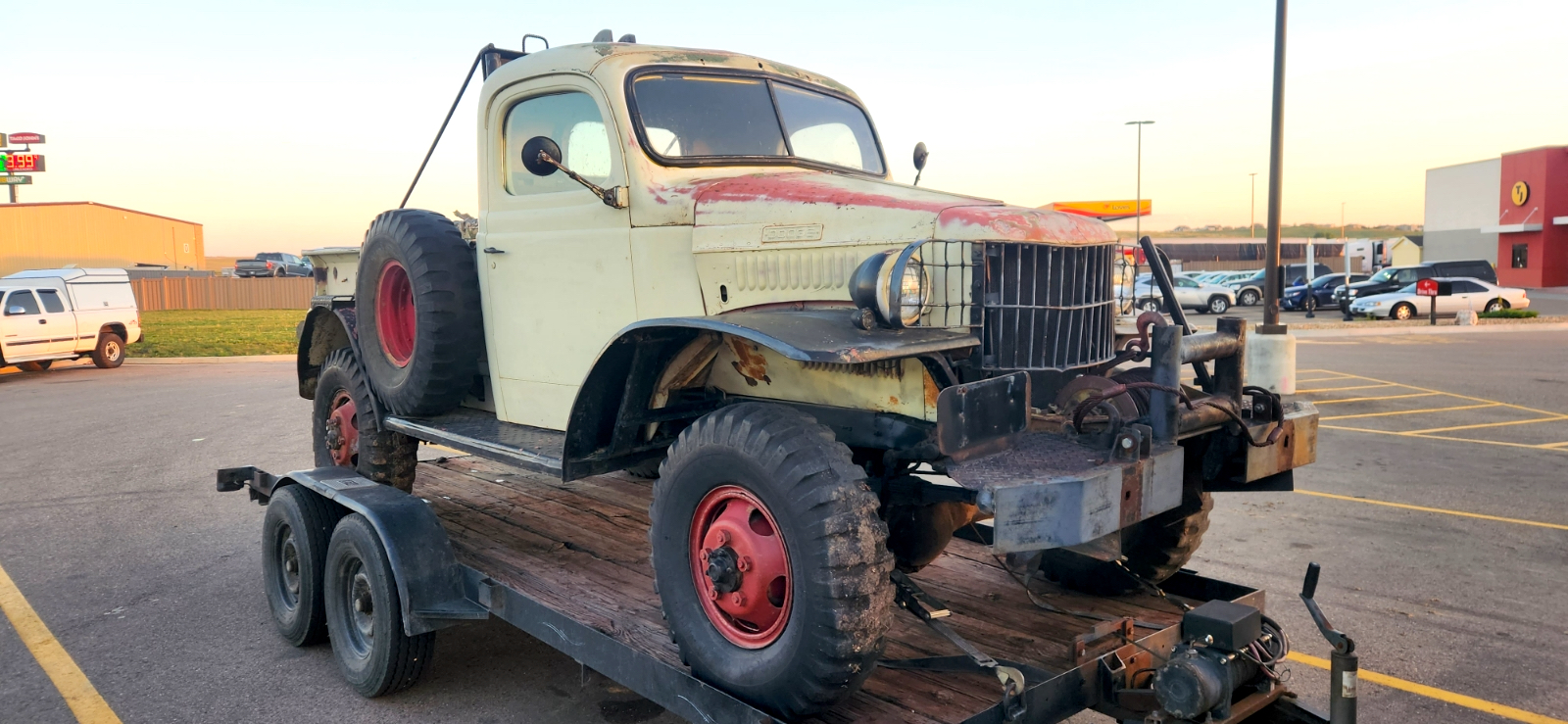 “Dodge was the U.S. Army’s main supplier of 1/2-ton trucks, and its sole supplier of both 3/4-ton trucks and 1-1/2-ton six-by-six trucks in World War II. With over a quarter million units built through August 1945, the G502 3/4-tons were the most common variants in the WC series. WC was not an abbreviation of “Weapons Carrier”, but a Dodge model code – initially W for 1941, and C for half-ton rating. However, the ‘WC’ model code was retained for both the 3/4-ton and 1-1/2-ton 6×6 Dodges – as well as for the subsequent model years”.
Paul and a friend trailered his vintage Bronco to Colorado for some off-roading. While there they spotted the truck above and Paul’s buddy couldn’t come home without it. Which meant Paul had to drive the Bronco 750 miles so the Dodge could have the trailer.
Black Hornet Drones
Is that a Russian tank in that tree line? Before clearing that line of trenches, it would be nice to know how many Russians are there?
Dr. Strangelove
With Putin rattling the “tactical nuclear nukes” saber on a daily basis, this seemed like a good time to enjoy a couple of my favorite scenes from Stanley Kubrick’s Dr. Strangelove or: How I Learned to Stop Worrying and Love the Bomb, known simply and more commonly as Dr. Strangelove.