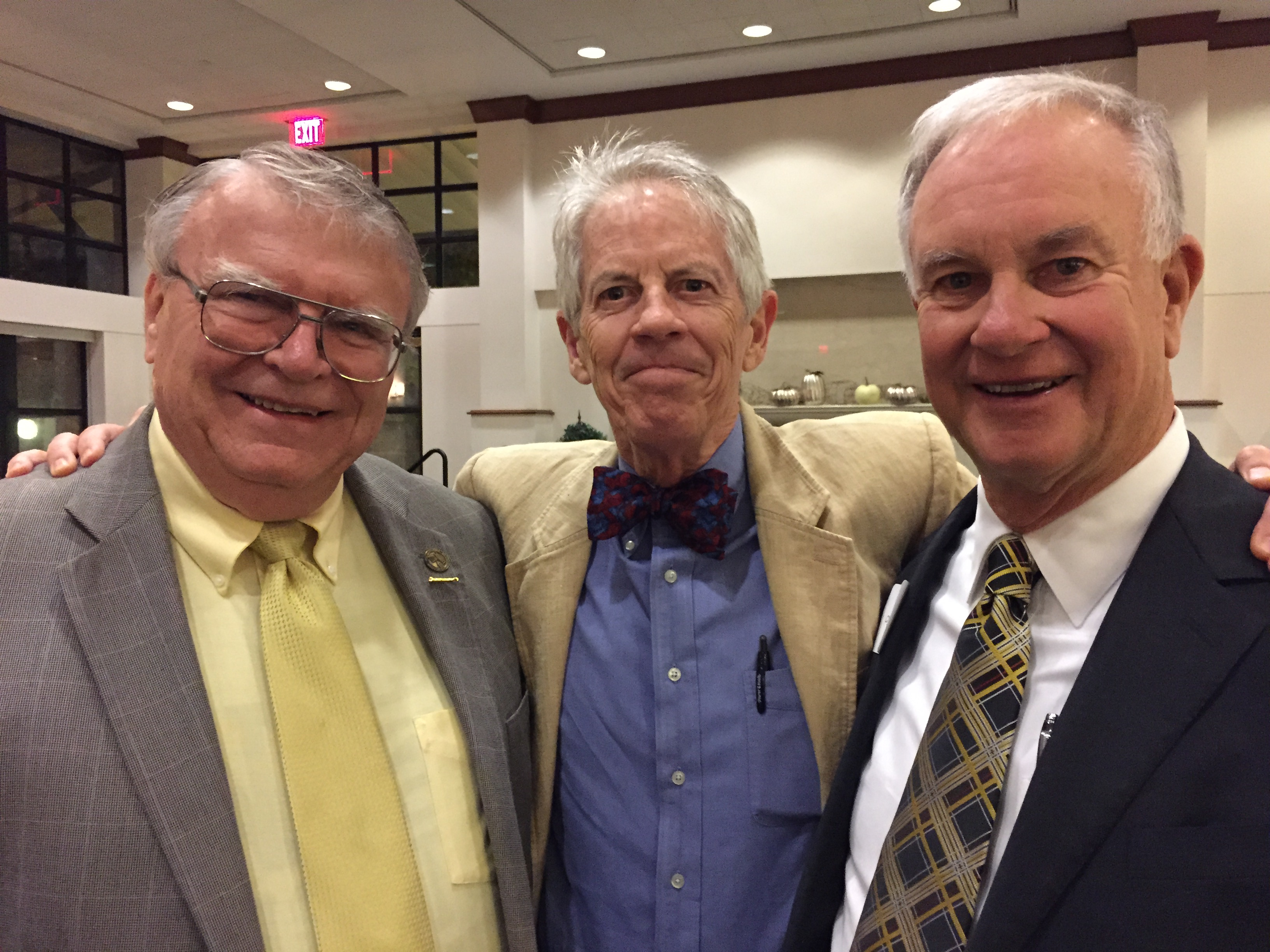
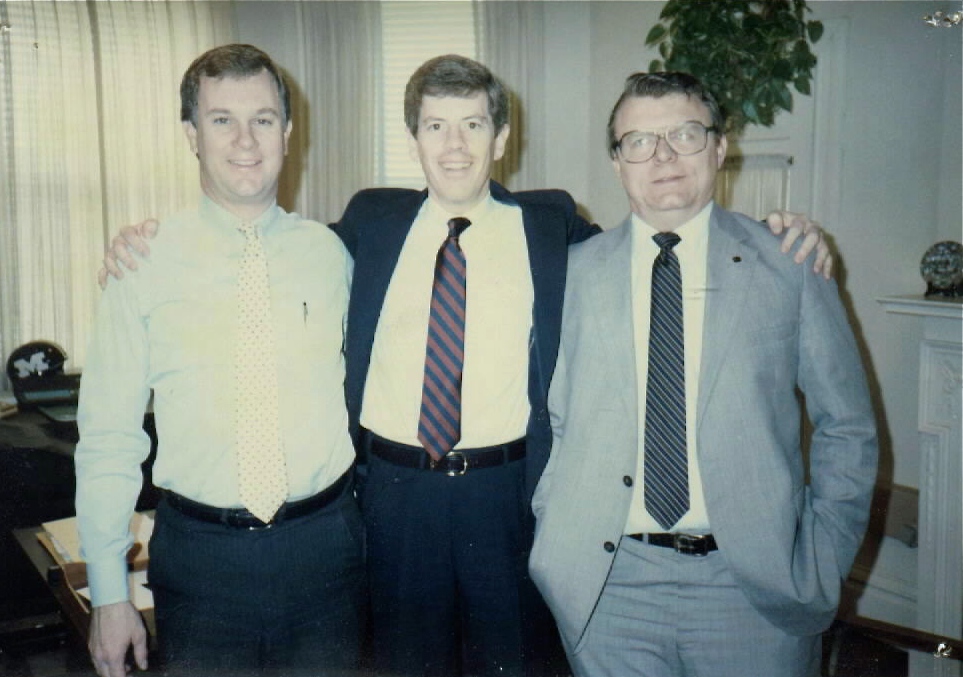
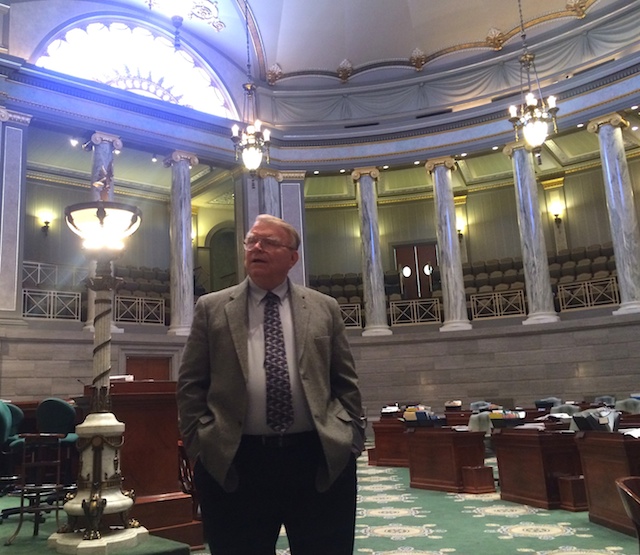
In December (2014) Bob Priddy will retire from his job as news director of The Missourinet. The network’s first and only news director. In this interview Bob talks about how the network began; interesting people and big stories; politics and history. I was privileged to work with Bob for almost 30 years and he’s one of the most talented and interesting people I’ve met. The interview runs just under half an hour. Hardly enough time to reflect on his amazing career.
Tag Archives: Bob Priddy
Missouri Capitol


Bob Priddy gets props from national news org
My friend and colleague Bob Priddy received some much deserved recognition at the opening session of the the Radio Television Digital News Assn/National Assn of Broadcasters annual meeting.
Bob, a 27-year member of the RTDNA board, is stepping down this year and they gave him not one, but TWO awards. The John Hogan Award, named for the founder of RTDNA, is given for distinguished service to the organization. The second award, the newly introduced Bob Priddy award, was presented to Priddy and will now be given to board members who exemplify Priddy’s distinguished and consistent service to RTDNA.
Bob is probably the best reporter I’ve ever met. More importantly, he is one of the best people I have ever met.
Bob Priddy
“Taking a break from the news”
The following anecdote won’t mean much to anyone who has never worked at a small town radio station covering local news stories. And I don’t share this to embarrass or disparage anyone still doing so. It’s just a sign of the times.
One of our network reporters called an affiliate in a small town, asking for a feed of a story about a bank robbery and the capture (and tasing) of the stickup guy. Our reporter was informed the station news person was on vacation and since they couldn’t find anyone to do the news in his absence, “they’re taking a break from the news this week.” Our reporter’s reaction?
“The bridge is too far away for me to walk to it and jump. Our bluffs are not high enough to guarantee a fatal descent if I were hurl myself off one of them and I do not want to spend years as a paraplegic watching for more of these signs. My Norelco razor will not cut through any arteries and the only scissors I am allowed to have are the school scissors my children left behind when they grew up.
My only recourse is to continue working in this industry until it reduces me to complete incoherence, upon which time I can be placed in a padded room where I shall be safe from the apocalypse.”
Philosopher and poet-journo Bob Priddy:
“Radio began to lose its soul when stations became “properties,” when communities became “markets,” and when staff became “human resources.”
Twitter coverage of execution
Missourinet (a Learfield network) News Director Bob Priddy covered last night’s execution of Dennis Skillicorn. Reporters and witnesses can’t take cell phones past a certain point, but Bob was planning to use Twitter to file updates before and after the execution (he was a witness).
The wifi he expected wasn’t available so he took notes and posted to @missourinet when he got back on line (at the motel, I assume).
As I expected, Twitter was a very effective tool in the hands of good and experienced reporters. Here’s a screen shot from early this morning.
Had reporters been allowed to keep their Blackberrys and iPhones, this is probably as close to live coverage of an execution as we’re likely to get.
And in the hands of someone as responsible as Bob Priddy, I think this might be a good idea. As I understand it, the rationale behind having witnesses is to insure the people of Missouri “see” this ultimate punishment. Twitter might be the least sensational way to accomplish this on a mass scale.
I’ll make a prediciton here: If not in Missouri, some state will allow or provide this coverage.

Garrison Keillor on the future of radio
“The future of public radio is shining bright if only we can wrest it out of the hands of people my age and into the hands of people forty years younger. The problem isn’t the medium — the technology is light, portable, easy to use — the problem is the heavy hand of tradition that keeps innovation at bay. There is so much that can be best conveyed through audio, Erin, and that won’t change. The music industry is getting flattened by the Internet, but there’s a great future for radio. I see reality radio as the next big thing — eavesdropping radio, the microphone picking up things you weren’t meant to hear — and then I see radio drama coming back to life, but radio drama that attempts to impersonate reality.
“As far as news goes, radio is the province of the Authoritative Voice, and people are always ready for the next one. We are creatures who love to listen to our own kind. We’re intrigued by the sound of ourselves. When I see people walking around with little wires running into their ears, I have to think radio has a future.”
Missouri prison life in 1800’s
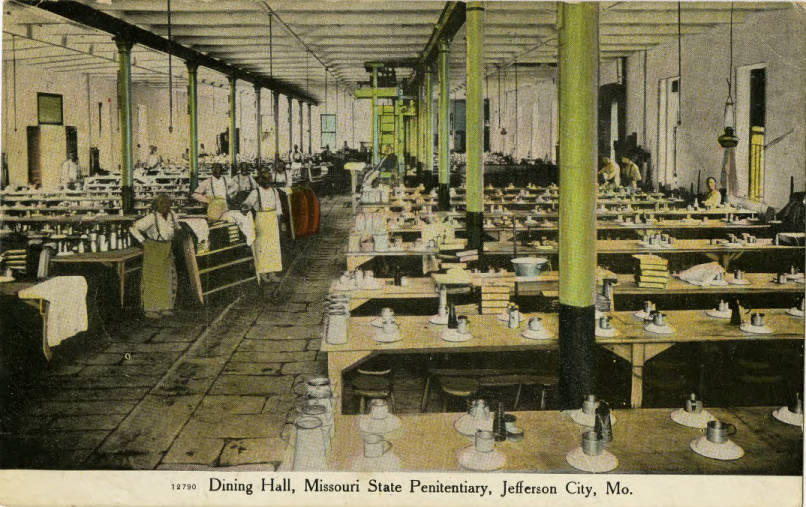
The Twin Hells, by John N. Reynolds, claims to be “A Thrilling Narrative of Life in the Kansas and Missouri Penitentiaries.” I haven’t read the entire account yet but will share this excerpt about the Missouri penitentiary:
“The inmates of the Missouri penitentiary are well clothed. In this respect, this prison has no rival. All the prisoners presented the appearance of being cleanly, so far as their clothing is concerned. All are dressed in stripes. None are exempt. Here are nearly two thousand men on an equality. None of them can look down upon others, and say, I am more nicely dressed than you. I never saw a convict dude in the entire lot. The prisoners are well fed. For breakfast, the bill of fare consists of bread, coffee, without milk or sugar, and hash. There is no change to this bill of fare. If the prisoner has been there for ten years, if not in the hospital, he has feasted upon hash every morning. Boiled meat, corn bread, potatoes and water makes up the dinner, and for supper the convict has bread, molasses and coffee. The principal objection to this diet is its monotony. Whenever a change of diet becomes a strict necessity, the prisoner is permitted to take a few meals in the hospital dining-room. Here he receives a first-class meal. This is a capital idea. A great deal of sickness is prevented by thus permitting the convict to have an occasional change of diet. On holidays, such as Thanksgiving day, Christmas, etc., an extra dinner is given, which is keenly relished by all. I have before me a statement of the expenses for a Sunday breakfast and dinner. There are only two meals given on Sunday. The hash was made up of 612 pounds of beef, 90 pounds of bacon, and 30 bushels of potatoes. Fifty-one pounds of coffee were used, and four and a half barrels of flour. The entire meal cost $68.38.”
It appears the account above is from the late 1800’s. I have not idea of the time period represented by the postcard below (from Bob Priddy’s extensive collection of Missouri postcards)

Newsroom change

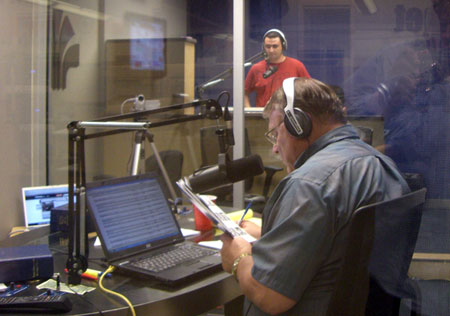
I only snapped one photo of Bob Priddy in action on election night. Through studio glass (you can see my reflection in this larger image) with producer John Simms in the background. MacBook Pro and video camera are streaming live video to Ustream. Big screen TV’s on the walls, high-speed connection to the Secretary of State’s website with up-to-the-minute returns.
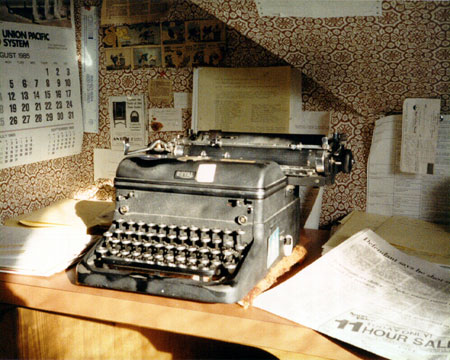
When I joined the company in 1984, Bob was still writing stories on this manual Royal typewriter (below). Audio was captured on reel-to-reel tape recorders and “dubbed” to analog carts. We had a UPI printer spewing out the news (on long rolls of paper), and election returns were phoned in by a reporter sitting in the Secretary of State’s office.

Can’t imagine what we’ll have in four years. Bob Priddy’s memory of those days is better than mine:
“Actually, we were using cassettes, not R2R in ’84. We relied on UPI for election returns with reporters at various gatherings of candidates. We didn’t put anybody in the SOS office until the Presidential primary of ’88, after studying what AP and UPI did in the 86 general election.”
Pseudonymous
I’ve been corresponding with a few political bloggers who I chided for being anonymous. Because, they explained, their ideas are so controversial, so inflammatory, so powerful… they risk their jobs or worse if they sign their names. But –they insist- they aren’t anonymous. They are “pseudonymous.” I had to look it up in the dictionary:
pseudonymous – writing or written under a false name
anonymous – not identified by name, of unknown name
So, if I write something and don’t sign any name to it, that’s anonymous. And if I sign a false name, that’s pseudonymous. Yes? Is this a distinction without a difference? Or, if I sign my letters “The Shadow,” readers won’t know who I am but they’ll know the letter was written by someone who calls himself “The Shadow.” And if I don’t sign the letter at all, the reader will have no way of knowing subsequent letters were written by the same person. Is that it?
I went to two of the smartest people I know for clarification. First, Bob Priddy, a long-time broadcast journalist and author:
“One hides behind a fake name. The other hides behind no name. Steve is a name. Anonymous is a word.
It’s the difference between hiding behind a red curtain or hiding behind a blue curtain. I suppose those who use pen names do so because they don’t want to be anonymous. It’s much more rewarding to hear people discussing who Howard Beale is than it is to hear people discussing who anonymous is because anonymous can be anybody and Howard Beale is somebody. Nobody discusses anonymous. Everybody discusses Howard Beale and therefore the sniper feels some kind of importance. Both are gutless but one is gutless with an ego.
My friend Kay Henderson (also a journalist) wrote this:
“I have never heard or seen the word “pseudonymous” before. Interesting. My first thought was of George Eliot who wrote under the male pseudonym because writing, at the time, was a “male profession.” My second thought was “Primary Colors” was written by “Anonymous” as you’ll recall.
I may be behind the times here, though. Is “Alice Cooper” or “Marilyn Manson” a pseudonym? How about “Madonna” or “Cher” or “Diddy” or “Snoop Dog” or any number of professional athletes who adopt a stage name? Our culture has grown so used to people who adopt another name/character/stage name in public that perhaps it’s not that much of a stretch to expect it to happen on-line.
Is political “speech” subject to different standards than are considered the norm for the rest of the culture? I will agree with my colleague that the cloak of a pseudonym is too often used by bloggers. But who will be the blogger police? Perhaps it will take something akin to pulling back the curtain and having Dorothy expose The Wizard to change the on-line culture. Perhaps more sites will forbid “anonymous” posting in the comments sections. I find the requirement of a name, however, laughable in most instances if you read the “names” which are used.”
I suspect we got such passionate response to this because the phantom bloggers would like to be out. No doubt all of their friends know of their secret identities (“That ‘Howard Beale’ guy? That’s me. Seriously.”). Questioning their ethics or courage stings. I’ll try to stop.