The results business

Mark Ramsey points to a survey of marketing professionals that shows growing pressure on accountability:

“86% of marketers say pressure has increased on them to account for results; no one said that the pressure has decreased. Moreover, 68% of organizations are measuring the quantifiable contribution of marketing to the bottom line.

Message to radio: You’re no longer in the advertising business. You’re in the results business. So which are you selling, advertising or results?”

“Poor whites are being conned”

So writes Leonard Pitts, a columnist for the Miami Herald who’s trying to understand why Barack Obama lost so decisively in West Virginia (and later in Kentucky). If there’s a victim here, it’s not Senator Obama.

“The white poor have been victims of a con job going back at least as far as the Civil War, when poor white men were used as cannon fodder for the right of rich white men — I repeat: rich white men — to keep slaves. They were told they fought for state’s rights.

From then till now, the white poor have often been the front line of white supremacy. You think people with college degrees and six-figure salaries are out there marching around under pointy white hoods, burning crosses? Hardly.

My point is that race has often been used as a means of distracting and diverting the white poor. They had little in life, nor any realistic expectation of having more.

But the one thing they did have — or so the con went — was whiteness itself. Which meant they had someone to be better than. Someone to look down upon.”

Hearing this idea so clearly expressed reminded me of some of my favorite films that incorporated this theme: To Kill A Mockingbird, In the Heat of the Night, Monster’s Ball, Mississippi Burning.

It will be interesting to see how the GOP works this lever between now and November.

Michael Spooner

A Google search led Mike Spooner (he goes by Michael these day) to this blog. I grew up with Mike, er, Michael, in Kennett, Missouri. He moved to Flint, Michigan, in 1964, did “some” college before getting drafted in 1969. Not a good year to get drafted. Following service he attended art college in Los Angeles and stayed for 28 years. From Michael’s bio:

“Michael Spooner has worked in the animation industry for twenty-five years with such notable studios as Walt Disney, Warner Brothers and DreamWorks. Michael’s professional career in art began in 1976, when he was invited to join the faculty at Art Center College of Design in Los Angeles, after graduating with distinction.  He taught for twelve years, simultaneously working as a freelance illustrator for clients that included the Public Broadcasting System, Zondervan Publishing House, Masda Motors, the National Football League, NBC Television, Paramount Pictures and Twentieth Century Fox.”

This sounds like a Brush with Near Greatness to me and I’ve asked Michael for an interview. Stay tuned.

He got lost for a couple of hours in our Flickr photostream and shares some photos from his stash. A couple of his Cub Scout pack; one of the KHS swim team; and one of the KHS junior high track team.

The swim team photo brought back fond memories of Diane West (far left). We dated a few times. She was 16 –and could drive– and I was still 15. She lived at the municipal swimming pool and exuded the intoxicating fragrance of chlorine.

It’s nice to hear from Mike and see a few long, lost photos from my youth.

“Waning Days of the Road Warrior”

I hate air travel. Not “white knuckle” hate, but “hassle hate.” Fortunately I don’t have to do much of it any more. But lots of people in our company do and I feel for them. I also wonder how much of it is really necessary. Usually while playing with iChat and live video streaming.

Latest issue of Business Week has an article titled, The Waning Days of the Road Warrior (Why the current slowdown in business travel may not end when the economy recovers).

“For years, Irv Rothman, CEO of Hewlett-Packard’s Financial Services division, traveled at least once a quarter—top three lieutenants in tow—from his New Jersey base to HP’s Silicon Valley headquarters. After enduring Newark airport hell and six-and-a-half hours of stale, germy air, the team would arrive, strung out, to meet with their boss. For one hour. Then they would turn around and do the whole thing all over again.

The super surge in oil prices and resulting spike in airfares is just one reason companies are ordering their road warriors home. Factor in, too, the misery of modern air travel, which has de-glamorized the business junket. HR types also have a new appreciation for how the frequent-flier lifestyle can wreck executives’ health and family lives. And they have come to realize that jetting off for a one-hour meeting, while instinctual for corporate strivers, is rarely productive.

So, if managers aren’t flying to meetings, what are they doing? Using newfangled technology that is finally delivering the kind of Star Trek-y, space- and time-shifting experiences that tech executives have blabbered on about forever. Videoconferencing, Web-enabled meetings, online collaboration tools—all are giving workers the ability to dart around the globe from their desk chairs.”

The article reminded me of driving from Jefferson City, MO, to Dubuque, IA (9 hours?) to call on a station manager who really didn’t want to see me. To get the appointment I said something like, “All I need is a minute of your time.”

When I walked into his office and started take a seat, he reminded me that I had said I only needed one minute and that’s all that I had. So I stood there with my little briefcase in hand and told him what our network could do for his station. (I didn’t sign him up) Today I might have just sent him a Quicktime file or made my “pitch” via iChat. No less effective and a lot less costly.

Videoconferencing and related technologies really only work when both parties want to hear what the other has to say. How many meetings take place because it was the only way the “prospect” could get the sales rep to leave her the fuck alone? (Wonder if there’s any data on that)

These days, most of the people I deal with in remote locations want to talk to me and I want to talk to them. And, increasingly, they have the tech skills to do a quick face-to-face.

And if I need to send them a url or an image or any other kind of file for that matter, it’s easy to do.

Old Schoolers will talk about body language and non-verbal communication and “pressing the flesh” and all the other arguments for being in the same room.

We’ll talk again when that airline ticket to the coast is $2,000.

Flip Video Camera

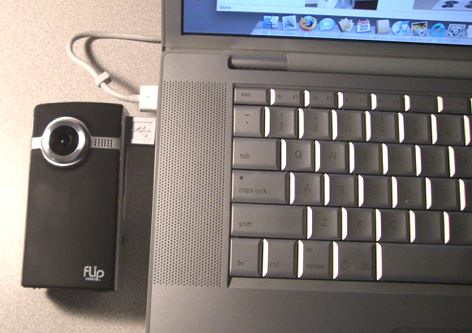
Yes, I am aware of how many video cameras I own. No, I do not need another one. I purchased a Flip video camera ($150.00) because I was so intrigued with the idea of a small, inexpensive camera designed to do just one thing.

They even did away with the USB cable and SD cards. You plug the Flip right into the USB port with a little… flip-out USB connector.

The one I got records an hour of video. I think the $100 model does 30 min. Check the website for specs.

Does the Flip take better video than my little Casio. Probably not. Is it as handy as a pocket on a shirt. Yes, indeedy, and it’s less than half the price.

I’m not sure what I’ll do with mine. I just wanted to see if this device is a cool as I’ve been hearing and reading. I think it might be. Toss it in your beach bag or your purse and go. Hit the red button and you’re recording. Makes the Sony Camcorder seem like a big old pain in the ass to lug around.

Flipcamera

Uses two AA batteries and works with Mac or PC.

Warning: You’ll hear me talking baby talk to our Golden Retrievers. Runs 90 sec.