
“News for Nerds. Stuff that matters.” Slashdot creator Rob Malda (CMDRTACO) gave the geekiest presentation I’ve heard to date but it was perfect. “One of the largest, self-moderated discussion groups on the web,” Slashdot generates 2.4 million page views per day. Learned a new expression: “Daddy Pants” The guy responsible for getting up at 2 a.m. to reboot the server is wearing the Daddy Pants.
Gnomedex: Google
Nelson Minor is a software engineer for Google and he gave a fascinating presentation to kick off this two day conference. Starting with the Google mission statement:
* Work on things that matter
* Affect everyone in the world
* Solve problems with algorithms
* Hire bright people and give them lots of freedom
* Don’t be afraid to try new things (According to Minor, Google News was the idea of one guy who said, “Hey, wouldn’t this be cool?”)
Average search time on Google: 1/5 of a second. He even explained how Google works…in a way that even I could sort of understand.
Gnomedex: Des Moines, IA
Opened up the windows on the 4Runner…cranked up the XM Radio…and headed for Des Moines and Gnomedex 3. Hundreds of geeks (and one wannabe) from all over the country descend on Des Moines for two days. Much more fun than the big computer/technology shows. Dinner with O. Kay Henderson who has great new hair cut (yeah, I know that sounds gay but I can only admire, not do it, so…). She’s interviewing John Kerry today and asked if I had any questions she wanted her to ask him. I couldn’t think of any.
Google News advanced search
Google News has added an advanced search page. Search for articles from specific news sources; search for articles from news sources located in a specific state or country; and perhaps most useful, search for articles published within a certain ranges of dates. [via CyberJournalist]
Jakob Nielsen on PDF
Usability expert Jakob Nielsen on PDF: “PDF is great for one thing and one thing only: printing documents. Paper is superior to computer screens in many ways, and users often prefer to print documents that are too long to easily read online. For online reading, however, PDF is the monster from the Black Lagoon. It puts its clammy hands all over people with a cruel grip that doesn’t let go.”
Mr. Rudy Day
Long-time friend Rudy Pylant is celebrating his 80th birthday (for the third time) with a big blow-out in Kennett this coming weekend. Lots of beer, BBQ and old friends. Event HQ is the Super 8 Motel. Back by popular demand is Willie P. Richardson. I’ve never heard him perform but his website appears to have all the info you need until I can post some video here. Previous Mr. Rudy Day’s featured the Red Neck Rhythm Rangers. One of those bands where the name is the best part of the experience.
Good ideas
“Good ideas are just there all of a sudden, like angels in the Bible.”
— Neal Stephenson’s Cryptonomicon. (pg 878)
Tom Colvin
One of the things I enjoyed most about my days in small town radio was co-hosting a daily, one-hour talk show (Grapevine) with Tom Colvin. The station owner thought it would be a good place to talk about community issues and events (seems quaint today, doesn’t it?). I like to think that Tom and I had chemistry. I could say “refrigerator” and Tom would laugh hysterically. It was intoxicating for someone who thought he was a funny guy. I must say nobody since has found me as amusing.
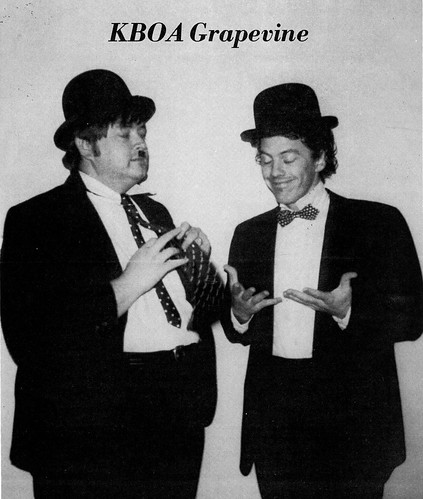
We had guests some days, took calls every day (live, no delay). Our Trivia Bowl seemed tdo be a local favorite. The show lasted about twelve years, right up to the time Tom and I left in 1984. I came to Learfield and Tom went to KTTR, Rolla, Missouri. Fast-forward nineteen years. Tom is returning to Kennett next week to take over as operations manager at our old station. Sort of. Many years of call letter and frequency shuffling has left me completely confused, but Tom says he’ll be programming 6 radio stations. We wish him well. I know the listeners to those stations will be well served.
A word from our sponsor.
My last couple of posts got me thinking. I put my name on a no-call list so telemarketers would stop trying to sell me stuff I didn’t ask for; I set up my new Google toolbar to block pop-up ads; I’ve never seen a commercial on anything I watch with my Tivo; same for my 100 XM Radio channels.
I understand the content-for-attention value proposition of “free” media. But the fact remains that most people will skip the commercials if they can. Is that stealing? Have I broken some unspoken agreement when skip past the commercials? I don’t think that’s the important question for advertisers (and the people that sell the advertising). How effective is a commercial (TV, radio, print, online) if it’s only being seen/heard/read because there was no easy way to avoid it?
The growing glut of SPAM and telemarketing calls has made me think about this more. These people are universally hated. And they know it. But they are willing to endure this because they’ve calculated that some tiny percent of the calls/emails DO work. We never thought about this with “old” media because it was so one-way. All radio and TV have commercials so if you want to watch Perry Mason, you’ll by-god watch the commercials. Does it really do any good for me to see/hear your commercial if I have a bad feeling about your company/product at the end of those 30/60 seconds? I supect the answer is –in some twisted way– yes. Yes, it does.
RIAA is going after music pirates
So the RIAA is going after music pirates (they call them thieves). Our company produces original content and we get pissed when people rip us off. We’ve even gone to court a few times. What I don’t understand is why the tech world can’t beat this (forget right or wrong for a minute). When the CEO of one of the big record companies gets around to embezzling a few million bucks, he or she will have no problem tucking them away in some off-shore bank. Why doesn’t some Arab country set up secure severs for music swapping? I guess what I’m asking is, is this technically possible? I guess the RIAA would go after the ISP (and everyone else) that makes it possible us to connect to servers in other countries. I just don’t like thinking that Big Business can beat down the Internet.