Podcasting candidate endorsements

Just listened to the latest podcast from the Missouri State Teachers Association. They call it The Pulse. Co-hosts Todd Fuller Gail McCray broke a little digital ground (I’m guessing) by using the podcast to announce the canidates the MSTA is endorsing in the November election. They spent the first part of the podcast explaining how their endorsement process works. Then they mentioned a few specific endorsements and pointed the listener back to their website for the full list of candidates.

Why do I think this is worth a post? As I listened to Todd and Gail explain this process, I kept thinking they would NEVER get airtime (radio or TV) for that kind of “deep dive.” But it’s important to their audience (teachers, candidates). And by using their podcast to make the announcement, it raises awareness of their podcast. (You now know about it because you read this blog which has nothing to do with education or politics.)

If you want to see/hear how to do an “association podcast,” check out MSTA’s The Pulse.

Delta Fair Parade

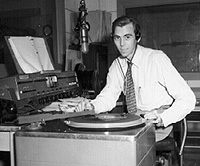
Charles Jolliff shares his flickr set of the 2006 Delta Fair Parade. Brings back lots of memories. My first radio interview (1972) was with Bill Walsh and Jack McDaniel, the Kennett businessmen who have been organizing the parade for about 50 years. My end of the interview was so bad, I spliced (magnetic tape, grease pencil, splicing block) in new questions. Took hours.

For years, Jeff Wheeler, Tom Colvin and I broadcast the parade live (You had to be there).

Back in the fifties, my father rode in the the parade in a wheelbarrow, as part of a radio station promotion. God bless America!

What new Arbitron rules mean for radio stations

“When listening is defined as broader than “radio” alone, then you are no longer in the “radio business.” You’re in the business of audio entertainment and information, regardless of distribution channel. That little home-grown Internet radio station from Zimbabwe is now your competitor. When “Listening” is defined according to things that do not require a radio, you are no longer in the “radio business.” Get it?” — Mark Ramsey

My kind of contract

Roger brought back a copy of the affiliation contract for The Davey Ramsey Show (financial advice?) from the recent meeting of the National Association of Broadcasters. They shove all kinds of promotional stuff under the door to your hotel room every night and this was in Roger’s pile one morning. I’m not familiar with the program but I love the contract. One page (front only). I spent my youth (okay, my middle years) trying to get people to sign affiliation contracts with our networks.

I did my best to keep them simple and understandable. But our attorneys never let me go this far. Here’s the full contract (PDF) and here are a few paragraphs:

Thank you for deciding to include The Dave Ramsey Show as part of your station lineup. Are you looking for a big, detailed contract? They are a pain and quite frankly, we don’t feel like dealing with them. Below you will find afew points that will guide our relationship. Please initial each one and return the contract via fax to 615-372-0573 (confidentiality assured).

1. You like us and we like you and therefore are agreeing to work together. You are going to start airing the program on station (station info)

3. Now that you have decided to carry The Dave Ramsey Show we will not be available for another station in your market. Don’t know why we have to state that we are not interested in cutting our legs out from under ourselves, but I guess this market exclusivity thing is a big deal.

5. Let’s try this. The Dave Ramsey Show should be carried LIVE. We think it is a mistake if it is not aired live. However, we understand that some stations are not able to make this happen. For now that is acceptable. All we want you to do is let us know that after we start winning for your station, that you will consider us for a live slot. You are not guaranteeing us this slot, you are not promising this slot, you are simply letting us know that you will consider it. Come on, is that too much to ask? We should be live anyway.

I don’t know how good this is from a legal standpoint, but it’s good marketing or PR or something. And in my experience, most contracts with radio stations weren’t worth much. My hat is off to whomever wrote this agreement.

WSJ: “How to get attention in a New-Media World”

Wall Street JournalThat’s the headline on a story in today’s Wall Street Journal. I won’t bother posting any of the many nuggets in this piece. You can read them yourself. And if you spend anytime online, you know a lot of this already.

Here’s what I want to know: How can any intelligent, semi-educated, reasonably well informed, man or woman entrusted with running a business (or some division or department of that business) not have at least heard about the things referenced in this story (blogs, podcasts, RSS, etc etc)?

We talk to people every day that insist (and I belive them) they’ve never even heard the terms. I don’t expect the average Joe (or Joanne) to be as into this “new media” (someday we won’t need the quotation marks) as I am… and I know that not everyone has access to the Internet. But if you own a TV set, a radio, read a newspaper or a magazine… how could you not have seen or heard one or two of the countless stories about “new media” during the last couple of years?

* I just read the local sports scores in The Daily Bugle
* I only watch Wheel of Fortune and QVC on TV
* I haven’t seen anything in People Magazine about all this stuff
* Cousin Bob on Country 108.7 would tell me if any of this stuff was important

What do you know? I answered my own question.

Let me stress that I’m not saying your business should be using any of the new media tools (you should)… but I remain mystified that there are people who have not a glimmer that something is happening.

Radio listeners don’t mind ads

Mark Ramsey points to this Arbitron study that concludes radio listeners don’t tune out when commercials come on. And wonders about the implications:

“If listeners don’t mind spots then why should they mind mediocre songs? And what ARE they listening through the spots for?”

The whizzing sound you hear is thousands of radio sales reps emailing the Arbitron study back and forth.

The power of the hyperlink

Iowa Senator Tom Harkin talked, by phone, with a group of Iowa radio reporters on Thursday morning. One of the reporters asked the Senator for his reaction to Venezuelan president Hugo Chavez’s comments about President Bush at the UN. One of our reporters was on that conference call and posted a story about the senator’s response to our website, RadioIowa.com. (“Harkin defends Venezuelan President’s UN speech against Bush”)

Radio Iowa News Director Kay Henderson blogged the entire story but the short version is The Drudge Report linked to the story…a shit storm rained down on Senator Harkin…his people try to get Kay to change the headline of our story on the web… a long, stressful day for everyone.

This is just one more small example of how the web has changed things. The stations the other radio reporters (on the conference call) work for probably all have websites but I don’t think they post news stories. So, in all likelihood, our little story was the only one online, at least initially.

BTW (Before the Web), one or all of those reporters might have aired the story on a couple of newscasts and people in Des Moines or Sioux City might have been pissed at the senator. And even if the wire services picked it up, it would have taken a little time to ripple out, and the reaction would have been diluted.

It’s now Saturday morning and I googled “Tom Harkin.” The top search result is: “Hearing Is Believing” on what appears to be a blog called Power Line.

“Harkin must have taken some heat for his comments on the radio, because he put a completely different statement on his web site, after the fact. To see what he really thinks, listen to the audio below.”

Power Line didn’t bother to link to our story or mention our network by name. And they stole our audio and posted the MP3 file to their site. But no matter. You get the idea.

Media was once an orderly thing:
Local radio station(s) – Local newspaper
Handful of larger city newspapers, TV stations & radio stations
Statewide radio network
Associated Press
National media

You could manage these. If you were clever, you could spin and control them a little. No more. We’re all breathing the same media air.

If Senator Harkin does the radio reporter conference call again, I sure would like to listen in.

989 people out of 1,000 listen to radio

Regular readers know I’m a fan of Mark Ramsey’s blog, Hear 2.0. Mark is the president of San Diego-based Mercury Radio Research, which recently conducted a 1,000-person national study of radio listening habits of people ages 12 through 54. Just 11 people said they didn’t listen to radio.

Mark spoke at one of the sessions at the NAB Radio Show, underway this week in Dallas and the Dallas Morning News covered:

“One of the key things that makes radio different from all these others (iPods, satellite radio, Internet radio, etc) and makes it stand out, and valuable, is the fact that there’s stuff between the songs that people value. In fact, the loyalty to the stations, preference for those stations, is driven very much by what’s between those songs. It’s about connecting with other people.”

Here’s Mark’s take on commercials:

“…there’s one group that hates commercials and another that can tolerate them. The issue with commercials seems to be, ‘Look, if you’re a zealot about commercials, well, of course you’re going to listen to an iPod.’ People inherently understand that commercials are a tax that you pay. The issue for radio is whether we demonstrate to them what that tax is buying them. … ‘Are we giving people something that’s worth the price they’re paying in commercials?’

That wasn’t such a scary question when there were no alternatives to the radio.

Note to self: Record a couple of hours of morning drive on one of the local radio stations and edit out everyhing except the “stuff between the songs that people value.”

Comment from Jim M:

“It seems to me the ratio between commercial time and music / content is way out of whack compared to what it used to be. I wonder if there are some statistics on how this ratio has evolved over time? I was thinking about this today, again, when a drive to the store and back treated me to 100% advertising. I like commercial radio for the fact that I can pick up on new music and the variety, but finding music these days seems to be truly hit and miss.”