Jimmy Haggett at WSM

I have a fondness for old photos. Especially photos from the early days of radio. My friend Charles Isbell sent me some good ones this week. They were found in an old house being torn down in Caruth, Missouri. They feature Jimmy Haggett, a musician and DJ who worked northeast Arkansas and southeast Missouri in the 50s. He and my father worked at KBOA at one point. You can find a bio at the link above.

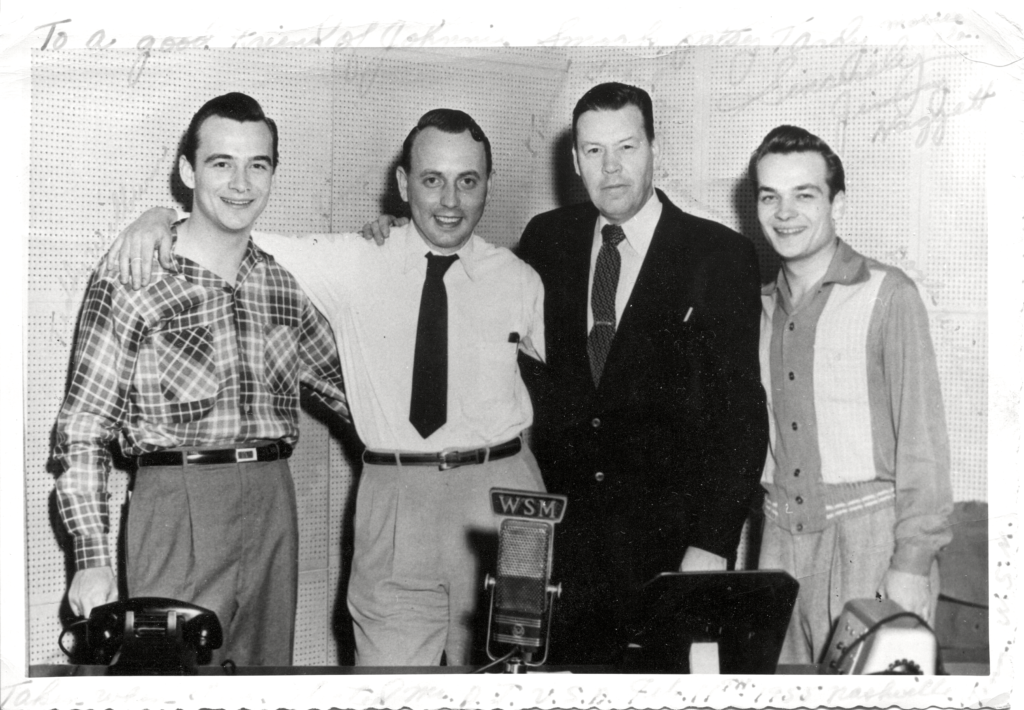
UPDATE from John Carpenter: “(These) Jimmy Haggett PR photos are all from Friday, February 11, 1955 at WSM Radio in Nashville. He’d been chosen “Mr. Disc Jockey, U.S.A.” for that month by the Country Music Disc Jockey Association. The award was noted in the March 1956 issue of “Cowboy Songs” magazine, in their “Disc Jockey Roundup” column: “A member of the CMDJA, Jimmy appeared over WSM, Nashville as ‘Mr. D.J., U.S.A.’ in February 1955, and appeared on Grand Ole Opry the following night.”
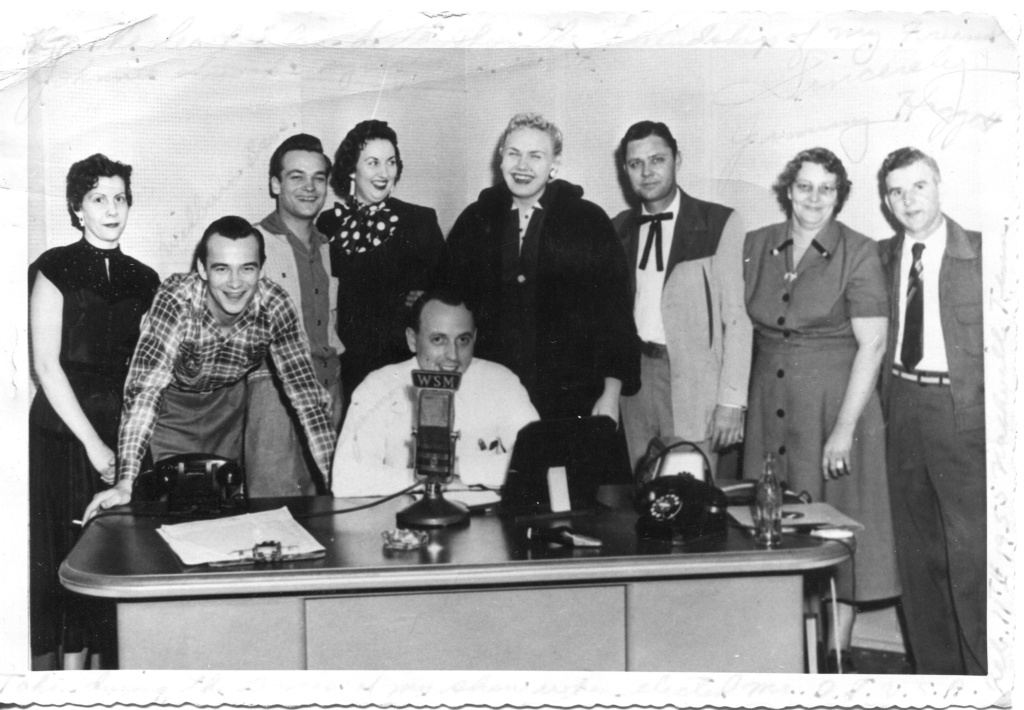

L-R: Unknown, Teddy Wilburn,Doyle Wilburn,unknown, Betty Jean and One Wheeler, unknown, unknown

As for the other people in the photos, two of the young men are The Wilburn Brothers (Teddy and Doyle). Looks like the photos were taken at WSM in Nashville, so perhaps some of the others are performers. If you recognize anybody, please leave a comment.
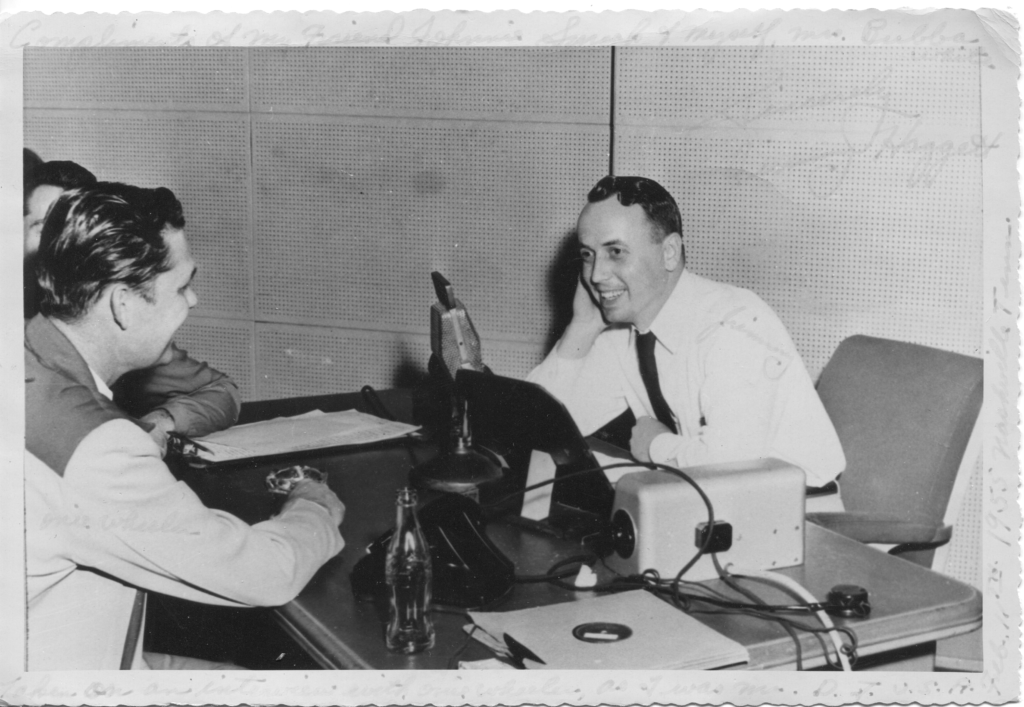
Interviewing Onie Wheeler. “Compliments of my friend Johnnie Smogh & myself, Mrs. Bubba White. Sincerely, Jimmy Haggett.”
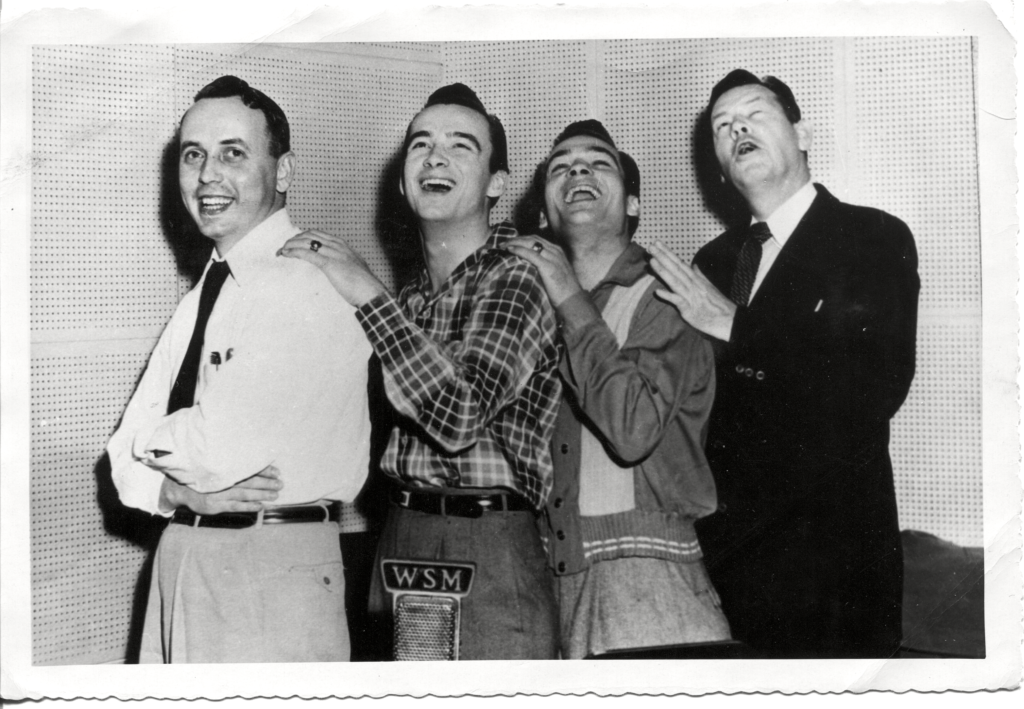
Jimmy with Teddy and Doyle in the photos above/below. Would like to know who the other gentleman is. Will work on it.
How was your day, Ian?

In chapter 8 of The Inevitable, Kevin Kelly talks about Remixing. “Unbundling existing products into their most primitive parts and then recombining in all possible ways.” He spends a good bit of time talking about video and the amazing new ways we will find to create and use it.

I will have my AI (we’ll all have one, or more than one) pull all of the available video of Ian Emmerson. He lives in the UK somewhere. Don’t know where. Or what he does for a living. But there’s a bazillion cameras in the UK so there will be no shortage of video.

My AI will edit each day’s video into a montage (of sorts). Ian waiting for one of those big red double-decker buses; Ian trudging into the building where he works; Ian in his cubicle; Ian getting fish and chips from a curb-side truck; Ian (alone) in the pub, having a pint before going back to his ‘flat.’ Pretty much the same stuff every day with an interesting character tossed in from time to time. Or, perhaps, just a character.

Each ‘episode’ will end with one of Ian’s songs, like the one below. I’ll let the AI pick the tune, based on that day’s ‘footage.’ I’ll probably let the AI pick a name for the series but I kind of like, “How was your day, Ian?”

“I am a fair witness, not a participant.”

“A fair witness is a character type from the 1961 science fiction novel Stranger in a Strange Land by the American author Robert A. Heinlein.”

“The novel tells the story of Valentine Michael Smith, a human who comes to Earth in early adulthood after being born on the planet Mars and raised by Martians. The novel explores his interaction with — and eventual transformation of — terrestrial culture.”

“Several later editions of the book have promoted it as “the most famous science fiction novel ever written”. While initially a success among science fiction readers, over the following years word-of-mouth caused sales to build, requiring numerous subsequent printings after the first edition. Eventually Stranger in a Strange Land became a cult classic.”

“A fair witness is a fictional profession invented for the novel. A fair witness is an individual trained to observe events and report exactly what he or she sees and hears, making no extrapolations or assumptions. A photographic memory is a prerequisite for the job, although this may be attainable with suitable training.” Continue reading →

RadioIowa.com

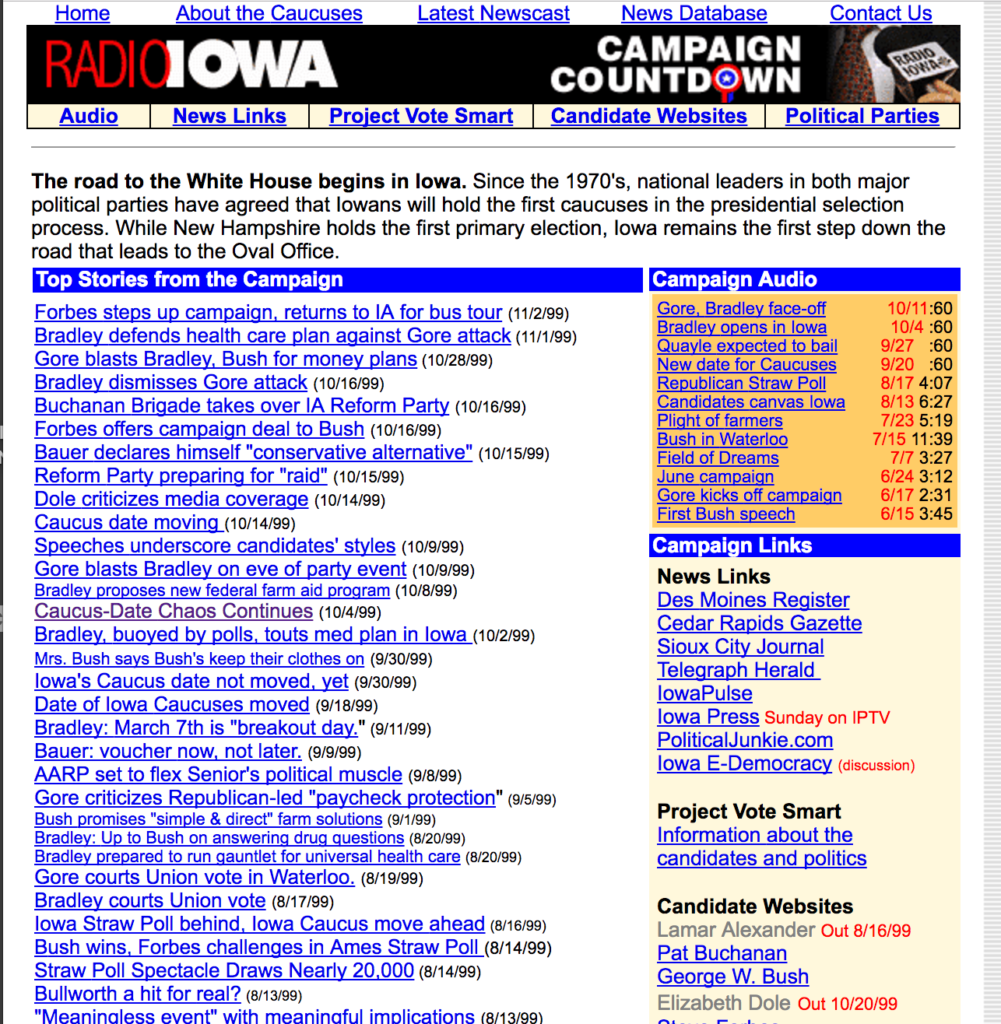
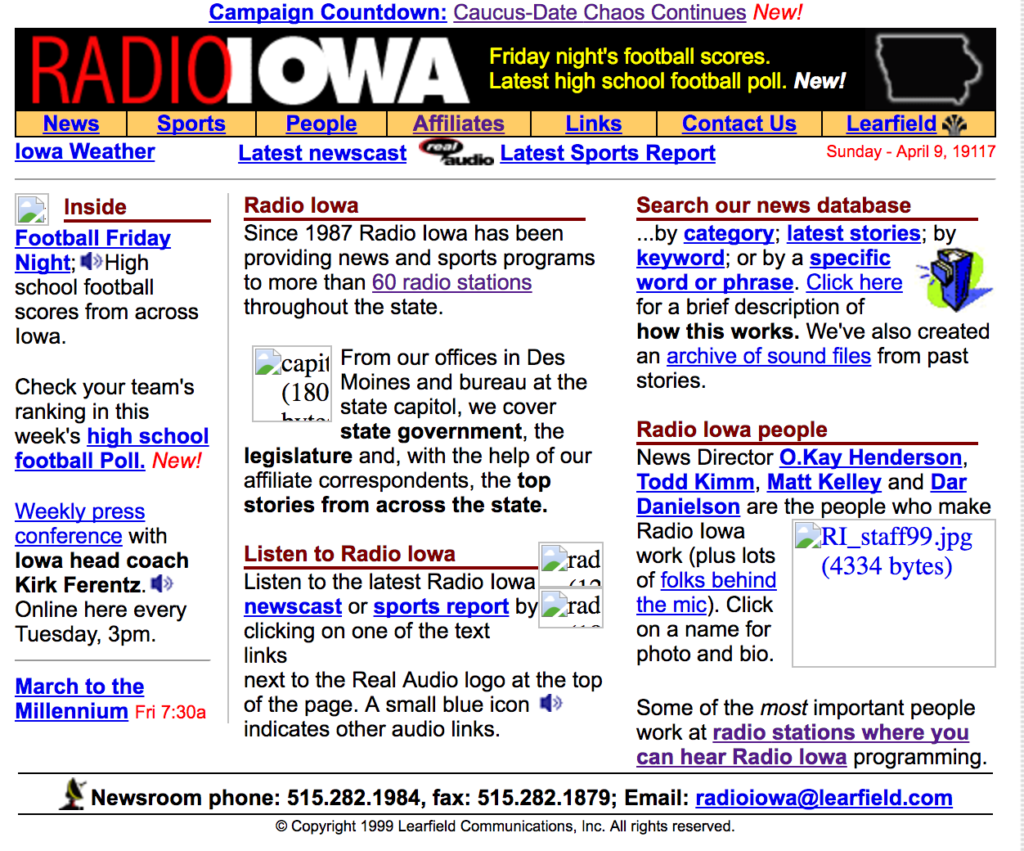
My next “small histories” project will be an Internet timeline showing when and how the company I worked for viewed and used this new technology. We registered our first domain (Learfield.com) on August 30, 1995 but didn’t do much with that (corporate) site. In July of 1996 we created a site for one of our news networks (Radio Iowa) but I don’t recall what kinds of content we were posting in those early days.

By November of 1999 we had gotten the hang of things and were putting up a lot of news (text and audio). The Iowa Caucuses pulls lots of attention to the state every four years and our network created a feature called Campaign Countdown. Our website made it possible to extend the life of the stories we fed via the radio network and reporter O. Kay Henderson cranked out a LOT of stories and interviews, all of which went online.

As we moved and updated servers and software, much of this content was lost. Or so I thought. While poking around on the Internet Archive WayBack Machine this weekend I found the Campaign Countdown reports.

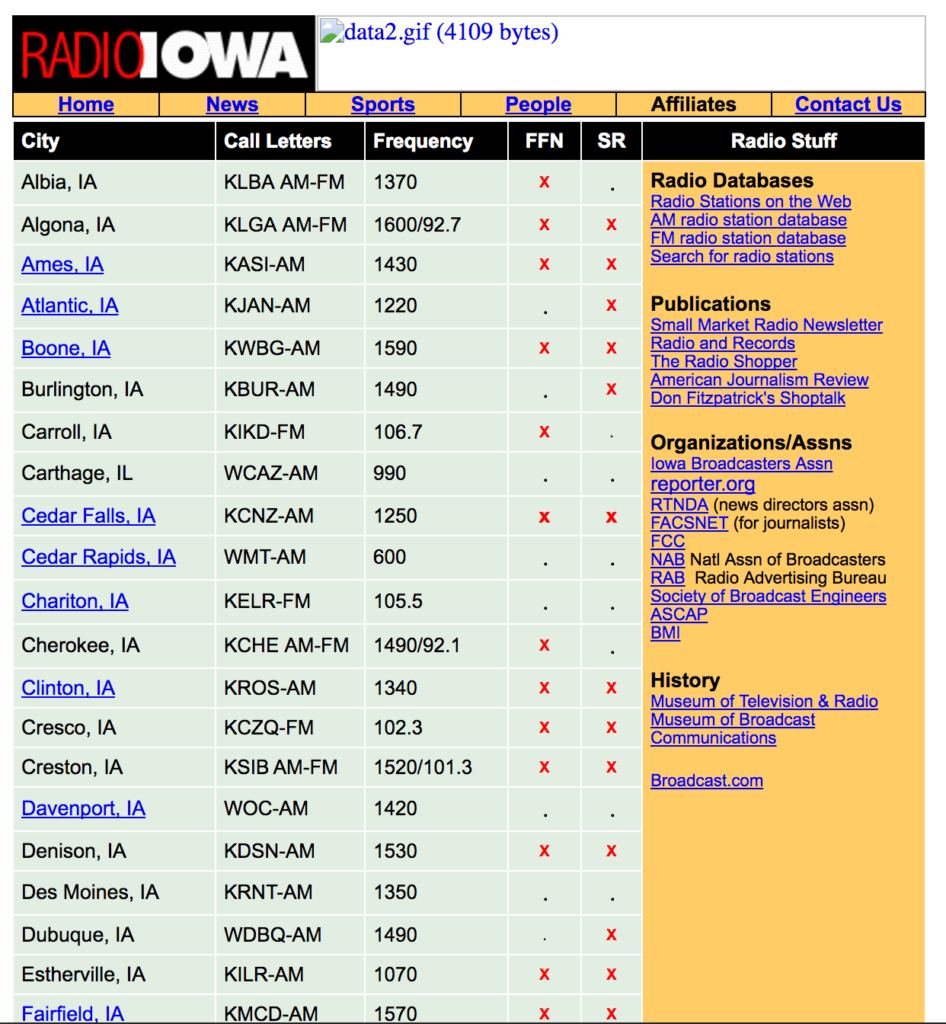
The design of the website is nothing to write home about (that’s on me) but he history is real and — thanks to the Internet Archive — preserved. (I made a donation and hope you will, too). From this screenshot (partial) of our Affiliates page and you can see that about half of the stations had websites in 1999.

In my experience, radio stations were slow to embrace the Internet. There were a lot of reasons for this. Some good and logical, some not. Most of the programming on small market stations was music and licensing and technical issues made it impractical to “stream.” I’m not sure we had that word in 1999. And why, many station managers asked, should I go to the expense and effort of creating a website when everyone we care about (advertisers and listeners) can hear our programing on the radio? Duh. And nobody was going to listen to music on a computer. (iTunes, the iPod, and XM Radio came along in 2001. Podcasting in 2004)

Second opinion nets different diagnosis 88% of time

“A new study finds that nearly 9 in 10 people who go for a second opinion after seeing a doctor are likely to leave with a refined or new diagnosis from what they were first told. Researchers at the Mayo Clinic examined 286 patient records of individuals who had decided to consult a second opinion, hoping to determine whether being referred to a second specialist impacted one’s likelihood of receiving an accurate diagnosis.”

“Among those with updated diagnoses, 66% received a refined or redefined diagnosis, while 21% were diagnosed with something completely different than what their first physician concluded.”

The study was published in the Journal of Evaluation in Clinical Practice.