Calculator Vault

Apps like this have been around for several years but I wasn’t aware of them until this morning when a friend told me about Calculator Vault. Looks just like the Calculator app that comes with iOS but when you put in a secret sequence of numbers and symbols, it takes you to hidden folders where you can safely store those naughty photos. Apps like these became popular, I’m told, when teens started Snapchatting.

The Fake PIN features creates “a second PIN that opens a decoy KeepSafe for times when someone pressures you to open your KeepSafe. You can even put photos in your fake KeepSafe that are ok for others to see.”

The Secret Door feature will “masquerade your KeepSafe as another app. With Secret Door enabled, others will see what appears like another app when they open KeepSafe, but you will know the secret to reveal the PIN pad and open your KeepSafe.”

I’m told the only way you’d see these hidden folders — assuming you were looking — is from within the app. Yes, the NSA probably knows about these but your mom might not. You should tell her before she gets busted.
Flying about to change completely. Because of cars.

10 to 15 years from now, the flying experience could look vastly different because of self-driving cars.

In Europe, high-speed rail wins 50% of all traffic when the journey length is less than 4.5 hours, according to the French National Railroads, and wins 90% of traffic when the journey is two hours or less.

Bags will get picked up in the city and travel separate from you and land at your destination. People won’t be traveling with their luggage. Perhaps it’s picked up by a self-driving car or a specific baggage robot instead.

And if an airline is controlling your ground transportation, it’ll be able to provide other services as well. “They come pick you up, they load your baggage, and potentially, your bag will be screened while sitting in the vehicle.

Teletype

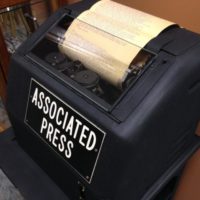
I recall visiting the radio station where my father worked and standing in front of the Associated Press teletype, entranced by the endless stream of words. Who was typing? Where were they? Did they ever stop?

Years later, as a young man, I got a job at the station and came to depend on the AP “wire.” It was our only link to real-time (I’m not sure that phrase even existed in 1972) news and information from outside our little town. The daily newspaper was tossed on the doorstep every afternoon (or you could get the Memphis paper a day late). The three national TV networks gave us a half-hour of national news each evening.

Our radio station didn’t have a national news network (until 1974) so we relied on the Associated Press newswire for just about everything throughout the day. During a live “board shift” we would dash to the AP teletype (in the transmitter room) and “rip the wire” which involved tearing a long strip of printed wire copy into piles of news, weather, sports, entertainment news, etc. If the paper jammed or the ribbon broke, we missed whatever was fed. If something the AP considered urgent was fed, an alarm bell on the teletype sounded.

A radio station had to have a wire service. Without it they were limited to playing records and reading local news and school lunch menus. The AP knew this and charged accordingly. Thousands of dollars a year. Contracts were for five years. But there was no alternative.

In 1984 I left the radio station to take a job managing The Missourinet, a statewide news network originating from Jefferson City, Missouri. I worked for (parent company) Learfield Communications for the next 28 years. One of the more interesting projects I worked on was the creation of a low-cost alternative to the Associated Press. We called it Learfield Data (later, Learfield Newswire).

I worked on this (along with bunch of other people) for a dozen years from the late ’80s through 2000. At one time we had 300 subscribers. When the World Wide Web became a reality in the mid-90s it was clear the days of wire services were numbered. Road kill on the Information Highway. You can read (PDF) the story of how it began and ended here: Learfield Data

Early Learfield websites

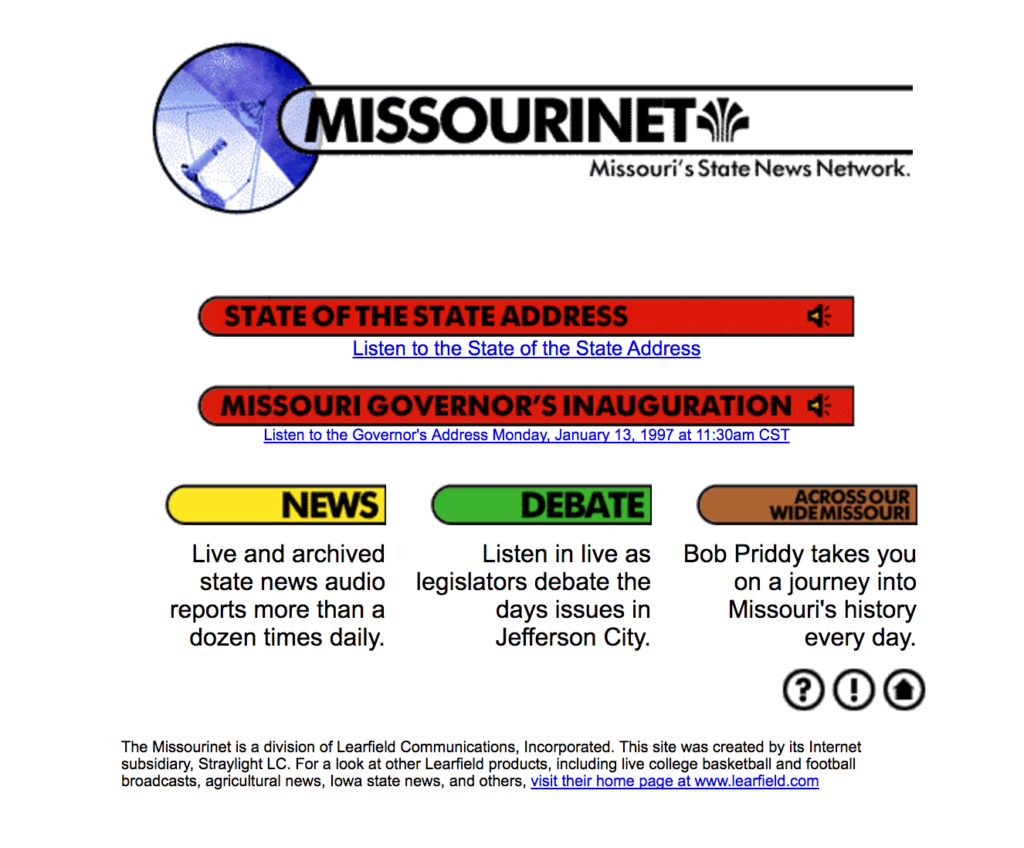
During the mid-90s I made a little career pivot that allowed me to work on our company’s Internet strategy although ‘strategy’ is too grand a term for what I/we were doing. I found and hired a couple of college kids who knew some html and created our first websites. The screenshots below (from the Wayback Machine) are from 1996-97.

A lot of websites looked like these in those days. Compared to many (most?) businesses, we were early to the game and registered domains for our networks in ’95 and ’96. I’m not sure having a one-word domain is a big deal these days. Or any domain for that matter.

Dan Shelley named RTDNA/F Executive Director

“The Radio Television Digital News Association and Foundation (RTDNA/F) today announced that longtime Association member, former Chairman of the Board and current Foundation Secretary/Treasurer Dan Shelley has been named Incoming Executive Director of the two organizations. Shelley begins work immediately and will assume the role of Executive Director in September.”

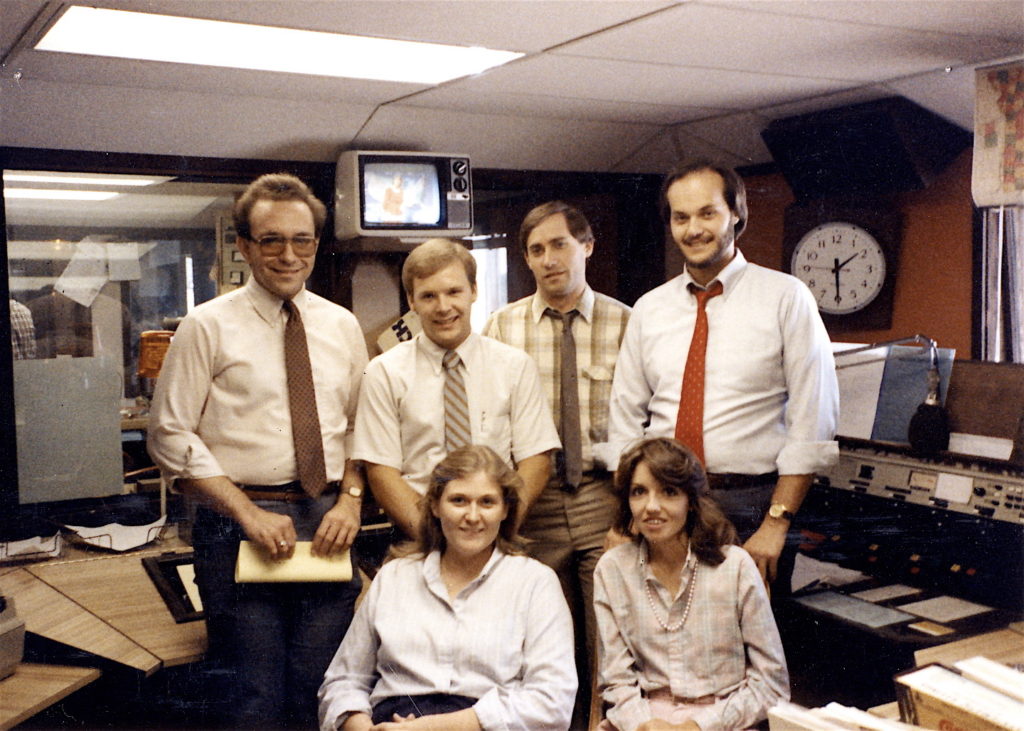
I met Dan in 1984 when he was news director at KTTS in Springfield, Missouri, and I was doing affiliate relations for The Missourinet (Dan’s the guy in the red tie). From Springfield Dan moved up to Milwaukee where he was news director of WTMJ for a few years before moving to New York to take over digital media for WCBS-TV. Then on to Radio One and, in 2015, iHeartMedia.

I interviewed Dan in 2005 when he was elected chairman of what was then RTNDA (Radio Television News Directors Association). They changed the name in 2009 because this digital thing just wasn’t going away. During that interview we talked about blogging, podcasting, satellite radio. For a little context, XM (satellite) Radio did it’s first broadcast in 2001; Facebook launched in 2004; podcasting became a thing that same year; YouTube started 2005; Twitter in 2006; and in January of 2007, Steve Jobs introduced the iPhone. Whew.

Media, journalism and Life As We Know It has undergone some big changes in the last dozen years. According to a 2016 Gallup Poll, “Americans’ trust and confidence in the mass media ‘to report the news fully, accurately and fairly’ has dropped to its lowest level in Gallup polling history, with 32% saying they have a great deal or fair amount of trust in the media. This is down eight percentage points from last year.” 

I don’t see how he can possibly find the time but Dan says we’ll talk again. Boy, am I looking forward to that.

This post was updated on April 6, 2017 at 6:50 p.m.