Homo Deus: Religion

One measure of a good (non-fiction) book is how much highlighting and underlining I do. The new book by Yuval Harari (Homo Deus: A Brief History of Tomorrow) filled seven pages (PDF) » Homo Deus -A Brief History of Tomorrow (Yuval Noah Harari)

Like his previous book (Sapiens), Homo Deus made me think about a lot of Big Ideas in fresh, new and sometimes uncomfortable ways. He makes some bold predictions but presents them more in terms of trends and in this regard the book reminded me of Kevin Kelley’s The Inevitable. Dr. Harari specializes in World History and macro-historical processes. (Wikipedia)

And the “macro-historical” perspective is what really grabbed in this book. It was good to be jolted out of my ‘election cycle’ time frame. I’ll probably do two or three posts on this book just to keep them from getting impossible long.

I came away with a new — and much broader — understanding of religion which Harari defines as: “any all-encompassing story that confers superhuman legitimacy on human laws, norms and values.”

He includes Liberalism, Communism and other modern creeds but one quickly understand from context that he’s not talking about “liberals vs. conservatives” in the narrow sense of American politics.

“Liberals, communists and followers of other modern creeds dislike describing their own system as a ‘religion’, because they identify religion with superstitions and supernatural powers. If you tell communists or liberals that they are religious, they think you’re accusing them of blindly believing in groundless pipe dreams. In fact, it means only that they believe in some system of moral laws that wasn’t invented by humans, but humans must nevertheless obey.”

This topic gets really interesting in the final chapter of the book but we’ll save that for another post.


The communist laws of history are similar to the commandments of the Christian God, inasmuch as they are superhuman forces that humans cannot change at will. According to Marx, we cannot change the laws of history.

Religion is a tool for preserving social order and for organising large-scale cooperation. […] Without the guiding hand of some religion, it is impossible to maintain large-scale social orders.

Religion is a deal, whereas spirituality is a journey. […] If you obey God, you’ll be admitted to heaven. If you disobey Him, you’ll burn in hell. […] Spiritual journeys take people in mysterious ways towards unknown destinations (Who am I?). […] For religions, spirituality is a dangerous threat.

Religion is interested above all in order. Science is interested above all in power (e.g. to cure diseases, fight wars and produce food.)

Modernity is a surprisingly simple deal. Humans agree to give up meaning in exchange for power.

Is economic growth more important than family bonds? By presuming to make such ethical judgements, free-market capitalism has crossed the border from the land of science into that of religion.

New technologies kill old gods and give birth to new gods. The revolutionary technologies of the twenty-first century are far more likely to spawn unprecedented religious movements than to revive medieval creeds.

Islamic fundamentalists may repeat the mantra that ‘Islam is the answer’, but religions that lose touch with the technological realities of the day forfeit their ability even to understand the questions being asked. […] Hundreds of millions may nevertheless go on believing in Islam, Christianity or Hinduism. But numbers alone don’t count for much in history. History is often shaped by small groups of forward-looking innovators rather than by backward-looking masses.

In the early twenty-first century the train of progress is again pulling out of the station — and this will probably be the last train to ever leave the station called Homo sapiens. Those who miss this train will never get a second chance. In order to get a seat on it you need to understand twenty-first-century technology, and in particular the powers of biotechnology and computer algorithms. […] If Marx came back to life today, he would probably urge his few remaining disciples to devote less time to reading Das Kapital and more time to studying the Internet and the human genome.

Ask yourself: what was the most influential discovery, invention or creation of the twentieth century? That’s a difficult question, because it is hard to choose from a long list of candidates, including scientific discoveries such as antibiotics, technological inventions such as computers, and ideological creations such as feminism. Now ask yourself: what was the most influential discovery, invention or creation of traditional religions such as Islam and Christianity in the twentieth century? This too is a very difficult question, because there is so little to choose from. What did priests, rabbis and muftis discover in the twentieth century that can be mentioned in the same breath as antibiotics, computers or feminism? Having mulled over these two questions, from where do you think the big changes of the twenty-first century will emerge: from the Islamic State, or Google?

The Bible is kept as a source of authority, even though it is no longer a true source of inspiration.

College theater days

I spent my first two years of college trying to keep my draft deferment and quickly figured out I could do that better as a Speech/Theater major than as a Business major. I got a small part in Taming of the Shrew (below) my junior year which earned me a tiny scholarship ($500 a semester?). In my senior year I played the idiot son John in Lion In Winter. From the review (PDF): “Mays, in an attempt to convey his awkwardness, at times overdid John’s walk.” (Reviews below).

I loved the theater crowd. It was as cliquish as any fraternity or sorority but we didn’t have to dress as nice. As much as I enjoyed it, I never developed an interest in community theater. I still have a recurring nightmare in which I have to go onstage before a huge audience but I have never been to a rehearsal. In the dream, I’m trying to figure out how I can have a script in my hand without the audience noticing. Or come up with a way to adlib through the whole thing.

Time as kaleidoscope

“There was also no longer any sense of my moving along a timeline. Time was no longer a path with the past behind me and the future before me, as we commonly conceive of it. Instead there was a sense of an eternally unfolding present moment. Rather than time being a journey along a linear path, change appeared to be mandala-like. It seemed to be like a flower seen from above, endlessly unfolding from within, or like a kaleidoscope’s image forever rearranging itself. It struck me as highly misleading to think in terms of there being a past behind us and a future ahead of us. Instead there was only this one present moment, eternally unfolding according to its nature. I found myself in an eternal, timeless present.”

The passage above is from Living As A River. I have a little trouble with the flower image but really like the kaleidoscope analogy. I even bought a small one and enjoy watching the tiny pieces of glass rearranging themselves. How many different patterns are possible, I wondered. I thought it would be a matter of permutations and combinations but couldn’t find a formula.

“The kaleidoscope was invented by Sir David Brewster about 1816 and patented in 1817. Sold usually as a toy, the kaleidoscope also has value for the pattern designer. […] The number of combinations and patterns is effectively without limit. (Encyclopaedia Britannica)

That surprises me a little. If there are x pieces of glass, it would seem there would be a finite number of combinations. But for the purposes of the analogy, “without limit” works just fine. But another question occurs to me: Is there a way to compute the probability the exact same pattern will repeat? But I’ve drifted pretty far from the “present moment.”

The image of our lives as a road stretching from birth to death, always in one direction, is pretty grooved into my psyche. But I like the kaleidoscope better. All the tiny, colored pieces of my existence, rearranging themselves, moment to moment, never the exact same pattern twice. Yes. That’s a more interesting way to imagine time.

Smelling good for other people

I don’t wear aftershave or cologne. At some level I think I’m bothered by the idea of wanting to smell good for someone else, although I suppose some might wear it because they like the smell. And when I’m in the presence of a man (or a woman, for that matter) with “too much” aftershave or cologne, eeewww! And, I’m sorry, but anyone who puts on scented aftershave or cologne does so because he wants to be noticed. Yeah, yeah, it closes up the pores and is antiseptic.

When I started shaving (high school?) I dabbed on a little Currier & Ives After Shave. Do they still make that? It seemed less perfume-y to me but I gave it up when I got to college. I think I tried English Leather once but found it sickeningly sweet. Other popular scents from that era included Canoe, Jade East, Brut and Aramis. I recall Brut being a popular gift for young men.

Do men (of any age) wear aftershave and cologne these days? If I were going to wear some sort of scent, I think I’d pay someone to cook up something that smelled like those big Marks-a-Lot permanent markers. Everybody likes that smell. Or maybe airplane glue.

Kahn Academy


While googling “permutations” I happened upon a Khan Academy tutorial (PRECALCULUS > PROBABILITY AND COMBINATORICS). A guy named Sal explaining the permutation formula and how to use it. I have not given this topic a thought since high school and while familiar with Kahn Academy, I never watched one of their tutorials. Wow. This seems like a great way to learn. Math was really hard for me but if I had had access to these I think I would have done much better.

From Bacteria to Bach and Back

From Bacteria to Back and Back. The Evolution of Minds, by Daniel C. Dennett. The book’s cover teased me with “How did we come to have minds?” The author dragged me through 300 pages of “groundwork” before providing anything I could recognize as an answer. But I took notes (below), if underlining counts as taking notes. And here’s a review by Thomas Nagel. And a 45 minute audio interview at The Big Think.

The immaterial mind, the conscious thinking thing that we know intimately through introspection, is somehow in communication with the material brain, which provides all the input but not of the understanding or experience. 

Can there be reasons without a reasoner, designs without a designer? (Dennett says yes)

A central feature of human interaction, and one of the features unique to our species, is the activity of asking others to explain themselves, to justify their choices and actions, and then judging, endorsing, rebutting their answers, in recursive rounds of the “why?”

Natural selection doesn’t have a mind, doesn’t itself have reasons. […] For instance, there are reasons why termite colonies have the features they do, but the termites do not have or represent reasons, and their excellent designs are not products of an intelligent designer.

Turing showed that it was possible to design mindless machines that were Absolutely Ignorant, but that could do arithmetic perfectly. […] He foresaw that there was a traversable path from Absolute Ignorance to Artificial Intelligence. […] Both Darwin and Turing claim to have discovered something truly unsettling to a human mind — competence without comprehension.

Why and how did human-style comprehension arrive on the scene?

Ontology – the set of “things” a person believes to exist.

Comprehension is an emergent effect of systems of uncomprehending competence.

What is consciousness for (if anything)? If unconscious processes are fully competent to perform all the cognitive operations of perception and control.

Information is always relative to what the receiver already knows.

If DNA can convey information about how to build a nest without any terms for “build” and “nest,” why couldn’t a nervous system do something equally inscrutable?

Intentional mind-clearing, jettisoning information or habits that endanger one’s welfare, is not an unusual phenomenon, sometimes called unlearning. […] The brain’s job in perception is to filter out, discard, and ignore all but the noteworthy features of the flux of energy striking one’s sensory organs.

One of Darwin’s most important contributions to thought was his denial of  essentialism, the ancient philosophical doctrine that claimed for each type of thing, each natural kind, there is an essence, a set of necessary and sufficient properties for being that kind of thing.

Children learn about seven words a day, on average, from birth to age six.

Understanding a word is not the same as having acquired a definition of it.

Words don’t exist,  strictly speaking. They have no mass, no energy, no chemical composition.

Memes are transmitted perceptually, not genetically.

Words are memes that can be pronounced.

“In terms of the brain, we know that concepts are somehow stored there, but we have little idea of exactly how.”

The acquisition of a language — and of memes more generally — is very much like the installation of a predesigned software app of considerable power, like Adobe Photoshop, a tool for professionals with many layers that most amateur users never encounter.

We may “know things” in one part of our brain that cannot be accessed by other parts of the brain when needed. The practice of talking to yourself creates new channels for communication that may, on occasion, tease the hidden knowledge into the open.

Nature makes heavy use of the Need to Know principle, and designs highly successful, adept, even cunning creatures who have no idea what they are doing or why.

Our thinking is enabled by the installation of a virtual machine made of virtual machines made of virtual machines.

We learn about others from hearing or reading what they say to us, and that’s how we learn about ourselves as well.

“We speak not only to tell others what we think, but to tell ourselves what we think.” — John Hughlings Jackson

Bare meanings, with no words yet attached, (can) occupy our attention in consciousness.

Evolution has given us a gift (the mind?) that sacrifices literal truth for utility.

(The mind is) that thinking thing with which you are so intimately acquainted that is hardly distinguishable from you, yourself. No wonder we are reluctant to see it as illusory; if it is illusory, so are we!

If free will is an illusion then so are (we).

Human consciousness is unlike all other varieties of animal consciousness in that it is a product in large part of cultural evolution, which installs a bounty of words and many other thinking tools in our brains, creating thereby a cognitive architecture unlike the “bottom-up” minds of animals. By supplying our minds with systems of representations, this architecture furnishes each of us with a perspective—a user-illusion—from which we have a limited, biased access to the workings of our brains, which we involuntarily misinterpret as a rendering of both the world’s external properties (colors, aromas, sounds,. . . ) and many of our own internal responses (expectations satisfied, desires identified, etc.).

Deep learning will not give us — in the next fifty years — anything like the “superhuman intelligence” that has attracted so much alarmed attention recently. […] I have always affirmed that “strong AI” is “possible in principle” — but I viewed it as a negligible practical possibility, because it would cost too much and not give us anything we really needed.

The real danger, I think, is not that machines more intelligent than we are will usurp our roles as captains of our destinies, but that we will over-estimate the comprehension of our latest thinking tools, prematurely ceding authority to them far beyond their competence.

When you are interacting with a computer, you should know you are interacting with a computer. Systems that deliberately conceal their shortcuts and gaps of incompetence should be deemed  fraudulent, and their creators should go to jail for committing the crime of creating or using an artificial intelligence that impersonates a human being.

Hair

I just purchased ($10) the 1968 cast recording of the Broadway musical Hair. I couldn’t find the album in Apple Music so I had to purchase from the iTunes store. The album charted No. 1 on the Billboard 200, the last Broadway musical cast album to do so (as of 2016, which finally saw The Hamilton Mixtape chart No. 1, although that is not a cast album). So says Wikipedia. Hair’s cast album stayed at No. 1 for 13 weeks in 1969. You had to be there.

Before Wikipedia and YouTube

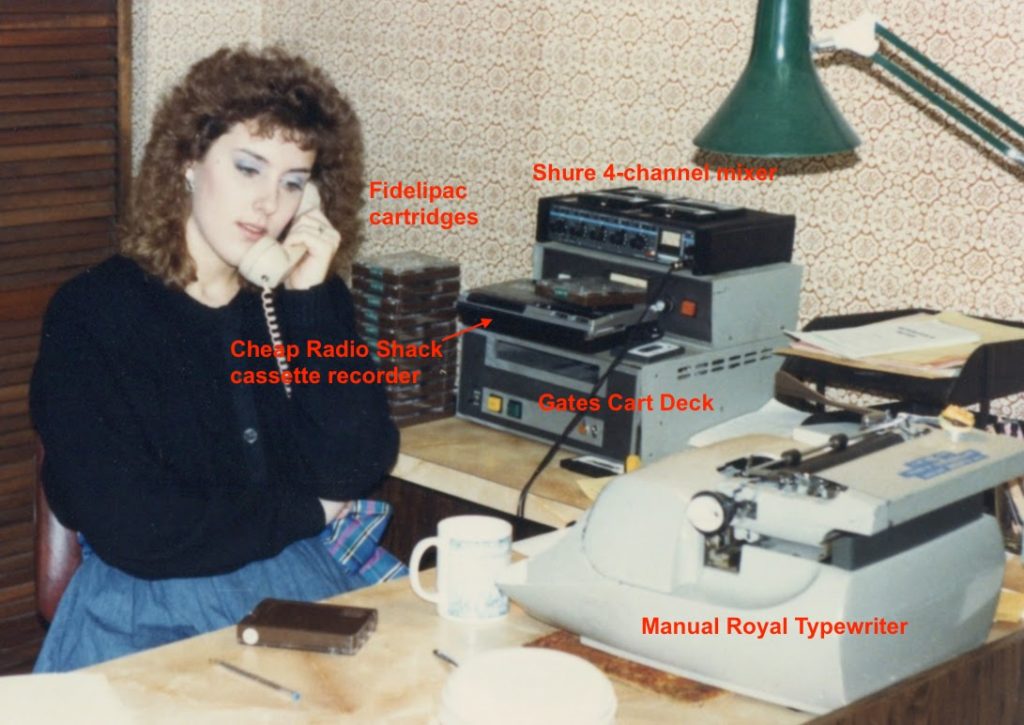
I’ve been sharing old photos from the early days of radio station KBOA. I worked there in the 70s and my dad before me. I’ve been updating content on the website I created about the early days (1947-1957) of the station. KBOA830.com was my first shot at a website, back in 1997 and didn’t get much attention after the initial setup because it focused on that ten year period.

While updating this week, I kept find relevant stuff on Wikipedia and YouTube and couldn’t figure out how I’d missed this stuff when creating the site. Then I realized Wikipedia didn’t come online until 2001 and YouTube in 2005. And I found other sites with great material about performers and on-air talent at KBOA.

What is Reality?

“Emergence theory is a new physics model currently being developed by a Los Angeles based team of scientists. Emergence theory intricately – yet simply – weaves together quantum mechanics, general and special relativity, the standard model and other mainstream physics theories into a complete, fundamental picture of a discretized, self-actualizing universe.”

“Physics allows the possibility that all the energy of the universe can be converted into a single, conscious system that itself is a network of conscious systems. Given enough time, what can happen will eventually happen. By this axiom, universal emergent consciousness has emerged via self-organization somewhere ahead of us in 4D spacetime. And because it is possible, it is inevitable. In fact, according to the evidence of retro-causality time loops, that inevitable future is co-creating us right now just as we are co-creating it.”