
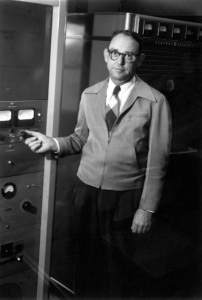
Ray Van Hooser was on the original staff of KBOA.
Category Archives: Radio
The Lumpkin Family
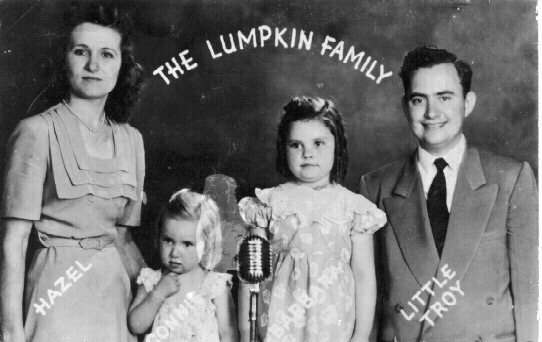
I’d watch a TV show based on a 50’s era family that made their living performing on small town radio stations. I might make one or both of the children “little people” passing as kids. Maybe the wife transgender. The gimmick would be they are all very talented but couldn’t make it as solo acts and discover — by humorous accident — that they’re a hit as a family. The thing practically writes itself.
An end of radio
 “Just as newspapers fell off a cliff, radio is about to follow. It’s going to happen faster than anyone expects. And of course, it will be replaced by a new thing, a long tail of audio that’s similar (but completely different) from what we were looking for from radio all along. And that audience is just waiting for you to create something worth listening to.”
Seth Godin blog post
The transistor radio
From Walter Isaacson’s The Innovators:
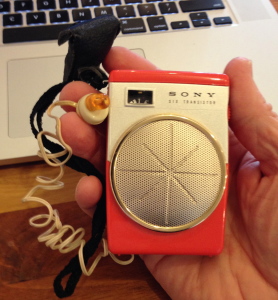 “Transistors were being sold in 1954 to the military for about $16 apiece. But in order to break into the consumer marker. Haggerty insisted that his engineers find a way to make them so that they could be sold for less than $3. They did. He also developed a Jobs-like knack, which would serve him then and in the future, for conjuring up devices that consumers did not yet know they needed but would soon find indispensable. In the case of the transistor, Haggerty came up with the idea of a small pocket radio. When he tried to convince RCA and other big firms that made tabletop radios to become a partner in the venture, they pointed out (rightly) that consumers were not demanding a pocket radio. But Haggerty understood the importance of spawning new markets rather than merely chasing old ones. He convinced a small Indianapolis company that built TV antenna boosters to join forces on what would be called the Regency TR-1 radio. Haggerty made the deal in June 1954 and, typically, insisted that the device be on the market by that November. It was. The Regency radio, the size of a pack of index cards, used four transistors and sold for $49.95. It was initially marketed partly as a security item, now that the Russians had the atom bomb. “In event of an enemy attack, your Regency TR-1 wiU become one of your most valued possessions,” the first owner s manual declared. But it quickly became an object of consumer desire and teenage obsession. Its plastic case came, iPod-like, in four colors: black, ivory, Mandarin Red, and Cloud Gray. Within a year, 100,000 had been sold, making it one of the most popular new products in history.”
“More fundamentally, the transistor radio became the first major example of a defining theme of the digital age: technology making devices personal. The radio was no longer a living-room appliance to be shared; it was a personal device that allowed you to listen to your own music where and when you wanted—even if it was music that your parents wanted to ban.”
Gaylon Watson

Yesterday I drove to the little town of Piedmont, in southeast Missouri, to meet Gaylon Watson. Gaylon worked at KBOA back in the fifties and I have long wanted to meet him and capture some oral history from those early days of the station where my father and I once worked. Gaylon’s eighty now but healthy and sharp as a tack. His 28 years in broadcasting covered a lot of ground and we only captured some of it in this recording.
Gaylon’s eighty now but healthy and sharp as a tack. His 28 years in broadcasting covered a lot of ground and we only captured some of it in this recording. We had to leave some on the editing room floor because of the noisy restaurant. After lunch Gaylon gave me the “Chamber of Commerce” tour of Piedmont (where he was mayor for 16 years) and then took me to meet his three dogs who live in splendor on 20 beautiful acres in the Missouri Ozarks.