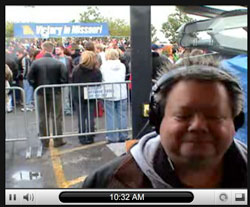
Interview: Dan Shelley, WCBS-TV

In July, my old friend Dan Shelley left WTMJ in Milwaukee and moved to New York as Executive Editor of Digital Media for WCBS-TV. I spoke with him this morning about digital media, journalism, blogging, radio, life in NY and riding in the elevator with Andy Rooney. Dan is pumped about his new job and living in Manhattan.

AUDIO: Interview with Dan Shelley

Dan offered this warning to broadcasters: “If you don’t do more than just stick your toe in the water, if you don’t plunge head-first and totally immerse yourself in the digital media future, and do it now, you will die.”

For those that might have missed it, I interviewed Dan in May, 2005, right after he took over as chairman of the Radio and Television News Director’s Association. He talked the “digital talk,” and now he’s “walking the digital walk.”

Sprint Radio

Digital Music News: “Sprint has just expanded its music service with several new features, including streaming radio. Sprint Radio, a collaboration involving Palo Alto-based mSpot, will offer fifty different audio and video channels across various music genres. News, weather, sports, finance and entertainment from NPR, ESPN and Radio Disney will also be part of the mix. Sprint Radio will be available for a $5.95 monthly fee.”

So, I can get music, news, weather and sports…on my cell phone. Commercial free, I assume. Will people pay $1.50 a week for this? Sprint obviously thinks they will.\

Update: I pulled the comments to this unintentionally inflammatory post.

Blipvert update

Clear Channel Radio has found its first buyer for blinks, its new one- to three-second radio spots. Fox Broadcasting Co. is the first to purchase and use two-second radio spots in an effort to promote the fall season premiers of “Prison Break,” “House” and “The Simpsons.” [AdAge]

Tod Maffin calls these “pop-up’s for radio.”

Problems for XM and Sirius?

WSJ: “Many people are simply having iPod adapters installed in their cars and skipping satellite altogether, a concept that was barely on the horizon when the industry was young.”

Not sure how big a problem this is. But I’m one of those folks spending more time with the pod and less listening to satellite radio. If I had to renew today… I would. A year from now…?

Car stereo with USB port

Eric Benderoff (Tech.Buzz/Chicago Tribune.com) loves his JVC KD-G720 car stereo, an aftermarket item into which he can plug (via USB port) an iPod, or a thumb drive filled with MP3 files. The songs play through the car stereo, and he can control the volume and song selection directly through the unit, not the iPod. When his iPod is plugged in, the car stereo charges the music player as it plays. And the song information scrolls across the stereo’s screen, telling him the artist, song name and album title. The thing can also receive satellite radio from XM or Sirius, spin CDs (in WMA and MP3 formats) And play terrestrial radio stations. All for about $200, not including installation.

JVC USB Stereo

This just makes so much more sense than some proprietary, factory-installed hardware. I might have to get me one of these. Yum. [via RAIN]

The radio ads I want to hear

Tod Maffin is looking forward to the day his satellite radio delivers ads he wants to hear:

“So, let’s take this to its natural next step in, say three years. You call up XM or Sirius and activate your radio. Besides asking for your billing address, they also seek out some basic demographic information. How old are you? What are your interests? Suddenly, your radio begins playing ads that are aimed at you and people like you. With my demographic profile in hand, the satellite service could have screened those (crappy spam-like ads) out and sent me ads specific to my interests.”

I sort of dread going through some long “check the products and services you’re interested in” procedure, but you’d only have to do it once and then keep it updated. Then, maybe once a month, they send me a link to a web page where I see a list of all the advertisers that hit my reciever in the past 30 days. I remove any that I don’t like. Sort like signing up for Netflix. Or, maybe they just have a bot crawl this blog and figure out what I care about.

Google makes ad deal with XM

“In its biggest offline media play to date, online search giant Google this morning announced plans to begin extending the reach of its online search advertisers to the nation’s largest satellite radio service, XM Satellite Radio. The deal is the latest development in Google’s push to expand beyond the Internet into the traditional media marketplace, and follows a series of tests with print media and radio outlets.”

Media Daily News [Thanks, XM Ben]

References available upon request

My buddy Morris left the radio news game this spring. After 30+ years. Tried his hand at the newspaper business but that didn’t work out. He says he wants to try something online. Blogging, podcasting, etc. I think he knows it will be a tough row to hoe (as momma used to say) but he sounds very positive. In his latest email he observed there just weren’t that many “serious news operations” (he was referring to radio, I believe) in Missouri.

News GuyMorris’ situation raises a good question. If you’re a radio news reporter, and you had to go out and find another job tomorrow, where would you look? Another radio station? Group ownership has reduced the competition (and need?) for your services. The local newspaper? They’ve got their own problems. A traditional fall-back has been PR for some company/association/department. But I always wondered if that wasn’t based on the notion that you could get all of your radio news buddies to run your press releases. On the other hand, I was in a room full of PR folks back in January so the jobs seem to be there.

Radio reporters have what seem to be some very marketable skills. They can do interviews. They can write stories. They can read well aloud. So, where do they go when it’s time to go?

Google AdSense for radio: Part Two

From today’s C|NET story on Google and radio advertising:

“So why the excitement? dMarc automates the process of buying ads, placing them in time slots and tracking them, which is usually done by ad agencies over the phone, experts said. Automation could lead to efficiency, and that means lower prices for advertisers while bringing in more sales for the radio stations. … The Google-dMarc system would be a big change from the current ad-buying system, where ad salespeople establish personal relationships with radio stations. Advertisers could better quantify how well an ad campaign is doing and modify the ads quickly depending on the response rate from listeners.”

Which reminded me of this from Chris Anderson’s The Long Tail:

“Meanwhile on the other side, those ad-driven media have their own ad sales forces. They pitch the advertisers and their media buyers on the virtues of their advertising vehicles. If all goes well, millions of dollars change hands. All of it is labor-intensive and made even more costly by the expensive schmoozing that’s required in businesses where a lack of trusted performance metrics makes salesmanship and personal relationships key to winning businesses.”

Only time will tell if Google can make this elephant dance, but revenue in Google’s most recent quarter was $2.5 billion, nearly double what it was a year ago. And Google has the money and time to figure this out:

“What’s neat about this is the radio stations get to preview the creative copy and we pre-approve all rates before they get aired. Radio stations and Google will explore on a case-by-case basis which opportunities make sense.”

The scariest quote in the story for me was:

“The fact that (what Google is trying) is more electronically based gives advertisers more comfort that they are getting what they are buying.” Ad agencies and stations “are still faxing invoices to each other and typing up affidavits.”

All of this brings back memories of Google’s earliest days. Everybody that used it said, “Damn, this is cool! THIS is how search is supposed to work. But, uh, how are they gonna make any money with this service if it’s free?” $2.5 billion last quarter. Maybe they’ll figure it out.

He left radio to become a clown

Radio Iowa News Queen O. Kay Henderson emailed this affiliate update:

“As you know, KICD news director Brent Palm left to take a job at Minnesota News Network. His replacement is Tim Torkildson. Mr. T worked in radio 12 to 15 years ago. He left radio to become a clown and ringmaster for a traveling circus. He’s now left that career, settled in Spencer and is starting his third week on the job.”

Welcome back, Tim. I’d surely love to interview you for smays.com.