
KBOA 830

In an earlier post I wondered about some recent move affecting the radio station I worked at many years ago. Our friend Jeff pointed us to a post on a radio message board:   
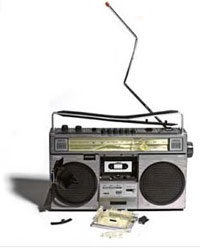
"Eagle Bluff Enterprises has received FCC permission to move KOTC from Kennett, Missouri to Memphis, Tennessee.  KOTC (830 AM) signed on in July 1947 as KBOA.  KOTC went silent on 6-1-08.  The justification for the STA was "The station has been temporarily turned off pending format changes and equipment repairs".  After the move, KOTC will diplex its 10 KW signal from a tower shared with WHBQ, 560 AM, in Memphis."

When I worked at KBOA the frequency (a daytime clear channel) was 830. When consolidation hit there was a series of call letter/frequency shuffles I was never interested enough to try to sort out.

I think they moved the KBOA calls to a frequency (105.5) licensed to Piggott, Arkansas, but operating in Kennett, MO. The 830 freq was assigned some newer, local (Kennett) calls (KOTC).

The KBOA I knew and loved died long ago. And it was nice to read some kind words about KBOA830.com. Thanks to all.
Sprint in the NFL radio business

“Sprint Nextel subscribers will be able to listen to live radio broadcasts of National Football League games this season as part of new partnership between the wireless provider and sports league.

IphonefootballThe live, cell-phone-accessible radio broadcasts—the centerpiece of the new NFL Mobile Live platform–will be available to all Sprint wireless subscribers who purchase a basic data plan as part of their services. In addition, as part of the agreement a select group of premium subscribers will be able to view live broadcasts of the NFL Network’s eight Thursday Night Football games on their phones starting on Nov. 6.” — MEDIA WEEK

Hmmm. Here’s one of several “take away’s” from this story by Mark Ramsey:

“For some reason, many broadcasters confuse the term “content” with “the stuff that’s on our air.” When I use the term “content” I mean the material that’s of serious interest to listeners. Stuff they will seek out. Not filler. Not commodities. McDonalds and NOBU may both offer “food,” but that’s where the similarity ends, and don’t think for a moment the patrons don’t know the difference.

In this case, the content is owned in its entirety by a third party – not a radio company. When it comes to professional sports play-by-play, radio is a distribution channel, not a content owner. Thus we will lose out to the owners of content in deals like this.”

Our company does broadcasts for a whole bunch of big (and small) colleges. We’ve been streaming (via Yahoo!) for years and on satellite radio for the last few years. It seems inevitable that these broadcasts will go directly to phones, sooner or later. Stay tuned? Dialed in?

Latest news consumption survey

The latest Pew biennial news consumption survey is out and offers no big surprises. Two new (to me) terms caught my eye: Integrators and Net-Newsers:

“Integrators, who get the news from both traditional sources and the internet, are a more engaged, sophisticated and demographically sought-after audience segment than those who mostly rely on traditional news sources. Integrators share some characteristics with a smaller, younger, more internet savvy audience segment – Net-Newsers – who principally turn to the web for news, and largely eschew traditional sources.”

I certainly think of myself as “engaged” and “sophisticated,” but long to be “younger” and “savvy.” Sigh.

These surveys often make no mention of radio. I was pleased to see that radio is hanging in, at least against TV.

“Notably, radio news also is an important element in Integrators’ news diet. Nearly half of Integrators (46%) listen to news on the radio during a typical day. While the internet is the main news source for Integrators during the course of the day, about as many in this segment rely on radio news as TV news during the day (32% radio vs. 36% TV news).”

The Big Question (assuming it is still up for question) is what happens when the Integrators have all gone to that Community Center In The Sky?

Pandora: “Game over for music radio”

“Terrestrial radio is in bigger trouble than ever, I am convinced. I just finished driving down a highway in rural (state), listening to streaming music on the free Pandora Radio app for my upgraded version 2.0 iPhone. This was via edge, not 3G. Pandora plays randomized songs. But when an all-you-can-eat music service (maybe Apple’s, someday) has this same kind of app, it’s game over for music radio.  I’ll be able to listen to any song I want while driving, and won’t even have to load it on my iPod before leaving.

If you are unfamiliar with Pandora, it works like this: I enter the name of a song or artist. Pandora creates a “station” that plays music like the example I submitted. I “like” or “dislike” each song and Pandora keeps tweaking my play-list accordingly. I can have as many stations as I choose. Just music. No annoying DJ’s. No commercials.

If I’m the program director of an “only the hits” radio station, should I be concerned about this technology? I can’t please all the people, all the time. But all of the people can please themselves, all of the time. What is my Plan B?

We’re gonna need a bigger dial

Mark Ramsey points us to this LA Times story about Chrysler’s plans to offer wireless Internet in its 2009 models. Something we all knew was coming. As always, Mr. Ramsey asks the good questions. Here’s one of them:

“What does it mean to be “radio” in a world where audio is fully integrated into an experience that includes video, text, interactivity, and personalization? The attraction to these services will not only be that they’re supplemental to radio, but that they expand the definition of radio. And that expansion will benefit only those broadcasters and their partners smart enough to recognize that the advantage of a broadcast tower is non-existent in this context.”

Or a satellite channel?