
“Air America Media has hired Ana Marie Cox as its first Washington, D.C.-based national correspondent, travelling the country to profile people and stories illustrating life in America. She will contribute text, video and audio content to airamerica.com, as well as to a weekly program to air on Air America’s radio network. Cox will debut on Air America on Monday, January 19 to report from the nation’s capital for Air America’s Inauguration coverage.”
Category Archives: Radio
A career in radio prepares you for (new career goes here)
Missouri’s new governor will be sworn in tomorrow and, as part of the transition, about 150 people working at state jobs under the previous administration were terminated. This happens with every four or eight years.
A few days before the state ax fell, I had a routine meeting with the chief public information officer for one of the state departments. Like many in that line of work, he had –I believe– started in radio or spent a number of years in broadcasting. The years of consolidation in that industry had left this person weary from new owners, pay cuts, job elimination… and happy to have a more stable job in state government. Two days later the person is, once again, looking for a job.
It’s only a rumor but I’ve heard many of these communications positions will be filled by attorneys under the new administration. Our new governor was formerly attorney general, but I’m not sure why one would want/need a lawyer in these positions. As I said, that’s just rumor.
All of which reminded me of the dozen years I spent working in local radio. They were more fun than I can describe. Whatever skills I acquired during that time (talking on the radio (??); writing commercials; covering a news story (sort of) seem so… irrelevant now. Okay, it’s a quarter of a century later, so why should this surprise me?
If I had stayed in radio, what would I be doing now? Programming a “cluster” of stations? Managing? (unlikely) And what would those years have prepared me to do?
I have no idea why so many radio people go into public relations or become PIO’s for some association or state agency. I always suspected they were hired for their communications skills. Comfortable in an on-air interview; familiar with writing news releases (?); good voice?
Still a useful skill set. But what else do you need to know how to do in 2009? Blogging? Podcasting? YouTube? Social media? Couldn’t hurt.
I hope everyone that lost their jobs last week finds new ones. And better ones. Free advice every morning from 6:30 a.m. – 8:00 a.m. at the Jefferson City Coffee Zone.
Printer Guy
The man sitting next to our (IT) printer is Shane. Shane is known and loved by all. Okay, a bunch of people know who he is and some of them probably love him.
I only bring him up to get into this excerpt from a recent This American Life. It’s only about 4 minutes long and semi-amusing (unless you are the guy that sits next to the printer in your office).
“You can’t create larger audiences by trying to create larger audiences”
The following excerpts are from an interview Mark Ramsey (Hear 2.0) did with Tom Asacker, a marketing and branding adviser and author (A Little Less Conversation: Connecting with Customers in a Noisy World).
One of the larger challenges facing radio?
“It seems that we’ve got a catch-22 on our hands, right? We need to get out on the street and keep selling in order to keep revenue coming in, so nobody wants to slow down in order to change the way they’re doing things, to really rethink it, because that might take away from sales time. I mean we’re putting out fires, and nobody wants to step back and say, “Wait a minute. Is there a better way of doing this?”
“It’s a difficult thing with an industry that’s been around this long, with people that are well entrenched in relationships up and down the chain. It’s tough to get people to change — to just say, “Put on the brakes, and let’s rethink radio.” But I think that that’s what needs to be done: Let’s rethink radio. Just like Steve Jobs said, “Let me rethink the MP3 player.” He didn’t say, “Well, we can do the MP3 player and slap this thing on it”; he said, “Stop, and let’s rethink the MP3 player.”
That’s a tough thing to do. It takes guts.”
Yes, it does. And he offers this rather brilliant (IMO) insight on creating audiences:
“You can’t create larger audiences by trying to create larger audiences. You can only create larger audiences by trying to get deeper with smaller audiences.
Think about how to get deeper and make more relevant, valuable connections with individuals in a culture or a subculture.
Don’t think about audience size. Think about the depth of the relationship and how important it is and how valuable it is. The more you do that, the bigger the audience gets.”
That’s probably true of friends as well. Best way to have a lot is to be a good one. You can listen to the entire interview at Hear 2.0.
Media 101
My recent visit to Central Methodist University included a tour of the campus which wound up in the studios of what was –I believe– the student radio station. I’m not sure when or why the station went off the air but the plan is to bring it back as an internet station.
During the few minutes I chatted with a couple of instructors and students about the project, I got the impression the approach will be… traditional, for lack of a better term. By that I mean, they’ll have a control room and studios with the usual assortment of recording and mixing hardware. Instead of pumping it all out to a transmitter and tower… they’ll stream it.
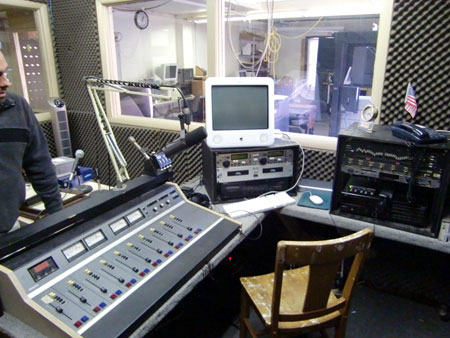 As for programming, they plan to do what we used to call “block programming.” An interview program followed by a news program followed by… Music licensing issues prevent them from programming music.
The way college radio stations have always been programmed. I don’t doubt the students can learn some useful skills and gain some valuable experience doing this but I’m not sure it will prepare them for the future that is already here.
So what would I do if they put me in charge of the program for a semester?
I’d start by dropping the term “radio” and go with “media.” Not “new media,” just media.
I’d assemble production teams made up of a producer and host (and co-host?). These teams would be responsible for one 25 minute program a week. Can be any topic (more on that in a moment)
A Senior Producer and Managing Editor would coordinate these teams (using Basescamp or some similar online collaboration tool) and insure quality standards and deadlines were being met.
All or most of these programs would be produced as live feeds and podcasts. Instead of a “college radio station” (Internet or otherwise), you’d have a portal site (I hate that term) that featured each of the individual programs with a link to that programs blog (where the hosts and producer interact with listener/viewers). Show notes, comments, etc.
The central feature of the portal page would be a video section. It could be a live stream of one of the shows being recorded or some live event on campus. Or just a live webcam from the student center.
Equipment. Each team would have a laptop, a digital camera (video capable) and a small webcam. All shows would be produced on location. No reason to schlep back to a studio jammed with expensive equipment.
I wouldn’t limit this project to just students. I’d open it up to the community as well, but with students producing.
Once these podcasts are up, it’s an easy matter to track which ones produce a following. If nobody downloads, you fix the podcast or replace it. But you aren’t limited to the 24 hours of a real-time station. You can have as many programs as you have people to produce and watch/listen.
So what are the students learning here?
- How to write, edit and tell a story
- How to shoot and edit video and share it with the world
- How to build an online community or tribe
- How to produce a live webcast
- How to take and edit photos
- How about a course in Smart Phone Reporting?
…and so on and so forth. I’m not an educator so there could be lots of things wrong with this approach. I’m pretty sure it would cost a lot less than a more traditional approach while involving many more students (in and out of the communications program). If you have suggestions on this mythical program, please include them in the comments. Or, if you see flaws, post those as well.
PS: I think this might be a powerful recruitment tool, as well.
UPDATE/12.08.08: On a recent edition of NPR’s Morning Edition, Steve Inskeep interviewed journalist Sreenath Sreenivasan who, within an hour of the attacks in Mubai, began hosting a web radio call-in show with other Indian journalists, relaying what they knew. Sreenivasan used a service called Blog TalkRadio:
“BlogTalkRadio is the social radio network that allows users to connect quickly and directly with their audience. Using an ordinary telephone and computer hosts can create free, live, call-in talk shows with unlimited participants that are automatically archived and made available as podcasts. No software download is required. Listeners can subscribe to shows via RSS into iTunes and other feed readers.”