
Category Archives: Radio
“Taking a break from the news”
The following anecdote won’t mean much to anyone who has never worked at a small town radio station covering local news stories. And I don’t share this to embarrass or disparage anyone still doing so. It’s just a sign of the times.
One of our network reporters called an affiliate in a small town, asking for a feed of a story about a bank robbery and the capture (and tasing) of the stickup guy. Our reporter was informed the station news person was on vacation and since they couldn’t find anyone to do the news in his absence, “they’re taking a break from the news this week.” Our reporter’s reaction?
“The bridge is too far away for me to walk to it and jump. Our bluffs are not high enough to guarantee a fatal descent if I were hurl myself off one of them and I do not want to spend years as a paraplegic watching for more of these signs. My Norelco razor will not cut through any arteries and the only scissors I am allowed to have are the school scissors my children left behind when they grew up.
My only recourse is to continue working in this industry until it reduces me to complete incoherence, upon which time I can be placed in a padded room where I shall be safe from the apocalypse.”
Philosopher and poet-journo Bob Priddy:
“Radio began to lose its soul when stations became “properties,” when communities became “markets,” and when staff became “human resources.”
Joe Bankhead retires. Finally.
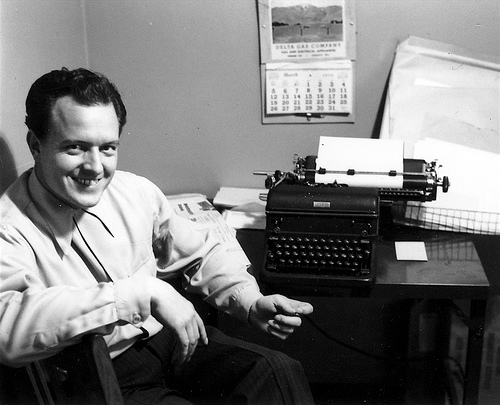
Joe Bankhead helped put KBOA (Kennett, MO) on the air back in 1947. One of the original employees. Also a good friend of my father. Joe tells his story better than I can. The man has seen a lot of radio.
Bomb shelters or spaceships
If you were recruiting for someone to manage a news organization in 2009, what skills or experience should you be looking for? What would the job description look like? (Since I know nothing about print, I’ll limit my questions to broadcast)
In my experience, most people who make it to “the top,” come from the sales side of the business. The men and women who made their bones in the newsroom occasionally wind up running the show but they are the exceptions. So we’re looking for sales and marketing experience, yes?
Someone who can figure out how to sell the advertising that funds company. Someone who can recruit and train people to sell 30 second radio and TV commercials?
What about this Internet thing? Do our sellers need to know how to sell banner ads (or whatever), too? Or does our manager have to manage two distinct type of sales departments? “Traditional” and online?
Strategically, do we manage the business we have today and hope it lasts a long time? Or, do we try to anticipate what our business will become in three, or five, or ten years? No easy task.
Clay Shirky says the advertising model that has defined and driven news organizations worked because advertisers didn’t have alternatives. Now they do.
But I’m getting away from my original question. Do we need a manager that is real good at “where we’ve been?” Someone with a good handle on where we’re headed? (if such a person exists) Or both? (tall order)
What if advertising –as we have come to know it– plays little or no part in funding news organizations in the future? Uh, let’s not go there. Too murky and scary.
As you can see, I have no answers… just questions. And I’m not sure they’re even the right ones.
Maybe it comes down to finding someone who knows how to build a spaceship, verses someone who knows how to build a bomb shelter. The spaceship has to get us to a very different place. The bomb shelter will protect us for as long as our food and water hold out.
Dollars moving from old radio to new radio?
“Internet Radio Makes Waves,” a new eMarketer report, predicts the radio industry will see double-digit losses in ad spending this year alone, with terrestrial radio bringing in $14.5 billion in ad revenues in 2009, a drop of 18% from 2008 levels.
ZenithOptimedia reports that in 2009, advertisers will spend $260 million on Internet radio and another $28 million on podcasting for a combined total of $288 million, up 28% from 2008. By 2011, that combined figure will reach nearly $394 million.