Superman Returns: Up in the sky…

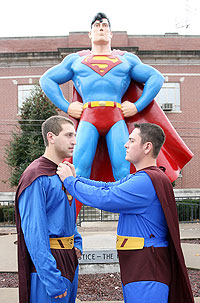
Fix my cape.They held a little celebration in Metropolis, Illinois, to mark the release of the “Superman Returns” DVD. UPI photographer Bill Greenblatt shares this photo of one Superman “look-a-like” adjusting the cape of another Man of Steel dead-ringer.

I have to wonder if Bill was being ironic when he captioned this image with “A wooden cut-out of Superman hangs on a building as hundreds lineup for a free DVD on the release date of “Superman Returns” in Metropolis, Illinois on November 28, 2006. Metropolis is the adopted home of Superman.”

The hopeless boredom on the faces of the people in line… the “Man of Plywood” missing an arm… thank you, Bill… thank you.

Will we see “local” radio again?

So Clear Channel is going to sell 400+ radio stations. Will these stations become more local? Mark Ramsey says it depends on who buys the stations and the “models of success” they try to follow:

1. Quality local talent with local connection and high entertainment value
2. Quality syndicated talent with high entertainment value
3. Low cost or no talent – regardless of its source (i.e., nothing matters but the music)

He concludes his post with the question: “Of those, which do you think is the toughest to achieve? And which is the cheapest?”

When I started in radio (1972), a lot of radio stations were still trying for #1. Not all of the local talent was “quality” and I’m not sure how “entertaining” we were. But syndicated programs were still a few years away and most communties weren’t ready to let you get away with juke box-ing the station.

But I think Ramsey sums up the options accurately and we’d see more station owners try #1 if #2 and #3 weren’t such attactive (short-term) options.

Ole Camp Meetin’ Time

Nostalgia Alert: We’re going back to 1947 in this post.
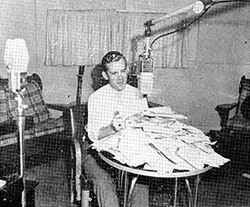
When KBOA went on the air (July 19, 1947), one of their first –and most popular– programs was “Ole Camp Meetin’ Time.” It was the creation of Ray Van (Hooser), the station’s first program director. The program featured hymns and gospel music but was far more than a “record show.” And it was immediately and immensly popular.

Sometime in the early ’50’s, Rudy Pylant (“Mr. Rudy”) took over Ole Camp Meetin’ Time and gave it his own special flavor (think Will Rogers-meets-Jerry Clower). The program continued to be hugely popular.

I was reminded of Ole Camp Meetin’ Time this week when my (life-long Kennett) friend Joann sent me one of the original Ole Camp Meetin’ Time Song Books. Published in late 1947, the radio staiton gave away thousands of these. Seems hopelessly quaint now but in 1947, these were like iPods.

If you grew up anywhere within a hundred miles or so of Kennett, Missouri, in the late 40’s or ’50s… you probably have memories of sitting at the breakfast table listening to Ole Camp Meetin’ Time. As I write this, I realize I don’t have the skill (or perhaps it is not possible) to convey how important this radio program was to the people that listened to it every monring. But, fortunately, I have some oral history that might come close.

You can read the introduction to the song book by station manager Paul C. Jones, after the jump.

So here we are sixty years later (gulp!) and it ain’t your father’s radio anymore. I have no illusions about returning to those days. But as I listen to the men that built KBOA talk about their love of radio (I’m not sure they would have said “the business” of radio)… I wonder if that same passion still exists today. I’m not in many stations these days so the flame might be burning brightly and I would not know. I’ve turned the comments on for this post for those than might.

Continue reading

Website: Expense or investment?

Mark Ramsey poses the following questions to broadcasters:

1. Is the purpose of your website just to put online what is already on the air, or is it something else?
2. Are we investing the necessary resources and talent in the development of our website, or are we having an intern update stuff in his spare time?
3. Are we giving people what they go to our station for in all its shapes and sizes on the web? Or are we offering one stream and a bunch of photos of our personalities?
4. If the content described in this article (Fast Company) can generate considerable traffic, can we convert that traffic to revenue? If so, why aren’t we investing for traffic instead of seeing our websites as expensive necessities?
5. If we keep crowing about how “local” our radio station is, exactly how does our website express that or service that?

Chicken LittleA couple of days ago, a broadcaster called me for advice on possible speakers/topics for an association meeting next spring. She wanted someone to come talk to them about “new media.” I asked her why?
“Uh, we need to figure out how to make some more money.” Or words to that effect.

I imagined thirsty villagers taking buckets and empty containers to a nearby well in hopes of finding water for their thirsty families.

I suggested that before you’d have anything to sell (to advertisers), you’d need to build an audience and that would take time and money. An investment.

“No, our owners won’t let us spend any money. We need to find some more money. That’s why we were thinking about the Internet.”

To completely exhaust the metaphor… if you don’t have the will or the resources to drill a new well… pray for rain.

John Mayer on Sheryl Crow

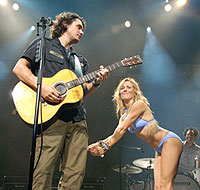
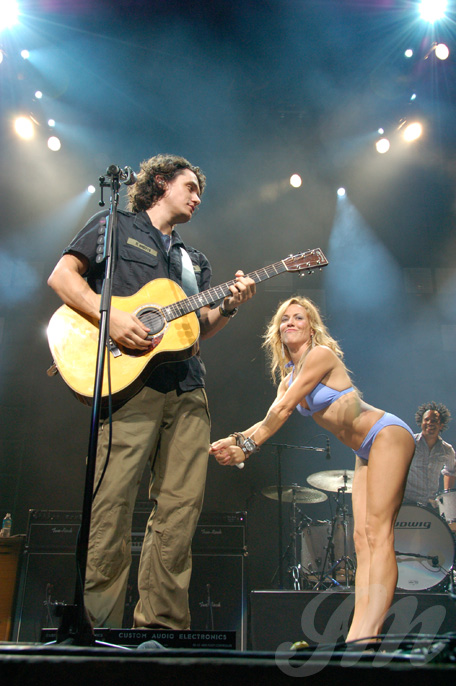
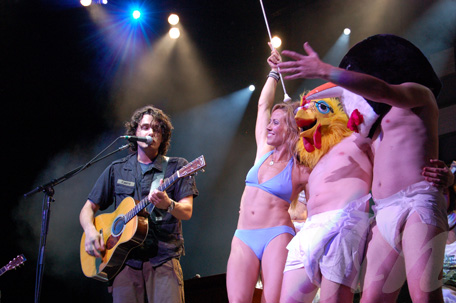
John Mayer and Sheryl CrowSheryl Crow and John Mayer recently toured together and during the next-to-last date, John Mayer come onstage during SC’s set, dressed as a bear. The following night, Ms. Crow interrupted his set, wearing a bikini and waving around a baton (I’m pretty sure she was a twirler in high school). Based on this post from Mr. Mayer’s blog (10/12/06), they had a good time:

“Sheryl – I hope you realize, even if for a fleeting moment just once a day, that everything you’ve ever hoped you would be, you are. I’ve never heard you sing a sour note, your record collection could freeze a Lower East Side hipster dead in his tracks and you have one of the hardest to find traits in a musician; you believe that nice isn’t the opposite of bad-ass. Add to that the great people you surround yourself with, and it’s no wonder I walk away from every conversation with you feeling like I expend twice the energy but say half as much as you do.”

Ms. Crow looks pretty good (for any age). There’s no permalink to the specific post on the Mayer blog.

ESPN launches local podcast network

ESPN is launching a local podcasting network. Sounds like they’re starting with shows from their five owned-and-operated stations while inviting affiliates to be part of the podcast network.

For more than a year, ESPN has been offering about 20 podcasts of national ESPN programming through PodCenter and selling advertisers two spots, one 15-second spot rolling prior to the content and a 30-second post-content spot. The new local podcasting network provides advertisers the opportunity to buy a local podcasting network or target individual markets or regions. Participating affiliates will get a share of the network revenue sold.

The local stations could (and may be) podcasting on their own but I have to believe this approach (whole greater than sum of parts) makes sense. Once clearance becomes a non-issue, there might be an explosion of such podcast networks. [Mediaweek via Radio and Records]

Cronkite and Murrow for an ironic millennium

From Maureen Dowd’s interview with Jon Stewart and Stephen Colbert in the current issue of Rolling Stone.

Rolling StoneStewart: “The cornerstone of politics these days is grievance. It’s really hard to keep that going when you’re in power. I’ve admired their ability to hold on to that idea of being aggrieved while maintaining almost absolute control of all functions of government. I love it.”

Colbert: “I think the way you said it the other day on your show was “Bush is not dumb. He speaks to us like we’re dumb.”

Stewart: “It was sort of like his trip to Baghdad. He went for four hours into the Green Zone and comes back and says Iraq is making great progress. It would be like if we went to the Olive Garden and started going, “I understand Italy.”

Stewart: “I still don’t consider myself political. People confuse political interest with interest in current events. The political industry is devoted to the electing and un-electing of officials, and that can be corrosive. If the Republicans don’t lose either house, people will talk about Karl Rove’s genius. There’s no genius. It will be the triumph of machine and money and strategy over reality. I don’t think that’s anything to honor or enjoy.

Edit note: My original post earlier today included the first Q and A as placeholder until I could purchase and read the full Rolling Stone article.

Google (still) moving into radio

“Web search leader Google Inc. is hiring scores of radio sales people and is spending heavily in a bid to expand its position in the $20 billion radio industry. Google spokesman Michael Mayzel said this week that the company will begin a public test of Google Audio Ads by the end of the year. Advertisers will be able to go online and sign up for targeted radio ads using the same AdWords system they use to buy Web search ads.” — Reuters

Thirty years of election coverage

The first election covered by The Missourinet (a network owned by the company I work for) was in 1976. News Director Bob Priddy orchestrated that first election night and every one since. Prior to The Missourinet, radio stations throughout the state focused on local races and relied on the wire services for news and numbers from throughout the state.

The Missourinet brought the sounds of election night from the state capitol and campaign headquarters throughout Missouri to the hometown audiences of our affiliates.

The technology has changed… and is changing… but insight and understanding Missourinet reporters bring to their election night coverage remains the focus of their reporting. Bob reflects on the past 30 years in this 10 minute video.

Gannett “Information Centers”

The Des Moines Register is not a newspaper anymore, it’s an “information center.” Excerpts from a Gannett memo:

“What is it? The Information Center is a way to gather and disseminate news and information across all platforms, 24/7. The Information Center will let us gather the very local news and information that customers want, then distribute it when, where and how our customers seek it.

“The Information Center, frankly, is the newsroom of the future. It will fulfill today’s needs for a more flexible, broader-based approach to the information gathering process. And it will be platform agnostic: News and information will be delivered to the right media — be it newspapers, online, mobile, video or ones not yet invented — at the right time. Our customers will decide which they prefer.”

This caught my attention because one of our networks (Radio Iowa) is headquartered in Des Moines and I’ve had some dealings (nothing recent) over the years with the paper. The Register is a big deal in Iowa.

If I learn anything about how this new concept is playing in the newsroom… er, the “information center,” I’ll let you know.

Anyone have thoughts on what the radio “newsroom of the future” should look like? [E-Media Tidbits]