YouTube isn’t just a platform. It’s infrastructure.

The excerpts below are from an article adapted from a blog post by Ryan McGrady. Ryan McGrady is a senior researcher with the Initiative for Digital Public Infrastructure at the University of Massachusetts at Amherst and a researcher with Media Cloud and the Media Ecosystems Analysis Group.

There are 14 billion videos on YouTube. More than one and a half videos for every person on the planet and that’s counting those that are publicly visible.

According to McGrady, YouTube started (February 2005) as a video platform, “but it has since become the backbone of one of the 21st century’s core forms of communication.”

Videos with 10,000 or more views account for nearly 94 percent of the site’s traffic overall but less than 4 percent of total uploads. Just under 5 percent of videos have no views at all, nearly three-quarters have no comments, and even more have no likes.

I uploaded my first video to YouTube on February 12, 2006 and more than 560 videos since. Those videos have been viewed 1,171,459 times for a total watch time of 19,171 hours. Amazingly, (to me) my channel has accounted for 3,376 views in the last 28 days. From day one I have had no interest in comments or likes and I never considered trying to monetize my videos. I always saw it as a place to park my videos so I could include them in a blog post.

I cannot argue with McGrady’s view that “YouTube is now less an opportunity than a requirement—something you have to use, because basic elements of society have organized around it.” 
Public-access Television

“From about 1920 to 1945, radio developed into the first electronic mass medium, monopolizing “the airwaves” and defining, along with newspapers, magazines, and motion pictures, an entire generation of mass culture. About 1945 the appearance of television began to transform radio’s content and role.” (Britannica.com)

Someone would be considered special (cool?) if they even knew someone who had been “on television.” Today anyone with a mobile device can share video (live or recorded) with the world. Everyone is “on TV” or in a “movie.” But back around 1970 we had something called Public-access Television.

“Public-access television (sometimes called community-access television) is traditionally a form of non-commercial mass media where the general public can create content television programming which is narrowcast through cable television specialty channels.” (Wikipedia)

Not long after cable TV came to the little town where I grew up, a local church invested in some recording equipment and began producing local programming.

I was a “radio announcer” (that was the job title back then) so I made a few –very embarrassingappearances on Time for Talk.

Age of Social Media Ending

That’s the title of an article in The Atlantic back in 2022. It’s behind a paywall so I’ll share a few of my favorite excerpts (and a few thoughts). The piece is a year old so some of this might less (or more) relevant.

The reporter traces an evolution/devolution of “social networks” to “social media.”

Instead of facilitating the modest use of existing connections—largely for offline life (to organize a birthday party, say)—social software turned those connections into a latent broadcast channel. All at once, billions of people saw themselves as celebrities, pundits, and tastemakers.

Blogs (and bloglike services, such as Tumblr) [hosted] “musings” seen by few and engaged by fewer. In 2008, the Dutch media theorist Geert Lovink published a book about blogs and social networks whose title summarized their average reach: Zero Comments.

I was blogging long before social networks or media. And I read lots of blogs. I recall being…mystified?… by the idea of social media.

“social media,” a name so familiar that it has ceased to bear meaning. But two decades ago, that term didn’t exist. […] “…social networking became social media around 2009, between the introduction of the smartphone and the launch of Instagram. Instead of connection—forging latent ties to people and organizations we would mostly ignore—social media offered platforms through which people could publish content as widely as possible, well beyond their networks of immediate contacts. Social media turned you, me, and everyone into broadcasters (if aspirational ones).” […] The network, which had previously been used to establish and maintain relationships, becomes reinterpreted as a channel through which to broadcast.

As a one-time broadcaster (radio) I understand the appeal of reaching an audience.

Social media showed that everyone has the potential to reach a massive audience at low cost and high gain—and that potential gave many people the impression that they deserve such an audience.

I loved blogging. Still do. But damned few people ever read this blog. And I got even fewer comments. Disabled that feature years ago. “The rush of likes and shares felt so good because the age of zero comments felt so lonely.”

Homeless Americans

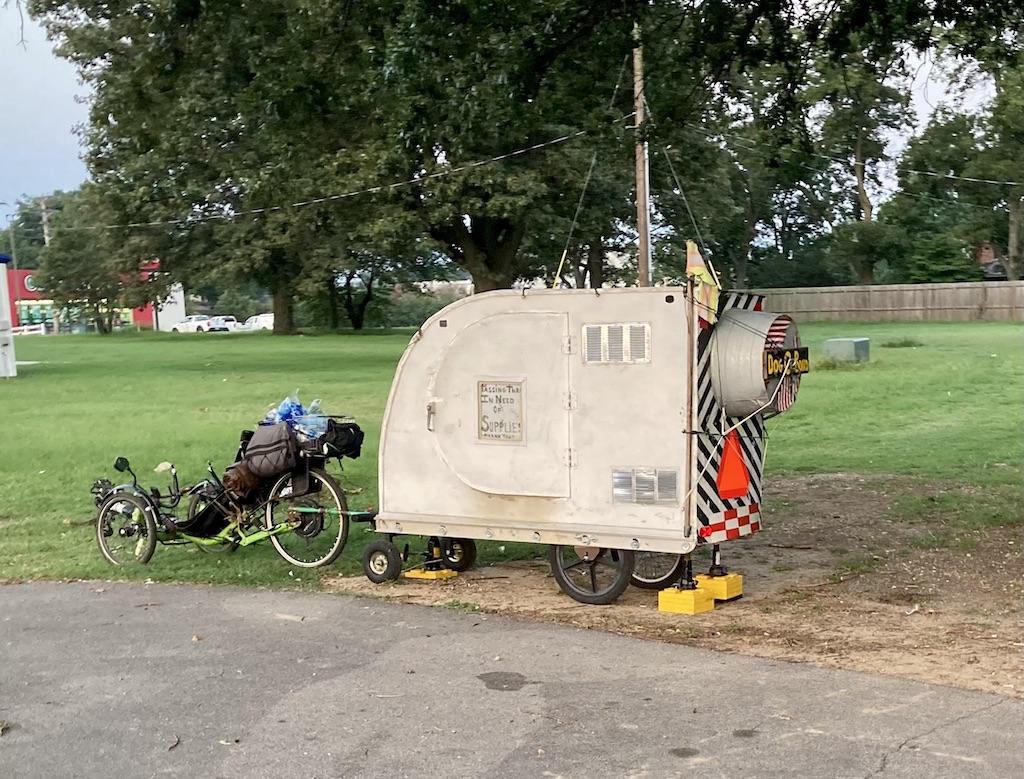
My friend John spotted this tiny home near the Walmart parking lot in Kennett, MO. Not sure if the owner qualifies as “homeless” but John is seeing more tents these days and tells of a homeless encampment nearby.


No shortage of stories on this problem but the most depressing thing about the following is it’s from 9 years ago.


Kennett is a small community in southern Missouri. A reminder that homeless is not just a problem in big cities like San Francisco and New York. The homeless are everywhere and they can’t be ignored (forever) and they are not going away.

Before we were monetized

From a WIRED post about smaller alternatives to the big social media sites;

“How will these smaller groups of happier people be monetized? This is a tough question for the billionaires. Happy people, the kind who eat sandwiches together, are boring. They don’t buy much. Their smartphones are six versions behind and have badly cracked screens. They fix bicycles, then they talk about fixing bicycles, then they show their friend, who just came over for no reason, how they fixed their bicycle, and their friend says, “Wow, good job,” and they make tea. That doesn’t seem like enough to build a town square on.”

Jobs

“We must do away with the absolutely specious notion that everybody has to earn a living. It is a fact today that one in ten thousand of us can make a technological breakthrough capable of supporting all the rest…. We keep inventing jobs because of this false idea that everybody has to be employed at some kind of drudgery because, according to Malthusian-Darwinian theory, he must justify his right to exist.”

–Buckminster Fuller, 1970

More on Jobs here…

Default Face

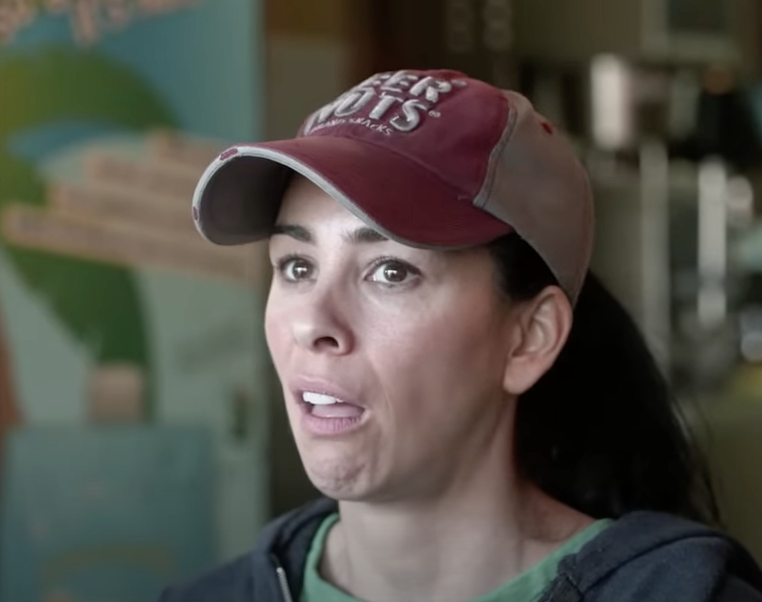
I recently watched an episode of Comedians In Cars Getting Coffee during which Sarah Silverman explains the concept of your “default face.” This is what your face looks like when it is without expression.

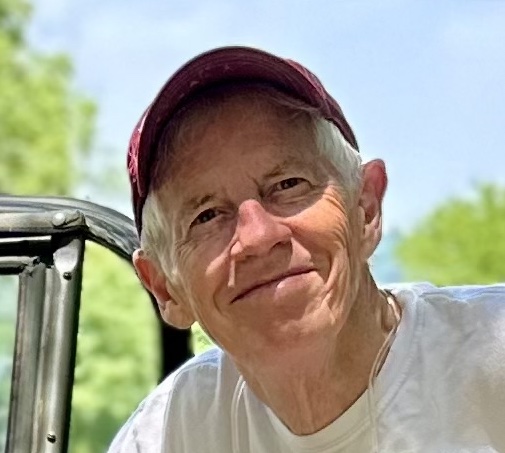
Ms. Silverman says you can “change your life” by simply changing your default face. I believe she is correct. I first noticed this about a month ago when I hung a small mirror from the windscreen in the Jeep (to watch the angry motorists forced to go slow behind me). I am also able to see my own face and I immediately saw my default face. Not pretty.

But when I smile… voila! I take five (ten?) years off my face. It will take a while for this to become my default face because it takes a) awareness and b) some extra facial muscles that don’t get used that often.

AM radio is being removed from many cars

Following are excerpts from a story in The Washington Post:

Ford, BMW, Volkswagen, Tesla and other automakers are eliminating AM radio from some new vehicles, stirring protests against the loss of a medium that has shaped American life for a century. […] Automakers, such as BMW, Volkswagen, Mazda and Tesla, are removing AM radios from new electric vehicles because electric engines can interfere with the sound of AM stations. And Ford, one of the nation’s top-three auto sellers, is taking a bigger step, eliminating AM from all of its vehicles, electric or gas-operated.

Some station owners and advertisers contend that losing access to the car dashboard will indeed be a death blow to many of the nation’s 4,185 AM stations. […] From the 1950s into the 1970s, Top 40 hit music stations in many big cities maintained astonishing shares of the audience, with 50 percent and more of listeners tuned to a single station. […] Ford says its data, pulled from internet-connected vehicles, shows that less than 5 percent of in-car listening is to AM stations.

Of the $11 billion in advertising revenue that radio pulled in last year, about $2 billion came into AM stations, according to BIA Advisory Services, which conducts research for broadcasters.

Some of the best years of my life were spent in and around radio. But I haven’t listened in years. The Land Rover doesn’t have a radio and the pickup truck has one but it’s never worked.

It wouldn’t be much of an exaggeration to say that radio –in one form or another– paid for every stitch of clothing I ever wore and every bite of food I ate. But it changed and I changed. I suspect FM radio will disappear some day.

Sheryl Crow Rock and Roll Hall of Fame induction

“I don’t feel like I’ve been doing this that long. It’s gone so fast. I really didn’t see this coming”

On November 3rd (2023) hometown girl Sheryl Crow will be inducted into the Rock and Roll Hall of Fame alongside George Michael, Missy Elliott, Rage Against The Machine, Willie Nelson, the Spinners, Kate Bush, Chaka Khan, DJ Kool Herc, Al Kooper, Bernie Taupin, and Don Cornelius. From the Rolling Stone interview:

I could not have predicted it if I tried, especially in the early days of my career, coming from a town with three stoplights. Having grown up listening to Willie on my radio station, I just couldn’t have predicted it. There’s no way.

First and foremost, Willie Nelson is my favorite person to sing with in the universe. But if I get to stand and sing with Chaka Khan, I’m afraid I will lose my shit. [Laughs] She’s one of the greatest singers of all time and just a badass.

When the Rock and Roll Hall of Fame and Museum opened up in Cleveland in 1995 with a massive stadium concert featuring Bob Dylan, Chuck Berry, Johnny Cash, Bruce Springsteen, Jerry Lee Lewis, and countless other rock veterans, Sheryl Crow was one of the youngest artists on the bill.