
Alabama paper launches paid site for Crimson Tide sports

Found this story by Joer Strupp at Editor & Publisher. This strikes me as a very smart move for a newspaper. I can see Alabama fans paying for this kind of niche content.

NEW YORK The Tuscaloosa (Ala.) News is the latest to launch a new paid Web site for its newspaper, announcing the creation of a new site devoted to University of Alabama athletics.

The daily paper, owned by The New York Times Company, will charge $10 per month or $59.95 per year for access to the TidesSportsExtra.com site, according to a release. It will be separate from the paper’s main Web page, which remains free.

“The site will offer in-depth coverage of University of Alabama athletics, including specialized blogs, forums, user profiles and video,” an announcement stated.

Added Chris Rattey, the News’ director of new media: “TideSportsExtra provides University of Alabama fans with content they cannot get anywhere else. With photos, blogs, video and extensive coverage, the site will offer an unparalleled fan experience.”

Among the paid-only items on the site will be columnist Cecil Hurt’s new blog, along with his columns and Internet talk show. “In addition to experiencing richer content, Web site users will be able to engage and participate more easily with comments, photos and videos, creating a deeper online community,” the announcement added.

The announcement comes one day after the Pittsburgh Post-Gazette launched PG+, a new paid site that offers additional blogging, discussion and community interaction online.

The company I work for has the marketing rights for the University of Alabama.

“The audience isn’t the audience anymore”

Thanks to Michael Kruse, a staff writer for the St. Petersburg Times for one of the best stories yet on the challenges facing “media exclusivity” in sports. In the interest of full disclosure, the company I work for (Learfield) pays serious money for just the sort of exclusivity described in in this piece, which focuses on a recent change in the media policy of the SEC, one college sports premier conference.

“… earlier this month (the SEC) sent to its 12 schools an eye-opening new media policy. It places increasingly stringent limits on reporters and how much audio, video and “real-time” blogging they can do at games, practices and news conferences. But even more interesting is that the policy also includes rules for fans in the stands. No updating Twitter feeds. No taking photos with phones and posting them on Facebook or Flickr. No taking videos and putting them on YouTube.

A conference spokesman said this policy was meant to try to keep as many eyeballs as possible on ESPN and CBS — which are paying the SEC $3 billion for the broadcast rights to the conference’s games over the next 15 years — and also on the SEC Digital Network — the conference’s own entity that’s scheduled to debut on SECSports.com later this month.”

The reporters covering sporting events have always (well, at least since blogs and such came along) been under certain restrictions regarding blogs and how much audio/video they could put online. The new policy by the SEC is “the most stringent language yet in college sports.”

“Ticketed fans can’t “produce or disseminate (or aid in producing or disseminating) any material or information about the Event, including, but not limited to, any account, description, picture, video, audio, reproduction or other information concerning the Event. …”

Sounds like I couldn’t call my brother and describe a thrilling touchdown run. God forbid, I took a photo or video clip and emailed it to him. The Times story included some really good quotes, like this one from Mike Masnick, editor of the blog techdirt:

“If it reaches the point where it’s not just 15 people doing this, it’s 1,000 people, it gets more and more difficult to stop,” he said. “At which point you either stop letting fans into games or you figure out a way to deal with the fact that fans are going to do this.”

…and this one from new media expert Clay Shirky:

“The idea that people can’t capture their own lived experience is a losing proposition.”

I encourage anyone involved with collegiate sports (and related media) to read the full story. Here’s my take-away:

“The audience isn’t the audience anymore. The SEC’s greatest supporters are now also the SEC’s biggest competitors.”

A video from the CEO

Learfield CEO Clyde Lear started blogging in March of 2006. And he’s been very consistent since then, writing or rewriting every post. This morning he asked me to come to his office to help him add a video to a post he was working on.

clyde-videoHe shot the video by setting his Casio Exilim on the window sill (to get the best light) and ad libbing his post in one take. By the time I got there, he had the file on the desktop of his iMac and just wanted to know best way to trim the front and back. I showed him how to do that in iMovie and then gave him the login to my YouTube account.

You can watch the video on his blog if you’re interested. I think the quality is pretty darned good.

Equally impressive –to me– is Clyde’s use of his blog and –in this instance– video to communicate something to the entire company. This is the next best thing to him walking into every employee’s office and talking to them, one on one. The entire process took maybe 30-40 minutes.

So there are two things at work here. First, our CEO wants to let us know why he does the things he does. He cares that we get it from him “directly.” Second, mastering the tools and skills needed to do this.

Am I making too much of this? Maybe. But had he had someone write (and rewrite) a script that he “delivered” to a crew who gave it to some editors who ran it past some lawyers and PR types… the message would have been a different one.

A new website for under $60.00

On Thursday of this past week one of our company websites “broke.” That’s my non-geek analysis. It wasn’t the first time and we knew it wouldn’t be the last, so –with the support and encouragement of our IT department– we decided to just flush it and start over.

At noon on Friday I installed a new WordPress theme ($59.95 from StudioPress) and started copying and pasting content. By four o’clock, I was pretty much done. Here’s a screen shot of the work-in-progress:

Learfield Communications is comprised of two operating divisions: Sports and News. We have a corporate website; a website for the sports division; one for the news division; and one for each of the networks that make up the news division.

The news division site was a challenge because we really didn’t have any dynamic content for the site and I hated putting up a “brochure” that never changed.

The WordPress site we tossed together in a few hours on Friday afternoon won’t win any awards but it will allow us to do things we couldn’t before. Like video. It’s becoming much easier to shoot, edit and host (yea YouTube and Vimeo!) video, so it makes sense to include it. WordPress has endless plug-ins for this task.

And WordPress is just a very good content management system, at least for our needs. I’ll be able to show folks in our marketing department how to create and update pages which makes it possible to keep the site fresh and current.

WordPress is very social-network friendly. Flickr, YouTube, Twitter… wherever you have content, you can quickly incorporate it.

The effectiveness of this –or any– website will be measured by the quantity and quality of the content and ease of interaction with the people who visit it. WordPress delivers.

It would have been easy to spend a couple of months a  few thousand dollars getting a simple site like this developed. I can now take that money and time and go improve some more of our sites. [END OF COMMERCIAL]

My first iPhone video

Forget for a moment that I have the iPhone in portrait orientation, and check out the quality of this brief walk through the newsroom. I’ve uploaded videos to YouTube from all kinds of cameras: Sony Camcorder; Flips; my beloved Casios; the MacBook iSight.

But I don’t think I’ve ever ended up with a clip that looked and sounded this good. I know, could be some Cupertino Mind Trick but I think I’m correct on this point. And the iPhone has YouTube option built right in.

iPhone jumps the shark

waslshiphone200Missourinet reporter Steve Walsh showed up for work on Thursday with a brand new iPhone. Like most of the folks in the newsroom, Steve is a long-time radio guy who remembers what a splicing block is used for.

All of our reporters know how to post stories to the web and about half of them are getting their Twitter on. But it was nice to see Steve invest his own hard-earned journo bucks in the latest tech. (I’ve encouraged him to take advantage of the 30 day grace period and upgrade to the new iPhone)

I can’t wait to see how Steve uses the iPhone to cover and report the news. To help him along, I thought I’d make a list of some apps that might be useful. I have these on my phone but the list is far from comprehensive and I welcome your suggestions in the comments.

  • Google News Reader
  • Tweetie – my Twitter client-of-choice
  • TweetMic – For recording audio and linking to Twitter
  • Camera – Comes with phone. Stills and video
  • Photogene – Great for cropping and tweaking still images

Steve does most of the heavy lifting for the Missourinet blog which can be found at Missourinet.com.

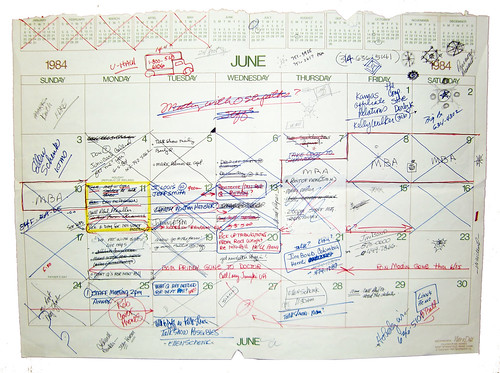
Desk Calendar (June 1984)

I’m pretty sure June 4, 1984, was my first official day at Learfield Communications. And since 25 years feels like something of a milestone, I’ve been trying to come up with something to post here to mark the date.

June, 1984

The calendar [larger image] above was on my desk that first month and means absolutely nothing to anyone that wasn’t around back then. And not much to the handful that was (Clyde, Roger, Bob), so I’ve annotated a few entries to jog their memories.

With good jobs hard to keep and harder to find these days, let the record show I am one lucky web boy. Can’t wait to see what the next 25 brings.

No more creating mass through scarcity

So you’ve got a TV station or radio station or newspaper with all this good “content.” The cost of producing it is already sunk so you put it on your website and sell some banner ads. Ch-ching. But it just isn’t working for a lot of “legacy media” and Terry Heaton explains why:

“The assumptions of any content play are that its value is so great that expensive, adjacent advertising will support it and that the mass attractive to advertisers can be created through scarcity. Neither of these assumptions is viable online, and the real problem is that both must be present for significant revenue to be realized.”

So what do we do?

“We should nurture our legacy products as best we can, but we simply must separate our ability to make money from our dependence on the content we create. The key to that is in defining, understanding and developing the Local Web.”

I added the bold in hopes that would help me understand what he’s saying. I think he’s referring to the content we are already creating. We have a story in the paper, we put it on the web. We have a good radio morning show, we stream it. And so on.

We can’t just “re-purpose” our existing content and expect to attract an audience that will be attractive to an advertiser. I think he’s right.

“creativity thrives on constraints”

The always insightful Amy Gahran poses a little thought experiment that I believe I’ve posted on a few times:

“What if social media (Twitter, Facebook, Delicious, Google Earth, etc.) were the only tool you could use to deliver the benefits of journalism to your community? You could still gather information however you choose (through in-person interviews, phone, Web, archive research, etc. — even social media), but you could only deliver your work via social media. How would you do it?”

I suspect this experiment is already out of the lab and we’ll see more and more examples. And I especially like the notion that “creativity thrives on constraints.” 140 characters. 30 sec of video. Boiling a story down to its essence.

My kind of war

I’ve read a lot news stories, blog posts and tweets this weekend, reminding everyone to remember the men and women who served and died in defense of our country. How best to do that? Little American flags? Those magnetic yellow “Support Our Troops” ribbons?

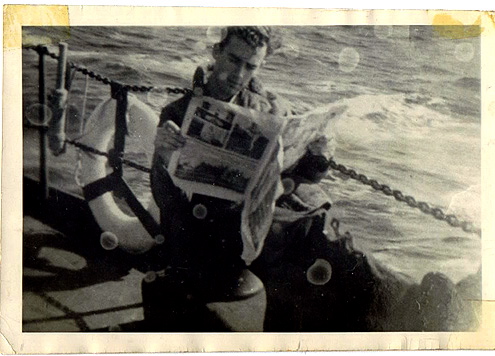
John MaysMy dad was in the Navy (a radio operator) and saw action in the pacific during WWII. He survived but never talked about it. To me or anyone else as far as I know. I do recall my mom telling me how relieved everyone was when it “started looking like we would win” the war. That was the first time I really understood it was possible for our country to lose a war. The movies always included some drama on that score but you knew the good guys would prevail. Not so for those who fought the thing.

Perhaps the best time to remember our men and women in uniform is before we send them off to fight and die. And if the cause isn’t just and right –whatever that means anymore– we don’t send them.

I grew up during the Cold War and I kind of miss it. If you think about it, a thermonuclear war is the only war where the politicians –who decide to go to war– might die in the first ten minutes. That is my kind of war.