Radio Iowa: The Blog, getting noticed

Allbritton Communications launched The Politico today. It’s a free tabloid with an estimated circulation of 25,000 aimed at political junkies and Beltway insiders, and its companion website.

The Politico has garnered attention by snagging high-profile journalists to run the paper. Two of The Washington Post’s top political journalists — editor John Harris and reporter Jim VandeHei — left to become The Politico’s editor-in-chief and executive editor, respectively. Reporters have been lured from Time, U.S. News and World Report and the New York Daily News, among others.

Ben SmithOne of these superstars, Ben Smith, is blogging and includes our own Kay Henderson (Radio Iowa) in “Ben’s Favorite Blogs.” Just the latest high-profile link love for the Bloggerista.

In this 2003 post, I included Kay in my list of “Blogs I Would Read if They Existed.” And now it does. And I do.

More The Politico here and here.

Relaunching news websites

Learfield NetworksOne of the first Learfield networks to have a website was Radio Iowa, our state news network in Iowa. That must have been around 1996 and it was created (using Frontpage) by Dan Arnall and Allen Hammock, a couple college guys we hired to help us figure out “this Internet thing.”

Dan and Allen went on to pursue new adventures a long time ago. And we’ve added lots of websites –for our company and for clients– since those early days.

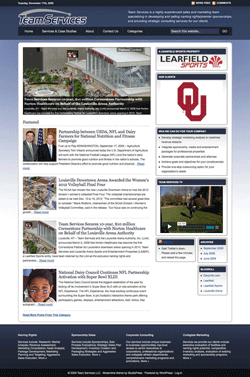
This week we relaunched RadioIowa.com. We relaunched WRN.com a about a month back and we’ll be putting up the new Missourinet.com in a couple of weeks.

Our news networks are pretty narrow in focus. We cover the legislature, state government and –with the help of our affiliates– news from throughout our respective states.

Our websites reflect that focus. State news and sports, with an emphasis on the sounds of the news. We are, first and foremost, radio networks. Our websites are designed to complement them. They are not high-traffic, destination sites. Time will tell if this strategy is the correct one. The next couple of years should be interesting.

Our new sites are very blog-like. At WRN.com, we blog the sports and our news director maintains a blog. At Radio Iowa, News Director O. Kay Henderson is generating a real following for her political blog.

Time will tell if I have taken us in the right direction with these sites. If you like what you see, email me and I’ll put you in touch with Andy Waschick, the man behind all of Learfield’s websites. If you don’t… please don’t tell me.

Very fast thumb typing


Because I don’t own a Blackberry or “smart phone,” I have not done any “texting” and have no thumb typing skills (I’m not even sure it’s called that). But many people are very adept at this, including Learfield’s own Tyne Morgan. Tyne is majoring in ag journalism at the University of Missouri and working part-time for one of our networks.

This little clip does not do justice to her amazing skill. She was keying –with one thumb– as fast as many people type with all ten fingers. And she doesn’t have to look at the keys. This might be more useful than the ability to make yourself invisible.

Thirty years of election coverage

The first election covered by The Missourinet (a network owned by the company I work for) was in 1976. News Director Bob Priddy orchestrated that first election night and every one since. Prior to The Missourinet, radio stations throughout the state focused on local races and relied on the wire services for news and numbers from throughout the state.

The Missourinet brought the sounds of election night from the state capitol and campaign headquarters throughout Missouri to the hometown audiences of our affiliates.

The technology has changed… and is changing… but insight and understanding Missourinet reporters bring to their election night coverage remains the focus of their reporting. Bob reflects on the past 30 years in this 10 minute video.

Interview: Dan Arnall, Business Editor, ABC News

Dan ArnallIn the mid-90’s (1996? 1995) I went searching for someone that could help our our company get online. Websites were a new thing and I didn’t have a clue where to start, so I called Mike McKean at the University of Missouri School of Journalism (not sure if he was a professor back then) and he said he had a student that was really sharp, had his own web page, and might be just what we were looking for.

I met with Dan who told me he and his best friend, Allen Hammock, had a company that could do just what we needed. I think the company was about 10 minutes old at that moment but we wound up hiring Dan and Allen (who became affectionately known as the Cyber Twins) to guide Learfield into the new digital age.

We got wet –like everybody else– when the Internet bubble burst and Dan and Allen moved on to pursue their careers. Dan, a graduate of the University of Missouri School of Journalism, kicked around in Seattle and San Francisco for a bit and then went back to to get his masters degree at Columbia University.

We chatted for half and hour earlier this evening, talking about his duties at ABC; the changing world of journalism and media; living in Manhatten and Brushes with Near Greatness (John Lithgow and Tony Danza). (AUDIO: 30 min, 10 meg MP3)

Technical Note: After screwing the pooch on a couple of Skype interviews, I’m proud to report this sounds pretty good. I was a tad hot but I didn’t lose the interview.

Google Juice: Blogs

Because of the way Google Page Rank works, blogs tend to rank higher than traditional websites (whatever that means in 2006). Most bloggers are well aware of this but it hit home for me this evening as I Googled “Learfield” …the company I work for. 105,000 search results. The corporate home page at the top, with the Learfield Sports “home” page (really a sub-page on the corporate site) at #2.

Coming in at #3 is the company blog, GrowLearfield.com. And it’s only been up for six months. Want more traffic for your business/association/organization? Make your home page a well-tended blog.

On a personal note, more and more of the people (from outside our company) with whom I come in contact, have found their way to smays.com. I confess that makes me a tad uncomfortable. If you drill down about three pages (nobody does) in that list of 105,000 “Learfield” results mentioned above, you’ll find smays.com.

Despite periodic disclaimers that this blog is in no way sanctioned by or officially connected to Learfield, I’m “out there” (just like George Costanza’s mother). Sort of like forgetting to remove your company windbreaker before getting the lap dance. You know nobody is looking at your jacket, but you’re aware you have it on.

PS: Yes, this post was prompted by the photograph of two (possibly) fornicating turtles.

Leveraging your customers (fans)

One of the ideas Seth Godin talks about (on his blog, in his speeches and in his new book) is turning your best customers into marketers. Make it easy for them to tell your story. One of the examples: The Beastie Boys gave digital cameras to fifty of their fans and invited them to film one of their concerts. They edited the best of these into a film.

I’m only remotely aware of who the Beastie Boys are but I love the idea. I’d love to try this with one of our sports properties. Some big rivalry might be fun (Missouri vs. Kansas?). The idea isn’t to get great play-by-play shots, but tail-gate fun, etc. I don’t know what you’d get but you announce that the resulting video will be on the Mizzou website (brought to you by Sponsor To Be Named?).

A lot of work? Sure. Big money maker? Maybe not. Lot of fun? Maybe.

Ivy League Long Tail

The company I work for owns (leases?) the multi-media marketing rights for some of the largest collegiate athletic programs in the country. So this story in USA TODAY about smaller colleges and conferences turning to the web to to deliver football and other sports, jumped out at me.

“Northern Arizona offered webcasts of home football games last year. Using the four cameras already set up to provide replays on the stadium scoreboard, the school added audio from their radio broadcasts along with continually updated statistics. Fans will be able to choose which team’s audio feed to which to listen. Games will be archived and can be downloaded to portable devices like Apple Computer’s iPod.

This fall, ESPN’s new online channel, ESPN 360, will show 30 football games, 10 of them, involving teams such as Virginia Tech, Purdue, Miami and Minnesota exclusively on that website. The site, available to about 6 million homes, will also have such features as chat rooms, statistics and online polls.

The schools don’t see the Web replacing television. Major conferences make millions of dollars from their football and basketball television contracts, but many also plan to webcast other sports, such as volleyball or swimming.


The Big Ten Conference announced plans this summer create its own cable channel for minor sports. The Big Ten Channel also will be available through the Internet, iPods, cellphones and other technologies.”


Note to Learfield Senior Management: Read The Long Tail to understand why and how this is happening and what it might mean for those of us at the “head.”

State radio networks

I spotted this in the monthly newsletter of StateNets (formerly the National Association of State Radio Networks): The Tennessee Radio Network has 66 full time (?) affiliates and only 11 have websites.

Of all the surveys and data and research I’ve read, this simple fact, unscientific as it is, speaks volumes to me about the radio business in 2006. If every one of your advertisers (okay, most of them) has some kind of online presence…why wouldn’t you?

In the same issue, Tom Dobrez –the head sales guy for the association– writes about “The New Media Blitz”:

“…we are all starting to feel its impact. A trip to 3 major markets in the last few weeks confirms the low level of respect radio is garnering from the nation’s major marketers. It’s just not hip. Its not now its so yesterday. The onslaughts have come from everywhere. First it was satellite radio, then Ipod and internet now its product placements etc. … It will be near impossible to get any media decision makers attention with spots only. The old way we sell it are GONE!”

Here’s my advice to my old StateNets buddies: Go down to the basement…set the Time Machine for 2000…and call me when you get there.

Web Content Strategist

For the past 6 or 7 years, I have been working with our company’s websites. Sometimes that means designing from scratch. Sometimes we outsource the design and/or development and I manage the project. I support usesrs –internal and clients– on various content managment tools. And a bunch of other stuff. And from the beginning, I’ve struggled with a title for this position.

Some of our folks introduce me as “web guru.” Hate that. Implies a level of mystical knowledge I will never posses. Same for “webmaster.” I’m not even the master of my domain.

I’ve used Online Editor and that’s not bad. Funky Web Monkey and Pile-Drivin’ Digital Daddy are fun but I’m really not funky nor a driver of pile. I fall back on “Web Guy” (Web Boy wasn’t working) from time to time.

Today, I spotted this title: Web Content Strategist. “Strategist” seems a bit grand but I do think a lot about what we’re doing and where we’re going with our growing number of websites. So, maybe.