
The God Theory

My interest in quantum theory, time and the relationship between consciousness and reality lead me to a book by Bernard Haisch titled The God Theory. (I’ve included a chunk of Dr. Haisch’s bio below). I include this post for my own reference.

“If you look up at the faint smudge in the night sky that is really the distant, huge Andromeda galaxy, you might see light that, from your point of  view, took two million years to traverse hat vast intergalactic distance before it was absorbed in your retina and registered as an image. For a beam of light itself, however, things look different. Instead of radiating from some star in the Andromeda galaxy and racing through space for two million years, every single photon sees itself, metaphorically speaking, as born and instantaneously absorbed in your eye. It is one simple jump that takes no time at all, according to the theory of special relativity. That’s because, in the reference frame of a particle traveling at the speed of light, all distances shrink to zero and all time collapses to nothing. From its own perspective, the photon of light leaps instantaneously from there to here because distance has no place in its existence. We can almost say that the photon was created because it had someplace to land and, in an instant, it jumped from there to here, even across two million light years of space from our perspective.”

“Bernard Haisch, Ph.D., is an astrophysicist and author of over 130 scientific publications. He served as a scientific editor of the Astrophysical Journal for ten years, and was Principal Investigator on several NASA research projects. After earning his Ph.D. from the University of Wisconsin in Madison, Haisch did postdoctoral research at the Joint Institute for Laboratory Astrophysics, University of Colorado at Boulder and the University of Utrecht, the Netherlands. His professional positions include Staff Scientist at the Lockheed Martin Solar and Astrophysics Laboratory; Deputy Director of the Center for Extreme Ultraviolet Astrophysics at the University of California, Berkeley; and Visiting Scientist at the Max-Planck-Institut fuer Extraterrestrische Physik in Garching, Germany. He was also Editor-in-Chief of the Journal of Scientific Exploration.”
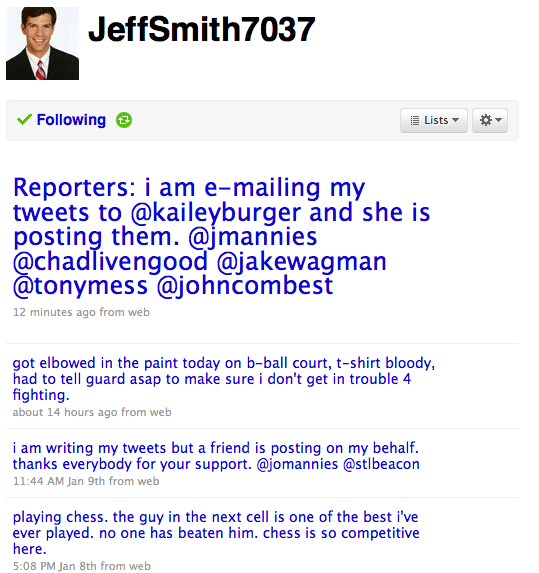
Tweeting from the slammer

I didn’t follow the story of the arrest and conviction of Jeff Smith last year. Here’s a couple of grafs from Wikipedia:

“Jeff Smith was a Democratic member of the Missouri Senate, representing the 4th district, covering the western portion of the City of St. Louis. On August 25, 2009 he pled guilty to two counts of obstruction of justice and resigned his seat. He admitted his involvement, and attempted cover-up, in two federal election law violations committed during his 2004 campaign for Congress.

Each conspiracy count is punishable by up to 20 years in prison and $250,000 in fines. He resigned effective August 25, 2009 and was sentenced to 1 year and a day of prison. He also was fined $50,000. His lawyer requested Smith be sent to a prison camp in Marion, Illinois.”

This morning I learned from @chadlivengood that Mr. Smith (@jeffmsith7027) is on Twitter. Seems Mr. Smith emails his tweets to a friend who posts for him.

I’m a curious why he has access to email but not Twitter? Anybody help me out with that? Would love to interview someone with the federal prison system who could illucidate.

Are there lots of federal prisoners on Twitter? Is there a list somewhere? What –if anything– does this say about social networking? Do prisoners within the same facility follow each other? Would it be tacky to do @fakejeffsmith feed with humorus tweets. Yes, I’m pretty sure it would.

Sivad is “Davis” spelled backward

Growing up in Kennett, Missouri, in the 50’s and 60’s, we got our TV from Memphis, 100 miles to the south. But we were blessed with a great selection of movies. One station, WHBQ, billed their offerings, “Million Dollar Movies.” And there was a great sub-set of horror movies (Dracula, Wolfman, Frankenstein, etc) presented as Fantastic Features. The Monster of Ceremonies was SIVAD, the only vampire with a hush-puppy southern accent.

How big was Sivad? He drew 30,000 fans to the Mid-South Fairgrounds, breaking the Beatles attendance record). You can learn more about Sivad and alter ego Watson Davis here.

Much thanks to Charles Jolliff for tipping us to this pop-culture flash-back.

Is this the future of advertising?

First, I am assuming this was a paid commercial. And I’m assuming Domino’s Pizza paid a premium. The ultimate “live read.” As I watched, I realized I was paying very close attention, trying to figure out what I was seeing.

Whose idea was this? The show’s writers? You damn well better have good writers if you’re going to try this. Was it Domino’s idea? Their ad agency?

My next thought was, this is a one trick pony. You can’t do this every night. Or even every week. But then it hit me, you wouldn’t need to. This segment had 100% of my attention. I clearly got the message that Domino’s Pizza was trying to make their product a lot better. I don’t need to see some mindless 30 second spot over and over.

This… whatever it is… didn’t insult my intelligence. It played to it in a tongue-in-cheek manner ideally suited to those who watch The Colbert Report. I have no trouble imagining an advertiser paying big bucks for this.

Mel Karmazin interview: “Fucking with the magic”

Mel Karmazin is the CEO of Sirius Satellite Radio. Before that he was head of CBS Radio. For most of his career he has been known as a “Wall Street darling” for his ability to drive up the price of his various companies’ stock. Don Imus frequently referred to him as the Zen Master. Let’s just say he knows a lot about radio and advertising. I was struck by his description of advertising and frank assessment that Google was “fucking with the magic.”

“I loved the model that I had then. At that point I had… I was the CEO of  CBS and I had a model where you buy a commercial… if you’re an advertiser you buy a commercial in the Super Bowl and, at that time, you paid two-and-a-half million dollars for a spot and had no idea if it worked. I mean, you had no idea if it sold product… did any good… I loved that model! That was a great model! And why …if I can get away with that model… if I’m in the business where I can sell advertising that way, why wouldn’t I want to do it?

No return on investment. And you know how everybody looks for return on investment? We had a a business model that didn’t worry about return on investment and then here comes Google. They screwed it up. They went to all these advertisers and said, we’ll let you know exactly what it is.”

Oooh. Reminds me of the old saw, “I know that only half of my advertising works, I just don’t know which half.” The full interview is worth a watch and confirmed my feeling that a real sea change (in advertising) is taking place.