
Tag Archives: time
Random Walk
 Author Lawrence Block on Random Walk: “Every now and then someone comes up to me at a speech or signing and says one of two things. ‘I’ve liked all your books,’ I’ll be told, ‘but there was one I couldn’t make heads or tails out of.’ Or just the opposite: ‘I’ve read most of your books, but there was one that really knocked me for a loop, and I’ve read it seventeen times now, and it’s completely changed my life.’ “It’s always the same book. Random Walk.”
I wrote the book in the spring of 1987, and never was a book more eager to be written. Paradoxically, never was a book less eager to be read–the advance sale was light, the reviews were venomous, and most readers never even knew the book existed. Now it’s getting a new lease on life, and I’m delighted. I don’t know that it’s time has come–it’s just as possible it’s time has come and gone. But I do know Random Walk has enormous impact on some of the people who read it, and I hope that now they’ll have a chance to find it.”
A few of my favorite passages: Continue reading
Thinking, Fast and Slow by Daniel Kahneman
Excerpts from Thinking, Fast and Slow by Daniel Kahneman. “The book’s main thesis is a differentiation between two modes of thought: “System 1” is fast, instinctive and emotional; “System 2″ is slower, more deliberative, and more logical.”
Most impressions and thoughts arise in your conscious experience without your knowing how they got there.
People tend to assess the relative importance of issues by the ease with which they are retrieved from memory — and this is largely determined by the extent of coverage of in the media.
I describe mental life by the metaphor of two agents, called System 1 and System 2, which respectively produce fast and slow thinking. The intuitive System 1 is more influential than your experience tells you, and it is the secret author of many of the choices and judgements you make.
We can be blind to the obvious, and we are also blind to our blindness.
When people believe a conclusion is true, they are also very likely to believe arguments that appear to support it, even when these arguments are unsound.
Cognition is embodied; you think with your body, not only with your brain.
A reliable way to make people believe in falsehoods is frequent repetition, because familiarity is not easily distinguished from truth.
Understanding a statement must begin with an attempt to believe it.
Contrary to the rules of philosophers of science, who advise testing hypotheses by trying to refute them, people (and scientists, quite often) seek data that are likely to be compatible with the beliefs they currently hold.
The world in our heads is not a precise replica of reality; our expectations about the frequency of events are distorted by the prevalence and emotional intensity of the messages to which we are exposed.
success = talent + luck
great success = a little more talent + a lot of luck
Our mind is strongly biased toward casual explanations and does not deal well with “mere statistics.”
We humans constantly fool ourselves by constructing flimsy accounts of the past and believing they are true.
You cannot help dealing with the limited information you have as if it were all there is to know. Our comforting conviction that the world makes sense rests on a secure foundation: our almost unlimited ability to ignore our ignorance.
In everyday language, we apply the word ‘know’ only when what is known is true and can be shown to be true. We can know something only if it is true and knowable.
For some of our most important beliefs we have no evidence at all, except that people we love and trust hold these beliefs. Considering how little we know, the confidence we have in our beliefs is preposterous — and it is also essential
Hindsight Bias – You cannot help dealing with the limited information you have as if it were all there is to know. Our comforting conviction that the world makes sense rests on a secure foundation: Our almost unlimited ability to ignore our ignorance.
A general limitation of the human mind is its imperfect ability to reconstruct past states of knowledge, or beliefs that have changed. Once you adopt a new view of the world (or of any part of it), you immediately lose much of your ability to recall what you used to believe before your mind changed.”
“The brains of humans and other animals contain a mechanism that is designed to give priority to bad news.”
Premortem – When the organization has almost come to an important decision but has not formally committed itself, Klein proposes gathering for a brief session a group of individuals who are knowledgeable about the decision. The premise of the session is a short speech: Imagine that we are a year into the future. We implemented the plan as it now exists. The outcome was a disaster. Please take 5 to 10 minutes to write a brief history of that disaster.
The Planning Fallacy – Most of us view the world as more benign than it really is, our own attributes as more favorable than they truly are, and the goals we adopts as more achievable than they are likely to be.
Optimistic individuals play a disproportionate role in shaping our lives.
Anyone who has been in the business world for a bit will recognize “the planning fallacy.” I just didn’t know it had a name.
When forecasting the outcomes of risky projects, executives too easily fall victim to the planning fallacy. In its grip, they make decisions based on delusional optimism rather than on a rational weighting of gains, losses, and probabilities. They overestimate benefits and underestimate costs. They spin scenarios of success while overlooking the potential for mistakes and miscalculations. As a result, they pursue initiatives that are unlikely to come in on budget or on time or to deliver the expected returns — or even to be completed.
In this view, people often (but not always) take on risky projects because they are overly optimistic about the odds they face. I will return to this idea several times in this book—it probably contributes to an explanation of why people litigate, why they start wars, and why they open small businesses.
How important is the CEO? – Because luck plays a large role, the quality of leadership and management practices cannot be inferred reliably from observations of success. And even if you had perfect foreknowledge that a CEO has brilliant vision and extraordinary competence, you still would be unable to predict how the company will perform with much better accuracy than the flip of a coin. On average, the gap in corporate profitability and stock returns between the outstanding firms and the less successful firms studied in Built to Last shrank to almost nothing in the period following the study. The average profitability of the companies identified in the famous In Search of Excellence dropped sharply as well within a short time.”
Availability cascade – William Eastery calls Daniel Kahneman’s Thinking, Fast and Slow, “one of the greatest and most engaging collections of insights into the human mind I have read.” I only mention this so I’ll have a reason to link to Professor Easterly’s review below. Tell me if this description of an “availability cascade” sounds familiar:
“An availability cascade is a self-sustaining chain of events, which may start from media reports of a relatively minor event and lead up to public’ panic and large-scale government action. On some occasions, a media story about a risk catches the attention of a segment of the public, which becomes aroused and worried. This emotional reaction becomes a story in itself, prompting additional coverage in the media, which in turn produces greater concern and involvement. The cycle is sometimes sped along deliberately by “availability entrepreneurs,” individuals or organizations who work to ensure a continuous flow of worrying news. The danger is increasingly exaggerated as the media compete for attention-grabbing headlines. Scientists and others who try to dampen the increasing fear and revulsion attract little attention, most of it hostile: anyone who claims that the danger is overstated is suspected of association with a “heinous cover-up.” The issue becomes politically important because it is on everyone’s mind, and the response of the political system is guided by the intensity of public sentiment. The availability cascade has now reset priorities. Other” risks, and other ways that resources could be applied for the public good, all have faded into the background.”
“The dominance of conclusions over arguments is most pronounced where emotions are involved. The psychologist Paul Slovic has proposed an affect heuristic in which people let their likes and dislikes determine their beliefs about the world. Your political preference determines the arguments that you find compelling. If you like the current health policy, you believe its benefits are substantial and its costs more manageable than the costs of alternatives. If you are a hawk in your attitude toward other nations, you probably think they are relatively weak and likely to submit to your country’s will. If you are a dove, you probably think they are strong and will not be easily coerced. Your emotional attitude to such things as irradiated food red meat, nuclear power, tattoos, or motorcycles drives your beliefs aboul their benefits and their risks. If you dislike any of these things, you probably believe that its risks are high and its benefits negligible.”
“A simple rule can help: before an issue is discussed, all members of the committee should be asked to write a very brief summary of their position. This procedure makes good use of the value of the diversity of knowledge and opinion in the group. The standard practice of open discussion gives too much weight to the opinions of those who speak early and assertively, causing others to line up behind them.
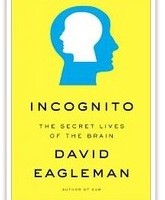
Incognito – The Secret Lives of the Brain by David Eagleman
It’s easy to think of “me” has “having” a brain, but this book left me thinking my brain has me. If there is a me apart from my brain, I fear it’s mostly along for the ride. Here are some ideas that brought out my highlighter.
 The brain generally does not need to know most things; it merely knows how to go out and retrieve the data. It computes on a need-to-know basis. pg 28
You’re not perceiving what’s out there. You’re perceiving whatever your brain tells you. pg 33
We have no access to the rapid and automatic machinery that gathers and estimates the statistics of the world. pg 34
Your brain is in the dark but your mind constructs light. pg 40
The difference between being awake and being asleep is merely that the data coming in from the eyes anchors the perception. Asleep vision (dreaming) is perception that is not tied down to anything in the real world; waking perception is something like dreaming with a little more commitment to what’s in front of you. pg 45
It’s easy to spot a hallucination only when it’s bizarre. For all we know, we hallucinate all the time. pg 46
Our expectations influence what we see. There has to be a match between your expectations and the incoming data for you to “see” anything. Awareness of your surroundings occurs only when sensory inputs violate expectations. pg 48, 50
The brain refines its model of the world by paying attention to its mistakes. pg 49
The brain tries to see the world only as well as it needs to. We are not conscious of most things until we ask ourselves questions about them. What we perceive in the outside world is generated by parts of the brain to which we do not have access. pg 54
Instead of reality being passively recorded by the brain, it is actively constructed by it. pg 82
There are thoughts you cannot think. pg 82
Evolution has carefully carved your eyes, internal organs,sexual organs, and so on — and also the character of your thoughts and beliefs. pg 82
“In general, we’re least aware of what our minds do best.” — Marvin Minsky, The Society of Mind
We are not able to see the instincts that are the very engines of our behavior. These programs are inaccessible to us not because they are unimportant, but because they’re critical. Conscious meddling would do nothing to improve them. pg88
Briefly glimpsed people are more beautiful. pg 92
We come to know our own attitudes and emotions, at least partially, by inferring them from observations of our own behavior. pg 134
David Eagleman is neuroscientist at Baylor College of Medicine, where he directs the Laboratory for Perception and Action.
The Great Mystery
“I regard the brain as a computer which will stop working when its components fail. There is no heaven or afterlife for broken down computers; that is a fairy story for people afraid of the dark.” — Stephen Hawking
“We’ll be alive again in a thousand blades of grass, and a million leaves, we’ll be falling in the raindrops and blowing in the fresh breeze, we’ll be glittering in the dew under the stars and moon out there in the physical world which is our true home and always was.” — His Dark Materials by Phillip Pullman
“You’re a collection of molecules and those molecules are made of smaller bits, and those bits are made of even smaller bits. The smallest bits in the universe are all identical. You are made of the same stuff as the concrete in the floor and the fly on the window. Your basic matter cannot be created or destroyed. All that will survive of what you call you life is the sum of your actions. Some might call the unending ripple effect of those actions a soul, or a spirit.” – The Religion War by Scott Adams
“When you die, it is said you see your whole life. But you don’t see it minute by minute, like a speeded-up film. It’s like everything you ever did in all your days was a brushstroke, and now you see the whole painting all at once.” — Lawrence Block’s Everybody Dies
I wonder how it all got started, this business about seeing your life flash before your eyes while you drown, as if panic, or the act of submergence, could startle time into such compression, crushing decades in the vice of your desperate, final seconds.
From The Art of Drowning by Billy Collins
You’re going to stay here for a week. Everyone gets a private room. Please feel at home. But while you’re here there’s one thing you must do. Out of the __ years of your life, we’d like to ask you to choose one memory, the one you remember and cherish most. There is a time limit. You have three days to decide. After you choose your memory, our staff will recreate it on film as exactly as possible. On Saturday we’ll show the films to everyone. The moment the memory comes back to you most vividly, you’ll go on to the other side, taking only that memory. — From the motion picture After Life
“Imagine that existence is like a sound recording. Listening to an old phonograph doesn’t alter the recording itself, and depending on where the needle is placed, you hear a certain piece of music. This is what we call the present. The music, before and after the song now being heard, is what we call the past and the future. Imagine, in like manner, every moment and day enduring in nature always. The record does not go away. All nows (all the songs on the record) exist simultaneously, although we can only experience the world (or the record) piece by piece. We do not experience time in which “Stardust” often plays, because we experience time linearly.” — Biocentrism by Robert Lanza (with Bob Berman)
“In spiritual terms the cycle of birth and rebirth is a workshop for making creative leaps of the soul. The natural and the supernatural are not doing different things but are involved in transformation on separate levels. At the moment of death the ingredients of your old body and old identity disappear. Your DNA and everything it created devolve back to their simple component parts. Your memories dissolve back into raw information. None of this raw material is simply recombined to produced a slightly altered person. To produce a new body capable of making new memories, the person who emerges must be new. You do not acquire a new soul, because the soul doesn’t have content. It’s not “you” but the center around which “you” coalesces, time after time. It’s your zero point.” — Deepak Chopra, Life After Death