James Arness

[See comment below]

When I heard that James Arness had died my first thought was, “How could he still be alive?!” It’s just that Gunsmoke was so long ago.

So I dug out this photo taken when Craig Watson and I “interviewed” the popular TV actor when he appeared at the Sikeston Bootheel Rodeo. KBOA news guys John Reeder did the recording and Craig (on the right) and I asked some questions. Marshall Dillon signed my Fanner 50 holster.

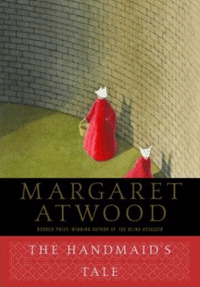
The Handmaid’s Tale by Margaret Atwood

I read The Handmaid’s Tale 25 years ago and it scared the crap out of me. It’s the story of “a future America under the violently oppressive rule of a far-right Christian sect. Women are back in the home and divided into domestic and reproductive functions, branded by coloured robes.”

If Tea Partiers read books this one would make them say “Hell yeah!” The rest of us cross our fingers and say, “It can’t happen here.” But it can, of course. We’re closer today than when the book was published.

BBC Interview »

Interview with William Gibson

My favorite author, far and away. Just finished his new novel, Zero History. Here are a few bits that caught my attention in the interview:

  • I find Twitter to be the most powerful aggregator of sheer novelty that humanity has yet possessed.
  • “I think the concept of “mainstream” is probably becoming archaic in some sense.”
  • “The mainstream is more digestible by osmosis”
  • “I wonder if we’ll ever have consensus (again)?”
  • “Generally, we don’t know what we were doing with something until we quit doing it.”
  • “When I see Glenn Beck –to the very small extent I do, if I can help it– it’s like Devo’s vision made flesh”
  • “I now write with the assumption that someone will google every unfamiliar word and term as they go through the book.”
  • “The footnote now lives in cyberspace, a click away”

Mel Karmazin interview: “Fucking with the magic”

Mel Karmazin is the CEO of Sirius Satellite Radio. Before that he was head of CBS Radio. For most of his career he has been known as a “Wall Street darling” for his ability to drive up the price of his various companies’ stock. Don Imus frequently referred to him as the Zen Master. Let’s just say he knows a lot about radio and advertising. I was struck by his description of advertising and frank assessment that Google was “fucking with the magic.”

“I loved the model that I had then. At that point I had… I was the CEO of  CBS and I had a model where you buy a commercial… if you’re an advertiser you buy a commercial in the Super Bowl and, at that time, you paid two-and-a-half million dollars for a spot and had no idea if it worked. I mean, you had no idea if it sold product… did any good… I loved that model! That was a great model! And why …if I can get away with that model… if I’m in the business where I can sell advertising that way, why wouldn’t I want to do it?

No return on investment. And you know how everybody looks for return on investment? We had a a business model that didn’t worry about return on investment and then here comes Google. They screwed it up. They went to all these advertisers and said, we’ll let you know exactly what it is.”

Oooh. Reminds me of the old saw, “I know that only half of my advertising works, I just don’t know which half.” The full interview is worth a watch and confirmed my feeling that a real sea change (in advertising) is taking place.

Who owns the interview?

I find this a very interesting question, asked and answered by Paul Bradshaw on E-Media Tidbits:

“Some time ago I was interviewed via e-mail for an article and, as I often do, after providing answers to the nine questions, I asked the following: “Mind if I republish these answers in full on my blog after the piece goes live?”

It turned out that the journalist actually did mind. In fact, in the correspondence that followed, the journalist explicitly refused me permission to publish my own answers before changing her mind and saying I could — but without the accompanying questions she had supplied. So who owns the interview?”

The thinking behind the question and Mr. Bradshaw’s post are worth a read for any reporter. And raise another question (in my mind):

Do I need your permission to publish an email you send me? Sure, it might be tacky… but once it hits my in-box, isn’t it mine, to do with as I please? Is there a legal answer to this question?

At a more pragmatic level, shouldn’t I just assume that anything I write and “release into the wild,” can and will wind up online? Are there enough lawyers to stop that?

Note to self: In the unlikely event someone asks to interview me, inform them that I reserve the option of publishing the full interview. If they don’t like that, don’t do the interview.