If the hype surrounding the iPhone hasn’t subsided yet, it will soon. Then what? Once the new has worn off this Next New Thing, will users still love ’em, or will they –like your mom’s cooking– be taken for granted. Or, worse yet, will the shortcomings (so well chronicled) become annoying and tiresome?
Those are some of the questions I hope to answer with a series of interviews I’m calling The iPhone Confessions. Brief visits with a few friends who took the iPhone plunge. Are they still gushing at the end of Week One? Or grumbling?
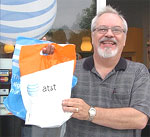
We’ll start with a visit with Tom Piper, a looonnnggg time Mac enthusiast and Early Adopter (LTMEEA). He was there when the iPhone was announced and in line to buy one of the first batch. The interview runs about 12 minutes.
In a recent interview with Mark Ramsey (Hear 2.0), marketing smart-guy Seth Godin talked about his new book, The Dip, and how some of the ideas therein apply to the future of radio.
Fifty years ago, Jerrell Shepherd mastered a form of broadcasting alchemy that turned small town radio lead into gold. It wasn’t much of a secret, however, since he readily shared it with countless radio station owners and managers who made the pilgrimage to Moberly, Missouri, in hopes of bringing some of Shepherd’s sales and programming magic back to their stations.
While most small market broadcasters were content to get “their fair share” of local advertising budgets (the bulk went to the local newspaper), Shepherd’s sales reps were trained to ask for it all and believed in their hearts they deserved it.
Mr. Shepherd’s approach to programming his stations was deceptively simple: report anything and everything that happened in each of the communities covered by his stations’ signals. The KWIX and KRES “Red Rovers” showed up just about every high school football game, junior high choral concert and chamber of commerce ribbon-cutting. And the Shepherd stations put it all on the air. Always with local sponsors. Lots of local sponsors.
Dave Shepherd grew up in the radio business and built on his father’s success, growing The Shepherd Group to 16 stations before selling them to a Florida-based company called GoodRadio.TV, for $30 million earlier this year.
I got Dave on the phone for a little chat and he talked about where small market radio has been… and where it’s going. He shared some thoughts on the Internet, iPods, HD, satellite and Google Radio.
He says he decided to sell because it just wasn’t as much fun as it used to be. And, in the next breath, he wondered if some of his father’s small town magic might work in The Big City.
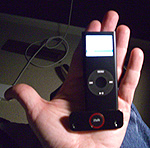
One of my rationalizations for buying a new iPod nano was the Voice Memo feature. Plug a mic in and record directly to the iPod. I had no idea how well this would work until tonight when I plugged in a tiny little mic called the iTalk Pro from Griffin Technology.
Pops into the bottom of the iPod and records in mono or stereo. The interface on the iPod is a wonder of simple design.
I’ll let you decide on the quality but I can certainly imagine recording an interview with this delightful little gadget. And I’ve always got the nano with me anyway, so…
In July, my old friend Dan Shelley left WTMJ in Milwaukee and moved to New York as Executive Editor of Digital Media for WCBS-TV. I spoke with him this morning about digital media, journalism, blogging, radio, life in NY and riding in the elevator with Andy Rooney. Dan is pumped about his new job and living in Manhattan.
Dan offered this warning to broadcasters: “If you don’t do more than just stick your toe in the water, if you don’t plunge head-first and totally immerse yourself in the digital media future, and do it now, you will die.”
For those that might have missed it, I interviewed Dan in May, 2005, right after he took over as chairman of the Radio and Television News Director’s Association. He talked the “digital talk,” and now he’s “walking the digital walk.”

 Those are some of the questions I hope to answer with a series of interviews I’m calling The iPhone Confessions. Brief visits with a few friends who took the iPhone plunge. Are they still gushing at the end of Week One? Or grumbling?
 Fifty years ago, Jerrell Shepherd mastered a form of broadcasting alchemy that turned small town radio lead into gold. It wasn’t much of a secret, however, since he readily shared it with countless radio station owners and managers who made the pilgrimage to Moberly, Missouri, in hopes of bringing some of Shepherd’s sales and programming magic back to their stations.
 One of my rationalizations for buying a new iPod nano was the Voice Memo feature. Plug a mic in and record directly to the iPod. I had no idea how well this would work until tonight when I plugged in a tiny little mic called the iTalk Pro from Griffin Technology.