
“Shovelware,” “repurposing” and facing reality

Found an interesting idea at “Teaching Online Journalism”:

“It is time to stop talking about repurposing and instead to start a discussion on how to re-imagine journalism.”

She proposes a radical (but obvious) shift in priorities:

“What some newsrooms (e.g., The Atlanta Journal-Constitution) have done is turn the workflow around — in a way that makes sense when the number of subscribers to the print product is decreasing and the number of online visitors is increasing: Make “Web first” the rule, in all cases. Produce for online, write for online, shoot for online, design for online. And then “repurpose” for the dying media — the print newspaper and the local TV newscast.”

Dying media?! Yikes! I don’t want to be in the staff meeting the first time someone blurts that out.
Vacation calculus and parenthood

“…most vacations are about memory upgrades. You become a different person after each trip, literally, as your brain takes on new shapes and chemistry from each experience. I think the selective memory phenomenon is what makes three bad days of planning and travel a worthy trade for two good days of actual vacation.” — Scott Adams

I’ve long held to a similar theory about parenthood. One might dislike everything associated with being a parent… might even dislike children… yet the second their child is born, they change. “I can’t explain it. You’d have to be a parent to understand this feeling!”

The common explanation is that the blessed event transforms you and erases any previously held notions you had about children and parenthood. I believe it has more to do with the species protecting itself. If the new parent did not change… well, you can finish the thought.

And even then, I wonder how many parents –in some dark corner of their hearts– occasionally wonder, “If I had it to do over again…”

But there are no do-overs in this game. So I hope every parent gets that molecular make-over that transforms them into loving, caring parents.

Fallout shelter radio ads

I remember well the back-yard fallout shelter craze (mania?). The family that lived behind us had one. It was clearly large enough for just one family but it was considered uncool to talk about who would live and who would die. And we lived in the landing approach path to the Strategic Air Command base in Blytheville, AR. Generally considered a prime target for a Russki ICBM.

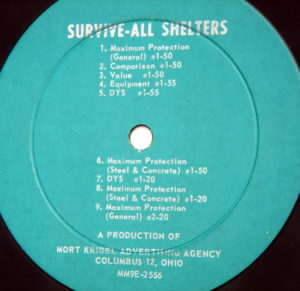
The nice folks at DinosaurGardens.com have posted some creative radio spots for Survive-All Fallout Shelters. (“Civil defense approved, FHA approved, no money down, five years to pay!”)

  1. Maximum Protection (General)
  2. Comparison
  3. Value
  4. Equipment
  5. DYS
  6. Maximum Protection (Steel and Concrete)
  7. DYS (short)
  8. Maximum Protection (Steel and Concrete) (short)
  9. Maximum Protection (General) (short)

Interview: Jason Rodgers, Fez-o-rama

RogersWith one of his custom designed fezzes sitting comfortably on my head, I got Jason Rodgers on the Skype horn today to find out the story behind the fezmonger and Fez-o-rama.

Some are born to the fez, others are called. I believe Jason falls into the latter group. I was surprised –don’t ask me why– to learn that Jason is trained in fashion design and might have written a text book or two.

I asked him about celebrity clients, his favorite designs, The Cult of the Eye, his fictional partner, “Joe,” and ukuleles.

AUDIO: Interview with Jason Rogers 11 min MP3

Jason is the newest member of The Royal and Exalted Order of the Fez.

“If the news is that important it will find me.”

This just in… the young process information differently. According to this story at NYT.com,

“…younger voters tend to be not just consumers of news and current events but conduits as well — sending out e-mailed links and videos to friends and their social networks. And in turn, they rely on friends and online connections for news to come to them. In essence, they are replacing the professional filter — reading The Washington Post, clicking on CNN.com — with a social one.”

“A December survey by the Pew Research Center for the People and the Press looked at how media were being consumed this campaign. In the most striking finding, half of respondents over the age of 50 and 39 percent of 30- to 49-year-olds reported watching local television news regularly for campaign news, while only 25 percent of people under 30 said they did.”

“Rather than treating video-sharing Web sites as traditional news sources, young people use them as tools and act as editors themselves.”

One quote in the story really jumped out at me:

“If the news is that important, it will find me.”

What does this mean for those of us in the news business?