
Good use of Web 2.0 tools by non-profit

One of the clients we work with is Missouri Children’s Trust Fund. It’s a non-profit that works with “partners” throughout the state to try to prevent child abuse and neglect.

When we started working with them a couple of years ago, they had an awful website that took days or weeks to update. They trusted us enough to scrap it and move to a blog (a scary word back then). Since then they’ve become master of their digital domain.

Their annual conference is underway and Kirk Schreiber –the executive director– has been posting updates to Twitter and –with a little help– posting photos from his iPhone.

Yesterday he whipped out a tiny digital recorder and did an interview with one of the keynote speakers for an upcoming podcast.

CTF and Missouri KidsFirst –a companion organization– have very small staffs but they’ve tapped into these web tools to tell their stories and they’re doing it themselves, for little or no cost.
Old growth media and the future of news

I’ve never been worried about the future of news but I couldn’t quite imagine what it will look like as old business models stop working. Steve Berlin Johnson –speaking at the South by Southwest Interactive Festival in Austin last week– sees today’s media as “…closer to a real-world ecosystem in the way it circulates information than it is like the old industrial, top-down models of mass media.”

“So this is what the old-growth forests tell us: there is going to be more content, not less; more information, more analysis, more precision, a wider range of niches covered. You can see the process happening already in most of the major sections of the paper: tech, politics, finance, sports. Now I suppose it’s possible that somehow investigative  or international reporting won’t thrive on its own in this new ecosystem, that we’ll look back in ten years and realize that most everything improved except for those two areas. But I think it’s just as possible that all this innovation elsewhere will free up the traditional media to focus on things like war reporting because they won’t need to pay for all the other content they’ve historically had to produce.”

And near the end of his speech, this warning:

“We’re going to spend so much time trying to figure out how to keep the old model on life support that we won’t be able to help invent a new model that actually might work better for everyone.”

Pew: State of News Media

TV consultant Terry Heaton offers his take on the latest “State of the News Media” report from Pew (Project for Excellence in Journalism) and offers a few predictions:

  1. It’s gone and it’s not coming back. Acceptance of this is the beginning of reinvention.
  2. Future revenue is about enabling commerce, not about serving advertising adjacent to or as an interruption of “content.”
  3. Journalism will survive the death of its institutions.
  4. Most journalists will be independent and work for whoever pays them the most, on a non-exclusive basis.
  5. Journalists will develop and exploit niche specialties.
  6. “The News” will be fast, transparent and authentic.
  7. Anchors will become mostly obsolete, like other middlemen that the Web routes around. I simply can read faster than I can have it read to me. Those that remain will be live hubs that filter multiple content inputs.

From the reports intro:

“There are growing doubts within the business, indeed, about whether the generation in charge has the vision and the boldness to reinvent the industry. It is unclear, say some, who the innovative leaders are, and a good many well-known figures have left the business. Reinvention does not usually come from managers prudently charting course. It tends to come from risk takers trying the unreasonable, seeing what others cannot, imagining what is not there and creating it.”

Will Ferrell’s “You’re Welcome America”

Even HBO was unwilling to air “You’re Welcome America: A Final Night with George W. Bush” in prime time. Perhaps it was the giant photo of a penis Will Ferrell kept calling up on the screen behind him.

But if you weren’t offended by the last eight years, you’ll be okay with this amazing one-man show. Ferrell was at his raunchy best. As funny as he could have been during his SNL salad days if he could have shrugged “fuck it” when appropriate.

It was difficult to distinguish which words actually came from W’s mouth and which were pulled from Ferrell’s very funny ass. So difficult in fact, the word TRUE would be flashed on the big screen to help us know the difference.

As with Oliver Stone’s W., I came away feeling more sad for #43 than mad.

Eagles concert

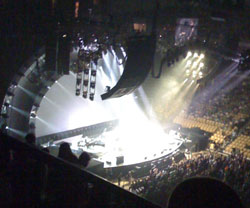
The Eagles provided the soundtrack for an important period in my life. Equally true, I assume, for others in the audience at last night’s Eagles concert. A lady sitting near us wasn’t born when the Eagles hit it big, but grew up listening with her parents.

The boys had to strain to hit a few of the notes but the memories were picture perfect. I like to think it’s more than Boomer nostalgia that keeps filling auditoriums for Stones and Eagles concerts. Which of today’s big artists will still be filling the seats in thirty years?

This photo was taken from the Cessna 350 as we flew over. But I’m not really complaining. We could see the jumbotron screens and music was loud enough, even from a couple of thousand feet.

It was a good show. The guitar licks alone would have been worth the price of the ticket.