“The audience is being assembled by the audience”

NYU professor and Internet thinker Clay Shirky on the future of accountability journalism in a world of declining newspapers. On the advertising-based business model of journalism:

“Best Buy was not willing to support the Baghdad bureau because Best Buy cared about news from Baghdad. They just didn’t have any other good choices.”

On the death of the home page:

“The number of people who go to the Times’ homepage as a percentage of total readership falls every year — because you don’t go to the Times, you go to the story, because someone Twittered it or put it on Facebook or sent it to you in email. So the audience is now being assembled not by the paper, but by other members of the audience.”

You can listen to Professor Shirky’s talk here.

Local bank phished. Again.

I received this text message last night. It never occurred to me it was anything but a scam. You call the number and some social engineer asks you for all kinds of questions about your accounts. And, yes, some number of clueless folks apparently called the number. I’d kind of like to know how they got my mobile number. Probably not that difficult. This same bank got hit by an email phishing scam a year or so back.

“Advertising Agencies and Social Media: A Culture Clash”

For some years I have sensed a fundamental shift in how we –the consuming public– feel about advertising. The following is from a post by Jason Falls. [Alas, the original post is gone.] I was tempted to just repost the piece in its entirety. He begins with the philosophical differences between advertising and social media:

“Social media is, in many ways, the antithesis of advertising. Advertising is one-way communications aimed at large groups of consumers. Social media is two-way communications that requires listening as well as speaking. It can also be said that social media is a multiple-way communications method as brands can speak and listen, but also watch other consumers talk to each other. An agency’s creatives and strategic planners suddenly having to factor in listening and observing to their communications process after decades of just shouting from the roof tops presents a seismic culture shift.

Social media is also about building relationships. Advertising is about driving people to a buying decision. In fact, I would propose that in most cases, advertising has nothing to do with a relationship. It’s all about persuading someone to take action, not discussing the decision-making process and becoming a trusted resource for the person choosing. As Chris Heuer says, good marketing today doesn’t try to sell the customer on something. It tries to help them buy it.

Similarly, it can be said that the essence of social media, in many ways, is good customer service. I would propose that, with exceptions certainly, advertising agencies have never cared about serving the customer. They care about making the sale. Advertising is most often used to drive customers to purchase, not care for them after the fact.

So, philosophically, advertising and social media are very different. Creatives, client services folks, account planners and the like are being asked to undertake a new method of communications that runs counter to everything they’ve ever been taught.”

A small shop within our company has been providing social media services to clients for a couple of years and it immediately became clear to us why advertising agencies weren’t keen on producing social media content for their clients. Again, Mr. Falls:

“Content creation also doesn’t scale well and is problematic for billing. Let’s say you have 20 brands producing social media content and you hire two people to produce that content. Depending upon the brand, audience and strategy, if they’re doing a good job, they’re producing an average of a blog post, Facebook content, several Tweets and perhaps video, images or some other type of content for each client every day. Can you write 10 blog posts in a day?

And how about this billing scenario: Let’s say a full-time agency employee producing content for a client is working 10 hours per week on that client’s social media efforts. They’re billed out at roughly $75 per hour. At that rate, which is conservative in price and volume, you’re billing $36,000 per year for their services as an agency. At the same time, you can go out and pay free-lance bloggers $25 per post (and that’s on the high end in most circumstances) and produce a similar volume of content for $6,500 per year (a blog post per day, five days per week, which is an aggressive clip for many agencies). How will you answer your client when they call you with a big, “WTF?”

If you are remotely involved in “old media” and/or advertising, I encourage you to read Mr. Fall’s complete post.

Something we want and couldn’t have before

A thoughtful essay on “content” and publishing by Paul Graham

“I don’t know exactly what the future will look like, but I’m not too worried about it. This sort of change tends to create as many good things as it kills. Indeed, the really interesting question is not what will happen to existing forms, but what new forms will appear.”

“When you see something that’s taking advantage of new technology to give people something they want that they couldn’t have before, you’re probably looking at a winner. And when you see something that’s merely reacting to new technology in an attempt to preserve some existing source of revenue, you’re probably looking at a loser.”

Emphasis mine.

Websites: Fast, easy, inexpensive

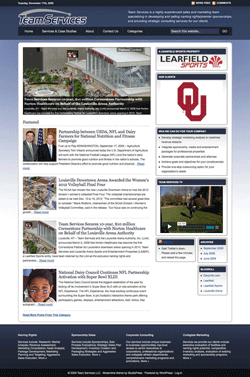
A couple of weeks ago I got a call from one of the guys in our Minnesota office. He wanted a website to serve the advertisers of one of our networks. Said he didn’t really have a budget and he’d like to have it by the first home game, to be played in a brand new stadium (just over a week away). They were going to have lots of photos and didn’t have a good way to share them with fans and sponsors.

I purchased a WordPress theme (from Studio Press) for $65 and paid another hundred or so to have it customized (thank you, Rebecca). Ten days later the site was up and running (still adding content, obviously).

I’ve been at this long enough to be amazed that I could give the guy a credible website for $200 in a week-and-a-half. AND because it’s WordPress, he –or one of his interns– can update this site thorughout the season. I remember when this would have taken months and cost thousands of dollars.

One never has enough clever people

I don’t think of myself as clever but it is something to which one might aspire. This article at FinancialPost.com identifies the attributes of clever and why organizations need such folk:

“The truth is that organizations need a particular kind of clever employees — people with a propensity for innovation and even iconoclasm. People who happily tread on organizational sacred ground while seeking new ways to produce sustained economic growth.

Clever people are highly talented individuals who have the potential to create disproportionate amounts of value from the resources that an organization makes available to them.”

And how does one spot a clever boy or girl?

  • They know their worth (their skills are not easily replicated).
  • They ask difficult questions.
  • They are organizationally savvy.
  • They are not impressed by corporate hierarchy.
  • They expect instant access to decision makers.
  • They are well connected outside of their organizations.
  • Their passion is for what they do, not for who they work for.
  • Even if you lead them well, they won’t thank you.

Learfield’s “kitchen conference room”

Learfield McCarty Street

When I started at Learfield Communications in 1984, the business was operated from a 3-story brick house on McCarty Street in Jefferson City, MO. The rooms were jammed with desks and partitions and the kitchen was the “common area.” In this photo (below), you see Clyde, Clarice Brown, Bob Priddy (all still with us) and a few others.

McCarty St Kitchen

This image captures that time very well. There was very much a family feel to the company. The days of high-tech conference rooms were many years in the future. This is one of several images I scanned from a contact sheet (thus the poor quality). The original prints are undoubtedly buried in a box in some closet.

The Handmaid’s Tale

“The Handmaid’s Tale is set in the Republic of Gilead, a country formed within the borders of what was formerly the United States of America by a racist, chauvinist, nativist, theocratic-organized military coup motivated by an ideologically-driven response to the pervasive ecological degradation of the land, widespread infertility, and attendant social dislocations. Beginning with a staged terrorist attack killing the President and ousting Congress, the coup leaders launched a revolution which overthrew the United States government and abolished the US Constitution. The new theocratic military dictatorship, styled “The Republic of Gilead”, moved quickly to consolidate its power and reorganize society along a new militarized, hierarchical, compulsorily-Christian regime of Old Testament-inspired social and religious orthodoxy among its newly-created social classes.”

Plot summary of The Handmaid’s Tale, by Margaret Atwood (Wikipedia). Sound familiar? Published in 1985.

Casting call for actors and zombies

“Collapse,” a SAG feature film from Iowa-based production companies Iowa Film Production Services/Storybench, will be casting in Coralville Sunday for feature parts, extras and zombies.

Open call with PMS Casting of Pella will be noon to 5 p.m. at production office 805 Second Street, Coralville (the old Scandinavian Design building across from Dairy Queen.)

Principal photography begins Sept. 30 and will run for five weeks in Johnson and Iowa counties. Compensation for speaking parts is equivalent to SAG low-budget scale of $268/day.

Non-agented actors can email a small photo in jpeg format to pmsfilmcasting@aol.com with resume and contact information.

This is Storybench’s third feature, following “The Offering” and “Splatter.” “Collapse” was written by Ottumwa’s Mike Saunders and will be directed by Saunders and fellow Ottumwan Jason Bolinger. Producing is Bruce Heppner-Elgin of Washington.

Characters being cast include:

ROBERT MORGAN – in his 40’s. A care-worn farmer doing his best to take care of his family. Teetering on the edge of losing his farm and dealing with a sick wife, his world is spinning out of control. When the zombies begin to attack the farm, he deals with them brutally and efficiently.

MOLLY MORGAN – Robert’s much-loved wife suffers from spells of pain and exhaustion. She is a loving, dutiful wife and mother but the stress is becoming too much for her.

WILL MORGAN – 13-14 years old and doesn’t quite fit in at school. A quiet child who feels a great deal of responsibility toward his family. Tired from the burden of helping his father and Hank with the farm chores and distracted by his parent’s absence in the stands, he loses his track event.

HANK – Mid-late 20’s, Hank has worked for the Morgans for about 10 years and is more like family than a farm hand. He is a surrogate big brother to Will. Tough and loyal, he is forced to give notice because he has his own bills to pay.

COACH BELL – Female, athletic and fit in her 40’s-50’s, she recognizes that Will is a kid in trouble and needs encouragement. Coach Bell speaks with his parents about her concerns for Will.

Dr. CHARLES MCFARLAND – Small town doctor in his 40’s. A contemporary of Robert’s, he knows that Molly’s illness is not something he can treat and tries to convince Robert to take Molly to a psychiatrist.

NURSE -30’s – She runs Dr. McFarland’s office and is efficient, yet motherly. Fits well into this small farming community and probably knows everything about everybody.

SHERIFF RHODES – Rough and tough local guy who has spent his entire life in this community. Late 40’s -early 50’s, he was probably a high school football hero in his youth. Rhodes is good at keeping his small town running smoothly because he knows everybody and is fair to them all. He wears cowboy boots and an exterior gruffness.

DEPUTY COOPER: An average nice guy in his mid-late 20’s. Single and easy going. Likes the relative peace of working in a small town and never thought he would have to deal with anything like this.

DANA – Just out of high school, Dana is a small town girl who attends community college and works at the local convenience gas mart. Robert rescues her but is later forced to kill her when she is bitten.

MR. LYNN A prosperous neighboring farmer in his 60’s, Mr. Lynn is losing his sight. Molly reads to him on occasion. When he hires Hank away from the Morgan farm, he adds to Robert’s troubles.

EDGAR HENNENLOTTER – A banker in his late 20’s. Because he is a city boy with a business degree, he considers himself to be better than the farmers his bank serves and has an air of arrogance and insincerity about him.

For more information visit PMS Casting’s web site.

New release that came into one of our newsrooms a couple of days ago. Golly, but I’d love to make up to Iowa just two talk with those waiting to audition. I mean, how does “Dana” feel about being “forced to kill her when she is bitten?” Or, how does “Robert” plan to deal with the zombies “brutally and efficiently?”

If you see this movie, leave us a comment.