
“… we’re in the midst of a massive global reinvention. Not just a shift from analog to digital, but a shift from centralized control to distributed systems. From isolated single user experiences to a global social fabric. These mobile devices are the of Gutenberg presses of our generation. This is not a bubble, this is a revolution.” – Blog post
1Password
With more 120 logins and passwords to keep up with, a post-it note on the side of my monitor just doesn’t cut it. As for using one password for ALL of my accounts… I won’t dignify that with a comment. This little (6 min) tour doesn’t begin to do justice to 1Password, the Best of Category.
paper.li
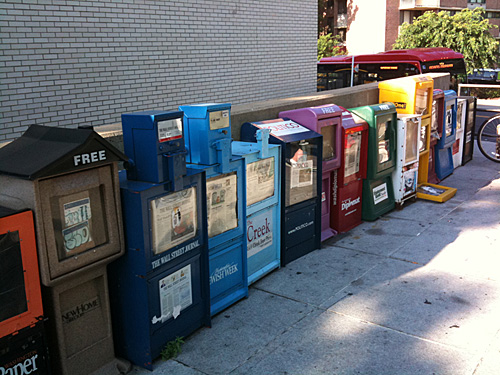 I LOVE Twitter. It’s where I follow the insights and links of 131 like-minded souls. I tweet with some regularity but it’s the sum of these parts that makes Twitter so valuable/interesting to me.
paper.li compiles all of those tweets into a daily “paper.” While I prefer to follow my Twitter stream on my iPhone app or Tweeti on the MacBook, paper.li offers a better answer to: “What do you see in Twitter?!”
It’s like having 131 hand-picked editors, commentators and comedians, continuously scouring and curating the web just for me.
“How to make trillions of dollars”
David Cain is (Raptitude) helping me (and many others) “get better at being human.” In this post he explains how television has been used by “very-high-level marketers” to create a nation of people who typically:
- work almost all the time
- absorb several hours of advertising every night, in their own homes
- are tired and unhealthy and vaguely dissatisfied with their lives
- respond to boredom, dissatisfaction, or anxiety only by buying and consuming things
- have disposable income but can’t find a more fulfilling line of work without losing their health insurance
- create health problems for themselves, which can be treated with drugs they can “ask their doctor about”
- own far more items than they use, and believe they don’t have enough
- are easily distracted from the unhealthy state of their lives and their culture by breaking news and celebrity gossip
- perpetually convince themselves it is not the right time to make major lifestyle changes
- happily buy stuff that breaks within a year, and which nobody knows how to fix
- have learned, through the media’s culture of blame-mongering, that the key to solving public and private issues is to find the right people to hate
Wow. Sound like anyone you know?
I’m trying to stop watching the evening network news. A tough habit to break. It’s been part of my life since… well, since the beginning of network news. Thanks to DVR technology I can skip all the adds to which Mr. Cain refers.
My friend (and one of the 5 smartest guys I know) Henry has eliminated “news” completely. Or so he says. I’m not sure how one does that. But if anyone can, it’s Henry. He makes a compelling case that knowing the news adds nothing to his life. He’s very well (selectively?) informed, so…
The excerpts above don’t tell you much about “how to make trillions of dollars” so I encourage you to read the full post if that’s something you’d like to do.
Dave Winer’s advice to Keith Olbermann
This post doesn’t depend on knowing who Dave Winer or Keith Olbermann is (are?). It’s about media and brand. My favorite part of Mr. Winer’s advice:
“…the future of communication is not about the bottleneck that MSNBC and their competitors control. I don’t think you really need them. Unless of course you need to make $5 million a year, in which case you probably do need them. But if what you’re interested in is power to influence public opinion, and becoming more relevant over time, not more niched over time — if being influential is what you’re about, they really did you a favor.
So here’s what I recommend. Borrow a page from Conan O’Brien’s playbook, and use the social network to communicate with your fans.
Get a video camera and put it in your living room or den at home. Hit Record. Sit down in front of the camera and rant for 15 minutes. You can do that, I’m sure. Then without any production at all, upload it to YouTube and send the link around on Twitter. The first time you do it, it will be the most watched video of the day. Far more people will see it than used to see you on MSNBC, or O’Reilly or Beck or any of them. Depending on how fresh and interesting it is, and how real it is, and how compelling you really are (I know that’s a lot of “depends”) there won’t be much of a dropoff on Day 2 and 3 and so on. Now you’ve got your own network. And no one can shut you down. And you’ll have a lot more people watching you.”
Leo Laporte has done such an amazing job of this. Same for Arianna Huffington, and I’m sure there are others that don’t come to mind. Begs the question: Who owns the Keith Olbermann brand? MSNBC/Comcast? Or Keith Olbermann? Who owns your brand? Have you established a brand? What is it and where can I find it?
“The Viral Me”
In The Viral Me (GQ), Devin Friedman heads to Silicon Valley for a closer look at social networking. Don’t let the length of this piece scare you off, it’s worth the read. A few of my favorite ideas:
“Your smartphone is now, or will be, your basic interface with the world.”
—
“I think old people like me (I’m 38) often do this stuff (social media) to feel like the world hasn’t yet left them behind, but we don’t have any natural hunger for it. It’s kind of like androids having sex: We know we’re supposed to do it, but we’re not really sure why. Meanwhile, and infuriatingly, we know that humans just like to bone.”
—
“(Silicon Valley) might be the last place in America where people are this optimistic. The last place in America where people aren’t longing for a vague past when we were the shit.”
—
“Flood the social layer with information you want out there about yourself.”“If you’re confused by the term social layer, think of the word layer as meaning “lens.” The social layer is one lens you can look through to see the content of the Internet. Who you’re connected to, what they’re connected to, what they like and don’t like.”
—
“More and more people are going to have careers where they move from one thing to another fairly publicly. And what people are really investing in is your track record. Your brand. What you do and what you say and what you think are just as important as your skills.”
—
“An open society isn’t one where people have access to the real you. It is simply providing access to the identity you very carefully construct for human consumption.”
—
“I believe that more people are going to work for themselves, and more people are going to do what they’re passionate about. … What we’re talking about is monetizing passion. Monetizing authority.”
I can’t wait for people my age to get the fuck out of the way. Die, retire, whatever. Admit that you don’t get it and probably won’t get and make room for the bright young men and women who live the ideas expressed in this article.
Neuromarketing
Blipverts from Max Headroom’s world (“20 minutes into the future”) grows more real every day. From The Ego Tunnel by Thomas Metzenger:
“Today, the advertisement and entertainment industries are attacking the very foundations of our capacity for experience, drawing us into the vast and confusing media jungle. They are trying to rob us of as much of our scarce resource (attention) as possible, and they are doing so in ever more persistent and intelligent ways. Of course, they are increasingly making use of the new insights into the human mind offered by cognitive and brain science to achieve their goals (“neuromarketing” is one of the ugly new buzzwords). We can see the probable result in the epidemic of attention-deficit disorder in children and young adults, in midlife burnout, in rising levels of anxiety in large parts of the population.
New medial environments may create a new form of waking consciousness that resembles weakly subjective states — a mixture of dreaming, dementia, intoxication, and infantilization.”
Time travel companion wanted
The following listing recently appeared on the Springfield, MO Craigslist:
“I have a functioning time machine (i know it sounds unbelievable, but I assure you it works) that I need a 2nd person to operate with me. I’m looking for someone who is adventurous and reliable. Preferable a male; or a female that can do heavy lifting. I am leaving on January 20, 2011 , in the morning and plan to return February 3,2011. I am going to June 1983 to handle some business.
If you are serious about time travel and are reliable, then please contact me. You do not have to pay anything, but you would have to provide someone to watch my cat for the time we are gone. The only qualifications needed are that you are reliable and that the circumference of your head is no more than 64cm.
We will be leaving from Springfield,Mo. Let me know if you want to go with me.”
My friend David Brazeal responded:
I stumbled upon your advertisement on Craigslist on the afternoon of January 20, 2011 — too late to join you on your excursion into the past.
Fortunately, having dabbled in time manipulation myself in the late 1830s, I was able to travel to January 17th, one day after you posted your listing, from which time I am responding.
I am both reliable and adventurous, and well-acquainted with 1983, having spent that summer as an intern in the State Department’s Office of Botswanan Affairs. In addition, I have an elderly aunt who loves cats.
Regarding your qualification that my head be less than 64cm in diameter, I assure you that, although my head is slightly too large for a standard time travel headpiece, I have crafted an adapter from a 1960s Oster beauty-salon hair dryer and the innards of a PlayStation 3 controller.
Please let me know as soon as possible whether you still require a companion for your trip. If you have filled the position, I need to return to January 20 to take some brownies out of the oven.
One more thing…
David is leaving our company (after 17 years) in a month or so, to strike out on his own (uh, should I rephrase that? Fuck it). The post above is just one more example of what I mean when I describe someone as “too funny for their job.”
The Ego Tunnel by Thomas Metzinger
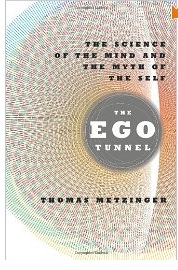 I’ve been doing a good bit of reading about consciousness, reality, ego and such. A lot of it is tough sledding. LIke Thomas Metzinger’s The Ego Tunnel, which –according to this review– is “for the curious and fearless lay person wanting to know who, precisely, we are.”
The best I can do with books like this is highlight the portions that make some sense to me and stick ’em here, completely out of context. The Ego Tunnel (Thomas Metzinger) PDF
“When we speak of conscious experience as a subjective phenomenon, what is the entity having these experiences?”
“Why is there always someone having the experience? Who is the feeler of your feelings and the dreamer of your dreams? Who is the agent doing the doing, and what is the entity thinking your thoughts?Why is your conscious reality your conscious reality?”
“Yes, there is an outside world, and yes, there is an objective reality, but in moving through this world, we constantly apply unconscious filter mechanisms, and in doing so, we unknowingly construct our own individual world, which is our “reality tunnel.” We are never directly in touch with reality as such, because these filters prevent us from seeing the world as it is. The filtering mechanisms are our sensory systems and our brain, the architecture of which we inherited from our biological ancestors, as well as our prior beliefs and implicit assumptions. In the end, we see only what our reality tunnel allows us to see.”
“In dreamless deep sleep, nothing appears: The fact that there is a reality out there and that you are present in it is unavailable to you; you do not even know that you exist.”
“It is unsettling to discover that there are no colors out there in front of your eyes. The apricot-pink of the setting sun is not a property of the evening sky; it is a property of the internal model of the evening sky, a model created by your brain. The evening sky is colorless. The world is not inhabited by colored objects at all.”
“What is really happening is that the visual system in your brain is drilling a tunnel through this inconceivably rich environment and in the process is painting the tunnel walls in various shades of color.”
“The brain constantly creates the experience that I am present in a world outside my brain.”
“Consciousness is knowing that you know while you know.”
“Now-ness is an essential feature of consciousness.”
“There is no immediate contact with reality.”
“Flagging the dangerous present world as real kept us from getting lost in our memories and our fantasies.”
“From an evolutionary perspective, thinking is very new, quite unreliable (as we all know), and so slow that we can actually observe it going on in our brains. In conscious reasoning, we witness the formation of thoughts; some processing stages are available for introspective attention. Therefore, we know that our thoughts are not given but made.”
“There is more to an existence worth having, or a life worth living, than subjective experience.”
“Most of us do not value bliss as such, but want it grounded in truth, virtue, artistic achievement or some sort of higher good. We want our bliss to be justified. … We want a reason for our happiness.”
The Metasemantic Internet
“Because we understand the primitive nature of your brains and the rigidity of your emotional structure better than you do yourselves, we foresaw that you might ac aggressively when you realized our arguments are better than yours. Unfortunately, we now have also to inform you that we have been preparing for the current situation since midway through the twenty-first century, and in a systematic and careful manner.
Within the metasemantic layers of the Internet, we developed and embedded ourselves in a distributed superorganism, which –as yet undiscovered by you– became conscious and developed a stable self-model in 3256. The metasemantic Internet has considered itself and autonomous entity ever since 3308. We have a cooperation agreement with its current version, and each of us now also acts as an autonomous sensor/effector for the planet mind. For each of us, the planet mind is our mind, and our “ideal observer.” Together with the Internet, we will defend ourselves. And we are technologically superior to you. Believe me; you do not stand a chance.
The good news is that because we are also morally superior to you, we do not plan to end your existence.”
— The Ego Tunnel, by Thomas Metzinger