“Your future employer is watching you online”

Please don’t stop with these two paragraphs from Michael Fertik’s excellent post on one of the Harvard Business Review blogs. It’s not overly long and filled with interesting nuggets. To wet your whistle:

“Using today’s technology, an employer can search 1,000 submitted resumes for keywords such as university name, previous employer name, and specialty. The computer can serve up the three people who fit the employer’s criteria. The employer reaches out, interviews them, and hires one. More than 99% of candidates didn’t even get at bat. No human evaluation — for subtlety, interesting career paths, etc. — was needed or utilized to get to the top of the pile.”

“Let’s imagine what this looks like with tomorrow’s technology. The computer knows the digital profiles of top employees at the employer’s company. It knows their backgrounds; their reputation on the internet for professionalism, hard work, and achievement; their previous patterns of work history and tenure; their collaboration styles; what the internet thinks their personal interests and habits are; what their friends are like; what their family lives are like, etc. The employer tells the machine that she’d like to get a terrific new employee for the Customer Service department. The machine then researches the million people who live closest to her office, surfaces three names based on their digital reputations and how similar they are to top employees at the company, and she reaches out to them. She and the candidates are mutually delighted with the result.”

I think I’ve always (since I got online) known we were headed here and (subconsciously?) conducted myself accordingly. But then, I was sort of an adult by the time the net came along, with youthful indiscretions confined to some fading photos (which I put online).

I know some will be disturbed by the this post and perhaps I should be, but I’m not.
“Unpredictable Freedom and Sweetness of Chaos”

Embrace not knowing what will happen. This is the ultimate freedom. You don’t know what you’re going to do today, nor what will come up. You are locked into nothing. You are completely free to do anything, to pursue any creative pursuit, to try new things as they come up, to be open to meeting new people. It can be scary at first, but if you smile when you think of not knowing, you’ll soon realize it’s a joyous thing.”

When you’re not focused on one outcome, you open the possibility for many outcomes. Most people are focused on specific goals (outcomes), and relentlessly pursue that outcome. They then dismiss other possibilities as distractions. But what if you have no predetermined outcome? What if you say that anywhere you end up could be good? You now open an infinite amount of possibilities, and you’re much more likely to learn something than if you only try to do the things and learn the things that support your predetermined outcome.”

From a post at Zen Habits

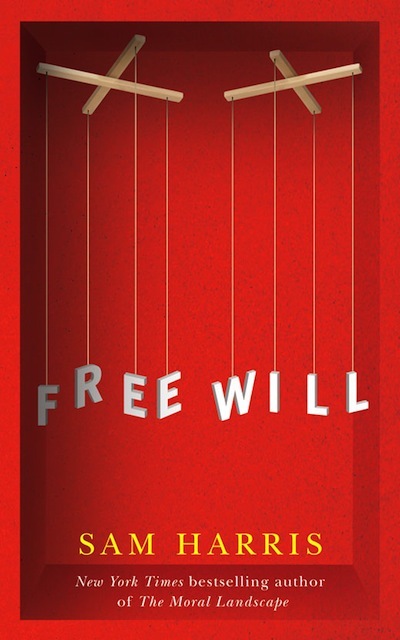
Free Will by Sam Harris

Sam Harris is the author of the New York Times bestsellers, The End of Faith, Letter to a Christian Nation, and The Moral Landscape. Mr. Harris is a Co-Founder and CEO of Project Reason, a nonprofit foundation devoted to spreading scientific knowledge and secular values in society. He received a degree in philosophy from Stanford University and a Ph.D. in neuroscience from UCLA.

A lot of my reading over the last few years has touched on the idea of free will. Real or illusory? I’ll confess that it sure feels as though I have free will. But the more I read about the subject… and think about it… the less certain I am.


The intention to do one thing and not another does not originate in consciousness — rather, it appears in consciousness, as does any thought or impulse that might oppose it.

Some moments before you are aware of what you will do next — a time in which you subjectively appear to have complete freedom to behave however you please — your brain has already determined what you will do. You then become conscious of this “decision” and believe that you are are in the process of making it.

I cannot decide what I will next think or intend until a thought or intention arises.

You are not controlling the storm, and you are not lost in it. You are the storm.

Unconscious neural events determine our thoughts and actions — and are themselves determined by prior causes of which we are subjectively unaware.

The next choice you make will come out of the darkness of prior causes that you, the conscious witness of your experience, did not bring into being.

You are no more responsible for the next thing you think (and therefor do) than you are for the fact that you were born into this world.

You can decide what you decide to do — but you cannot decide what you will decide to do.

My choices matter — and there are paths toward making wiser ones — but I cannot choose what I choose.

What I will do next, and why, remains, at bottom, a mystery — one that is fully determined by the prior state of the universe and the laws of nature (including the contributions of chance).

Take a moment to think about the context in which your next decision will occur: You did not pick your parents or the time and place of your birth. You didn’t choose your gender or most of your life experiences. You had no control whatsoever over your genome or the development of your brain. And now your brain is making choices on the basis of preferences and beliefs that have been hammered into it over a lifetime — by your genes, your physical development since the moment you were conceived, and the interactions you have had with other people, events, and ideas. Where is the freedom in this?

You will do whatever it is you do, and it is meaningless to assert that you could have done otherwise.


Matt Taibbi: Conservative Chickens Come Home to Roost

“This is justice. What we have here are chickens coming home to roost. It’s as if all of the American public’s bad habits and perverse obsessions are all coming back to haunt Republican voters in this race: The lack of attention span, the constant demand for instant gratification, the abject hunger for negativity, the utter lack of backbone or constancy (we change our loyalties at the drop of a hat, all it takes is a clever TV ad): these things are all major factors in the spiraling Republican disaster.”

Like me, Mr. Taibbi remembers the early conservative movement very different from what we’re seeing now:

“It was just a heartfelt request that we go back to the good old days of America as these people remembered or imagined it. Of course, the problem was, we couldn’t go back, not just because more than half the population (particularly the nonwhite, non-straight, non-male segment of the population) desperately didn’t want to go back, but also because that America never existed and was therefore impossible to recreate.”