We live tuned in to ourselves, but tuned out from life.
We easily lose sight of the distinction between Reality and our ideas about Reality.
Meditation is an expression of faith in direct experience itself.
Meditation is useless. (Because) meditation is, finally, just to be here. Not over there, in some other place called peace or freedom or enlightenment. Not longing for something else. Not trying to be, or to acquire, something new or different. … We can’t do meditation for any reason other than to be aware. … If you’re sitting in meditation to get something — you’re not here.
Meditation is about deeply seeing what’s going on within your own mind.
In meditation, we see that there is no cosmic mystery to break through. … Reality and Truth don’t require any “figuring out.”
You can’t become enlightened (because) you’re already here, immersed in it. It’s like trying to become human.
The practice of meditation frees us from our insane desire to control ourselves and others.
If you can get past the resistance to meditation, nothing else in life will be an obstacle.
In each new moment we can live in either awareness or ignorance.
Our meditation practice reflects the attitude we take in life.
At the heart of meditation is the intention to be awake. (To experience) Reality as it is,before goals, ideas, or desires sprout. … Meditation is never a means to an end.
Meditation is not about doing anything. It is simply paying attention. … If our will is directed toward any object or purpose — even toward meditation correctly — then we’re not in meditation.
Meditation is continually returning to life so that we don’t miss it. There’s no gap, no distinction, between you and what you’re doing.
Instead of practicing now and here, we get lost in thought about it.
Enlightenment isn’t something we need to figure out. It’s just remembering — waking up to what you knew all along but were not paying attention to. There’s nothing to figure out. It’s only a matter of seeing and not talking to yourself.
Over time you’ll discover that meditation won’t give you ideas at all.
Meditation is a matter of zero or 100 percent. Either you’re present or you’re not. There are no in-betweens.
To the extent that we’re not fully present as we live our life, a good portion of our life passes away unlived.
Meditation is awareness.
The very distinction of “out there” and “in here” is just another mental construct. It isn’t Real.
The more present we are, the bigger the picture we see. The bigger picture we see, the more things seem to slow down. And when the Whole is seen, all is utterly still.
Almost everything we do is done for a purpose a result, an outcome. In meditation, however, we let go of hopes and fears, plans and outcomes, and simply come back to here and now.
The desire of one who is awake is simply to be awake.
We can ever really explain how we feel — we can only feel how we feel.
Waking up means, more than anything else, that we learn to see ourselves.
Meditation is about your attitude toward life.
We put together a world in our mind. We carry all kinds of ideas, beliefs, notions, and prejudices — and, for most of us, that is our reality. It’s where we live. We regularly confuse what we believe with what we actually know.
Everything in culture is built around the premise of going after something else.
We find awakening so elusive because we’re looking for it. And if we’re looking for it, that means we believe it’s not here.
There is no “out there.”
We need to awaken, again and again, in each new moment. And in each moment, we have a new opportunity to wake up.
Life is all at once. It’s forever now. It’s never “then.”

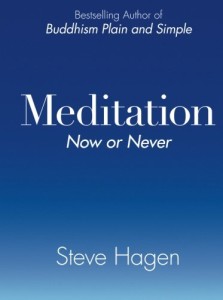 Publisher’s Weekly: Zen priest Hagen, author of Buddhism Plain and Simple and Buddhism Is Not What You Think, offers a brief and wonderfully accessible primer on meditation, which can be a surprisingly difficult practice for many beginners. He helpfully defines meditation via negativa: meditation is not a self-help program, a quick fix, a mind-training technique or a way to relax before jumping right back into the fray of our busy lives. It’s a lifelong practice that can, and should, seep into every arena of the quotidian, so that when we’re attentively folding laundry or taking out the trash, we’re doing meditation. It involves teaching the mind just to be here, says Hagen.