People having fun in old Land Rovers
Reply

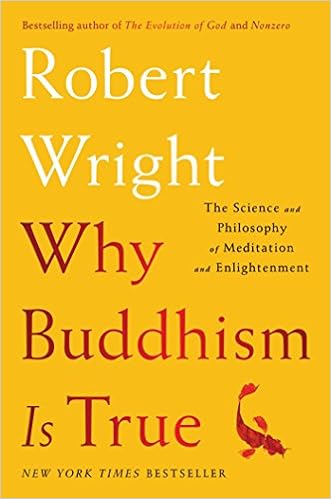 The full title of this book is: Why Buddhism is True: The Science and Philosophy of Meditation and Enlightenment. And it’s the science and philosophy parts of the book that I found most insightful. There is so much within and about Buddhism that are really hard for me to grasp. Emptiness, non-self, just to mention two. This book gave me — for the first time — a tiny, brief glimpse of what these might be. The author explains how natural selection plays such an important role in determining who and what we are. And his explanation of consciousness is the best I’ve come across. This was a breakthrough book for me. I’ll be reading it again. Here are a few excerpts, stripped of all context.
“Evolutionary psychology – the study of how the human brain was designed — by natural selection — to mislead us, even enslave us. […] Our brains are designed to, among other things, delude us.”
“More and more, it seems, groups of people define their identity in terms of sharp opposition to other groups of people.”
“Feelings are designed to encode judgments about things in our environment.”
“Natural selection didn’t design your mind to see the world clearly; it designed your mind to have perceptions and beliefs that would help take care of your genes.”
“Meditation can be seen as, among other things, a process of dispelling illusions.”
“One thing all feelings have in common is that they were originally “designed” to convince you to follow them. They feel right and true almost by definition. They actively discourage you from viewing them objectively.”
“Default Mode Network” — A network in the brain that, according to brain scan studies, is active when we’re doing nothing in particular — not talking to people, not focusing on our work or any other task, not playing a sport or reading a book or watching a movie. […] What you’re generally not doing when your mind is wandering is directly experiencing the present moment.”
“Much of the point of Buddhism is to confront suffering rather than evade it, and by confronting it, by looking at it unflinchingly, undermine it.” #
“We are not our bodies”
“This is not mine, this I am not, this is not my self.”
“Thoughts think themselves.”
“The closer we look at the mind, the more it seems to consist of a lot of different players, players that sometimes collaborate but sometimes fight for control, with victory going to the one that is in some sense the strongest. In other words, it’s a jungle in there, and you’re not the king of the jungle.”
“You think you’re directing the movie, but you’re actually just watching it.”
“Why would natural selection design a brain that leaves people deluded about themselves? One answer is that if we believe something about ourselves, that will help us convince other people to believe it.”
“The different modules (of the brain) are competing for your attention, and when the mind “wanders” from one module to another, what’s actually happening is that the second module has acquired enough strength to wrestle control of your consciousness away from the first module.”
“Theory of mind network” — The part of the brain involved in thinking about what other people are thinking.
“Thoughts, which we normally think of as emanating from the conscious self, are actually directed toward what we think of as the conscious self, after which we embrace the thoughts as belonging to that self.”
“(Brain) modules think thoughts. Or rather, modules generate thoughts, and then if those thoughts prove in some sense stronger than the creations of competing modules, they become thought thoughts — that is, they enter consciousness.”
“While observing the mind during meditation, it (can) seem like ‘thoughts think themselves’ — because the modules do their work outside of consciousness, so, as far as the conscious mind can tell, the thoughts are coming out of nowhere. […] The conscious self doesn’t create thoughts; it receives them.”
“It’s sort of like going to the movies. We go to the movies and there’s a very absorbing story and we’re pulled into the story and we feel so many emotions… excited, afraid, in love… And then we sit back and see these are just pixels of light projected on a screen. Everything we thought is happening is not really happening. It’s the same way with our thoughts. We get caught up in the story, in the drama of them, forgetting their essentially insubstantial nature. Escaping this drama — seeing your thoughts as passing before you rather than emanating from you — can carry you closer to the not-self experience.” #
“Thoughts that intrude (during meditation) often seem to have feelings attached to them. What’s more, their ability to hold my attention — in other words, to keep me enthralled, to keep me from noticing that they’re holding my attention — seems to depend on the strength of those feelings.”
“Feelings are, among other things, your brain’s way of labeling the importance of thoughts, and importance determines which thoughts enter consciousness.”
“Emptiness is not the absence of everything, but the absence of essence. To perceive emptiness is to perceive raw sensory data without doing what we’re naturally inclined to do: build a theory about what is at the heart of the data and then encapsulate that theory in a sense of essence.” #
“We are designed to judge things and to encode those judgements in feelings.” #
“If there’s something you don’t have any feelings at all about, you probably won’t much notice it in the first place.”
“At the root of the way we treat people is the essence we see them as having. So it matters whether these perceptions of essence are really true or whether, as the doctrine of emptiness suggests, they are in some sense illusions.”
“Not seeing essence and not having preconceptions are one and the same, because the essence we perceive in things is a preconception about them that has been programmed into our brain.”
“If you’re nothing, if you disappear, you can then be everything. But you can’t be everything unless you are nothing.” — Gary Weber
“The things in your environment — the sights, the sounds, the smells, the people, the news, the videos — are pushing your buttons, activating feelings that, however subtly, set in motion trains of thought and reaction that govern your behavior, sometimes in ways that are unfortunate. And they will keep doing that unless you start paying attention to what’s going on.”
“The things inside us are subject to causes, to conditions — and it is the fate of all conditioned things to change when conditions change. And conditions change pretty much all the time.”
“Making real progress in mindfulness meditation almost inevitably means becoming more aware of the mechanics by which your feelings, if left to their own devices, shape your perceptions, thoughts, and behavior — and becoming more aware of the things in your environment that activate those feelings in the first place. […] Becoming more aware of what causes what.” #
“The idea is to finely sense the workings of the machine (the mind) and use that understanding to rewire it, to subvert its programming, to radically alter its response to the causes, the conditions, impinging on it.”
“Natural selection engineered the delusions that control us; it built them into our brains.”
Reviews: New Yorker; New York Times; National Review
According to the app I use to track my meditation practice, today was the 365th consecutive day of sitting. Cool. One year with zero misses. Which means absolutely nothing other than I’ve been consistent in my practice. I started keeping track on November 30, 2014 and ran up a string of 371 days before missing a day (pneumonia). The next run — 271 days — ended while I was out of town attending my 50th high school reunion. Which might be the worst excuse imaginable. And now I’m less than a week away from beating that 371 string. Two days without meditating in the past 1,007 days.
The only day that counts, of course, is today. The app and keeping my streak alive give me a little extra incentive to sit every day but I don’t need much incentive these days. The time I spend in meditation is almost always the best part of my day.
Next milestone? 500 days.
 I am pleased to report that Sue Grafton fans will not be disappointed by the latest Sue Grafton novel. Y is for Yesterday delivers the goods. One of her best yarns, in my opinion. She’s been cranking these out since 1982 and, yes, like all such series, there’s a bit of a formula but it’s a good one. Lots of characters in this one with the main plot jumping back and forth between 1979 and 1989. A potentially annoying device but she pulls it off nicely. And a good sub-plot that ties up a loose end from her previous novel. I assume Z Is for (?) is already written and will be out in a year or two. Sad to think it might be her last Kinsey Millhone book. I’ll miss that girl.
The truck is mine! By that I mean I paid the last installment and the paperwork is on the way. Still a few items to take care of but the restoration is mostly complete. I received a detailed, two-page description of the disassembly and reassembly that might be interesting to fans of vintage cars and trucks.

“Down to the last nut and bolt. Every component was completely removed, beginning with the engine.”
“I also don’t get when they call them neo-Nazis. What does the “neo” part mean? Something innovative and new? It’s just Nazi. They wear 88 pins, they chant German Nazi slogans. If it sounds and looks like a Nazi, assume it’s a Nazi. One more thing — they call Trump a Nazi-sympathizer. Why be so generous. What distinguishes a sympathizer from an actual Nazi?”
— Dave Winer
The evolution of the early Land Rover trucks can get a little complicated. Mine was made in 1979 (Series III) in Santana, Spain. Land Rover made 440,000 of this type between 1971 and 1985. The video below features a Series I truck. They didn’t use that term until the Series II trucks came along and all previous trucks then became Series I, by default.
 The brain has the ability to generate vivid, life-like images and scenes. It does this seemingly on its own. These scenes can appear in one’s consciousness at any moment and they can be nearly indistinguishable from reality (‘out there’ as opposed to ‘in your head’). These thoughts, in my experience, are mostly beyond ‘our’ control. They happen to us. And while we can’t prevent them, we can — with practice — observe them. See them for what they are. The analogy that best captures this for me is a Fear Hologram Projector.
“Fear” because the scenarios that trouble me most involve fear and worry and anxiety. “Hologram” because these little mental vignettes are so incredibly real. I don’t know why the brain (some brains) persists in creating these but the brain in my head pulls from a lifetime of images and situations and mashes them up with the most negative of emotions and ideas.
It’s like walking down one of the endless passages in my brain and suddenly finding myself in one of these holograms. And the more mental attention I give it, the sharper and more detailed it seems. The hologram seems to need the energy of my attention to project. The fear hologram can loop endlessly for days or weeks. Or longer.
The brain can, of course, create a more positive, pleasant scenario. We like to imagine good and happy things happening. It would seem to be just as easy to create that kind of hologram as the awful kind. If ‘I’ am going to imagine some future, why wouldn’t I choose to something pleasant? The only answer I can come up with is I don’t get to choose. These mostly just happen. They come unbidden.
How do we turn off the Fear Hologram Projector?
Well, we can’t turn it off until we recognize what’s happening. We can’t see the projector when we’re in the middle of the hologram loop. The key here is probably mindfulness. Seeing what is really occurring. Not in your head but in the real, objective world around you (if you believe in such a thing). We might think of this as “experiential reality.” What we see, hear, touch, smell, taste.
When I find myself trapped in a fear hologram, it feels dark, like a movie theater. The images on the screen are more vivid in a darkened theater. And I can’t see the projector because I don’t know to look for it, or where to look.
But if I can be mindful enough to recognize I’m in a hologram — something generated by a (I choose not to say ‘my’) mind — I can bring up the house lights of my awareness! And in that instant I can see that the images are not real. They’re brain stuff. Stuff ‘I’ didn’t choose. Under the bright light of my awareness, the hologram images fade and as my awareness stops powering the projector, the images disappear. My belief, my buy-in is necessary for the hologram to exist.
I’m reminded of lines from my reading about Buddhism and Taoism.
“Am I conscious now? It troubles me that I seem so often to be unconscious. I wonder what this unconsciousness is. I cannot believe I spend most of my life in a kind of darkness. Surely that cannot be so. Yet every time I ask the question it feels as though I am waking up, or that a light is switching on.” – Ten Zen Questions
“Belief is at best an educated, informed conjecture about Reality. In contrast, seeing — raw, direct, unadulterated experience — is the direct perception of Reality Itself. […] Base your actions on what you see, rather than on what you think.” – Buddhism Plain and Simple
The bad news: our brains (okay, fuck it! My brain) have an endless capacity for materializing FHP’s (Fear Hologram Projectors), twenty-four/seven. And a lifetime of material from which to create the loops. Access to all our fears and anxieties.
The good news: it’s pretty easy to hit the house lights, spot the projector and pull the attention plug. If we can stay mindful. Of course, mindfulness doesn’t necessarily mean a state of meditative bliss. If you’re rocketing down a black ski slope; lining up for a night landing on an aircraft carrier; or in the middle of brain surgery… you’re probably not trapped on some mental fear loop. And lots of daily, less challenging tasks, can help us stay in the moment. But the mind never stops. You can hit the house lights and pull the plug on the fear projector… and find yourself back in some anxious future 30 seconds later. And this can repeat over and over, day and night.
At the risk of oversimplifying, I am either ‘awake’ or not-awake. Not-awake can take several forms, of course. There the subconscious which is probably what I’ve been talking about. How frustrating that it handles all of those life and death tasks (breathing, heart, etc) without any help from the conscious me…. and still finds time to gin up endless fear and anxiety scenarios.
Then there are dreams — which tend to be more real than the Fear Holograms — but there’s nothing we can do about those. Fortunately, mine seem to fade quickly upon awakening. And I’ve read that we also experience unconsciousness most nights. Dreamless sleep. Would like to have more of that.
I expect to be reaching for the switch to the house lights for the rest of my life. Endlessly pulling the plug on the FHP. But I find some comfort in the belief that “Thoughts think themselves.” I don’t control them. That’s the subconscious, forever and always.
And I have the cushion. Meditation. Observing the mind, allowing it to become quieter (rarely quiet). Awakening, if only for a moment.
“This “no mobile phone” phobia is an emerging term that some psychologists use to describe the fear people have of being without their smartphone. And the latest evidence suggests that it happens because these devices have become so personalized that they are seen as extensions of ourselves. […] While previous research has linked nomophobia to anxieties around an inability to communicate and a fear of missing out, the new research suggest that phone owners also form strong personal attachments to the devices themselves, due to the photos, messages and other data that they hold.”
The restoration seems to have moved to the interior of the truck which — I hope — means we’re getting near the end.
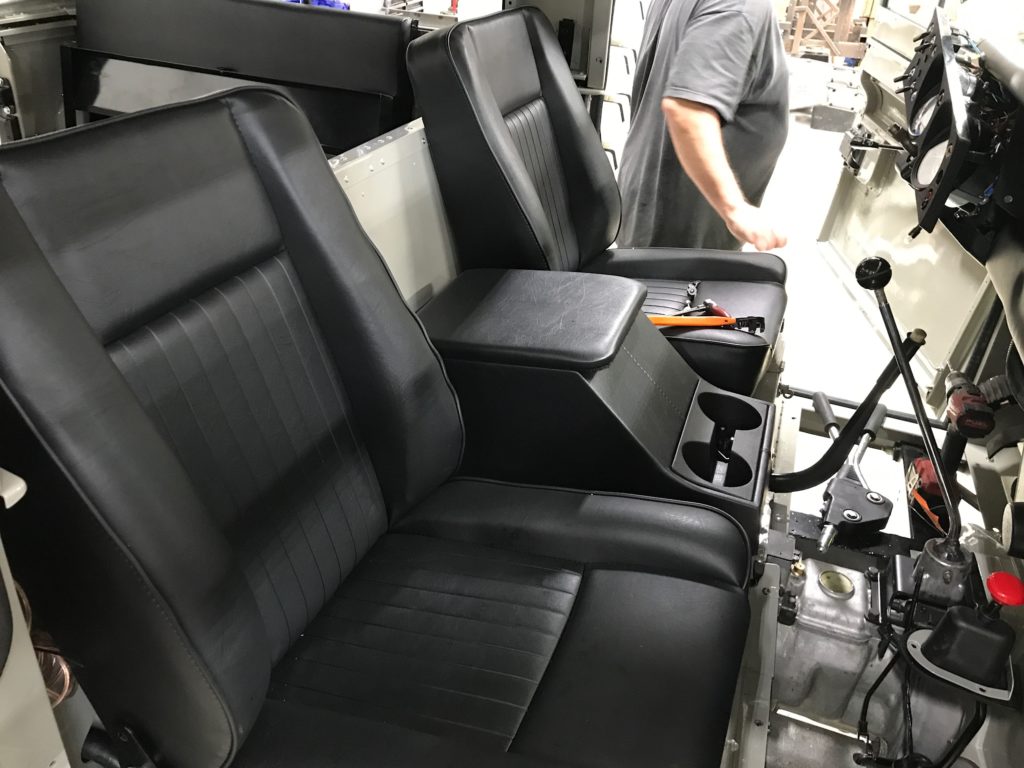
The original three-across bench seats have been replaced with bucket seats (vinyl) and storage compartment. These seats are about as modern as I would care to go. Would have been fine with the originals but then I have never ridden on those. I’m sure these are better.
All of the original glass has been replaced with safety glass. That suggests the original glass was not safety glass!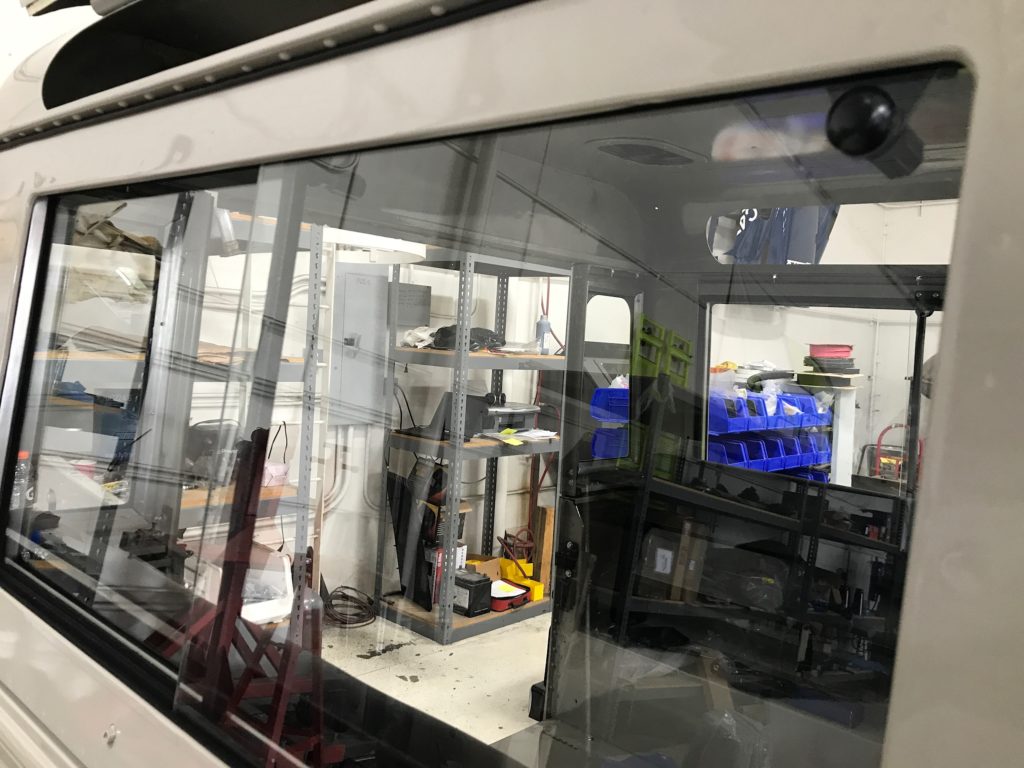
The side windows on the rear of the truck slide horizontally to open and close. Just like the side windows on the cab. Suspect sight lines might be better than the MINI.

There are four vents in the ceiling of the hardtop. These can be opened and closed to control airflow that’s scooped in from the top of the truck.