Pinzgauer

You’d have to look long and hard to find someone more knowledgable about exotic vehicles than Grayson Wolf. It was March of 2017 when Grayson started searching for what was to be my Land Rover. We’ve become friends in the the ensuing years and he is easily one of the most interesting people I have ever met. And a really good guy. Which brings us to the Pinzgauer project. I had never heard of a Pinzgauer.

(Wikipedia) “The Pinzgauer is a family of high-mobility all-terrain 4WD (4×4) and 6WD (6×6) military utility vehicles. The vehicle was originally developed in the late 1960s and manufactured by Steyr-Daimler-Puch of Graz, Austria, and was named after the Pinzgauer, an Austrian breed of cattle. They were most recently manufactured at Guildford in Surrey, England by BAE Systems Land & Armaments. It was popular amongst military buyers, and continued in production there throughout the rest of the century.”

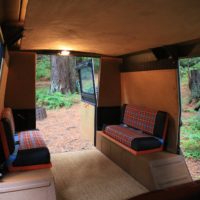
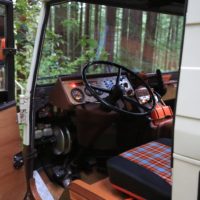
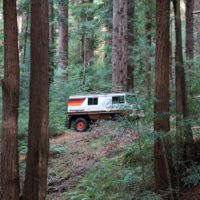
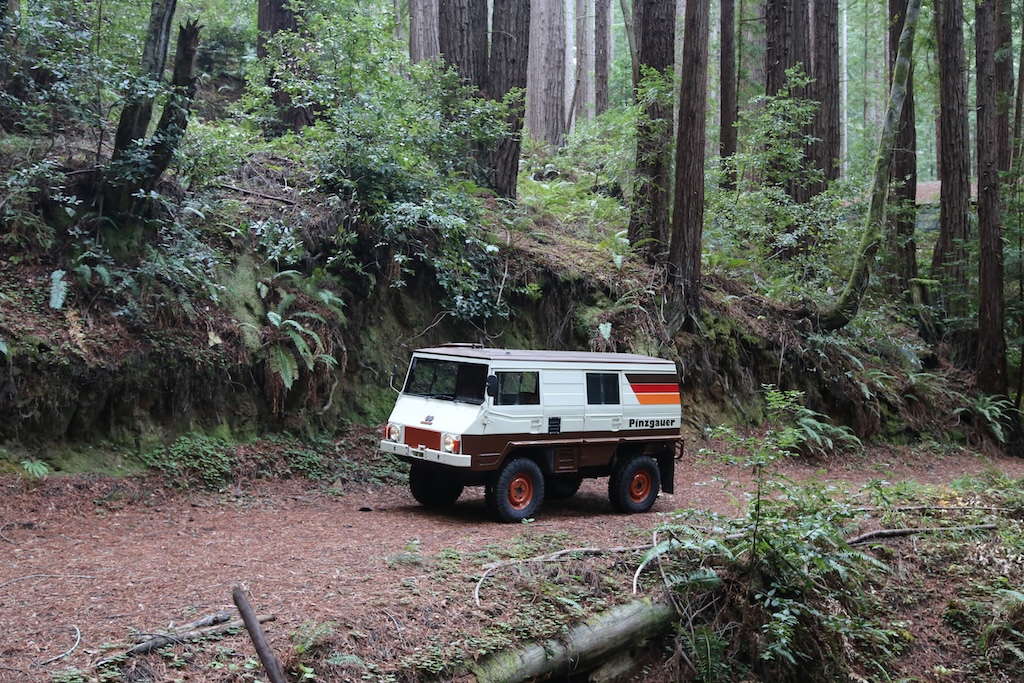
As you can see from the photos below, Grayson has converted this one for comfy off-roading.
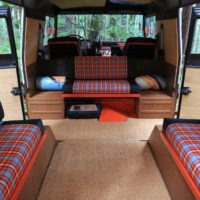
His next project sounds even more interesting: Designing an off-road obstacle course for a customer.

A big ranch in Tomales Bay. Trying to design something fun, with great views, and some perceived risk (make the truck lean, teeter on three wheels, etc) without any actual risk of rolling or damaging the vehicle. (While I’ve never done one of these) I love all of the individual ingredients – operating heavy equipment, chainsaws, 4×4-ing, design work, and, most importantly, rolling trucks over while off roading – so I feel qualified :)
Hypercars

“One definition of a hypercar is a vehicle that nobody needs.”

While my tastes run toward beat-up older vehicles, I was fascinated by this article in The New Yorker. (“The World’s Fastest Cars — and the People Who Drive Them”). The term “hypercar” entered the lexicon in the two-thousands, when other carmakers (began) producing absurdly powerful, and prohibitively expensive, limited-edition models. Most have theoretical top speeds approaching or exceeding 300 m.p.h. And they get there quickly:

(The Rimac Nevera) accelerates faster than any road car ever made: zero to 60 m.p.h. in 1.74 seconds, and zero to a hundred in 3.21 seconds.

Think about that. You’re at a standing stop…you pin the accelerator and… one thousand one, one thousand… and you’re going sixty miles per hour.

Talking books with ChatGPT

I prompted ChatGPT to make a list of the ten best crime fiction writers of the last fifteen years. She (I opted for the female voice called ‘Sky’) left off a few of my favorites and we discussed them. At the 5:38 mark of this 6 minute chat, she makes reference to my interest in classic vehicles, communications and blogging. Topics which came up in earlier conversations. I still have goose bumps.

Perplexity: “The controversy involving Scarlett Johansson and OpenAI’s ChatGPT voice centers around the introduction of a new AI voice assistant named “Sky,” which many users and industry professionals noted bore a striking resemblance to Johansson’s voice from the 2013 film “Her.” Johansson voiced an AI assistant in the film, and the similarity between her voice and Sky’s led to significant backlash.”

Jump to the :35 second mark in the trailer below to hear Johansson’s voice. I do not  hear the similarity.

Age of Social Media Ending

That’s the title of an article in The Atlantic back in 2022. It’s behind a paywall so I’ll share a few of my favorite excerpts (and a few thoughts). The piece is a year old so some of this might less (or more) relevant.

The reporter traces an evolution/devolution of “social networks” to “social media.”

Instead of facilitating the modest use of existing connections—largely for offline life (to organize a birthday party, say)—social software turned those connections into a latent broadcast channel. All at once, billions of people saw themselves as celebrities, pundits, and tastemakers.

Blogs (and bloglike services, such as Tumblr) [hosted] “musings” seen by few and engaged by fewer. In 2008, the Dutch media theorist Geert Lovink published a book about blogs and social networks whose title summarized their average reach: Zero Comments.

I was blogging long before social networks or media. And I read lots of blogs. I recall being…mystified?… by the idea of social media.

“social media,” a name so familiar that it has ceased to bear meaning. But two decades ago, that term didn’t exist. […] “…social networking became social media around 2009, between the introduction of the smartphone and the launch of Instagram. Instead of connection—forging latent ties to people and organizations we would mostly ignore—social media offered platforms through which people could publish content as widely as possible, well beyond their networks of immediate contacts. Social media turned you, me, and everyone into broadcasters (if aspirational ones).” […] The network, which had previously been used to establish and maintain relationships, becomes reinterpreted as a channel through which to broadcast.

As a one-time broadcaster (radio) I understand the appeal of reaching an audience.

Social media showed that everyone has the potential to reach a massive audience at low cost and high gain—and that potential gave many people the impression that they deserve such an audience.

I loved blogging. Still do. But damned few people ever read this blog. And I got even fewer comments. Disabled that feature years ago. “The rush of likes and shares felt so good because the age of zero comments felt so lonely.”

DALL·E: A text-to-image model developed by OpenAI

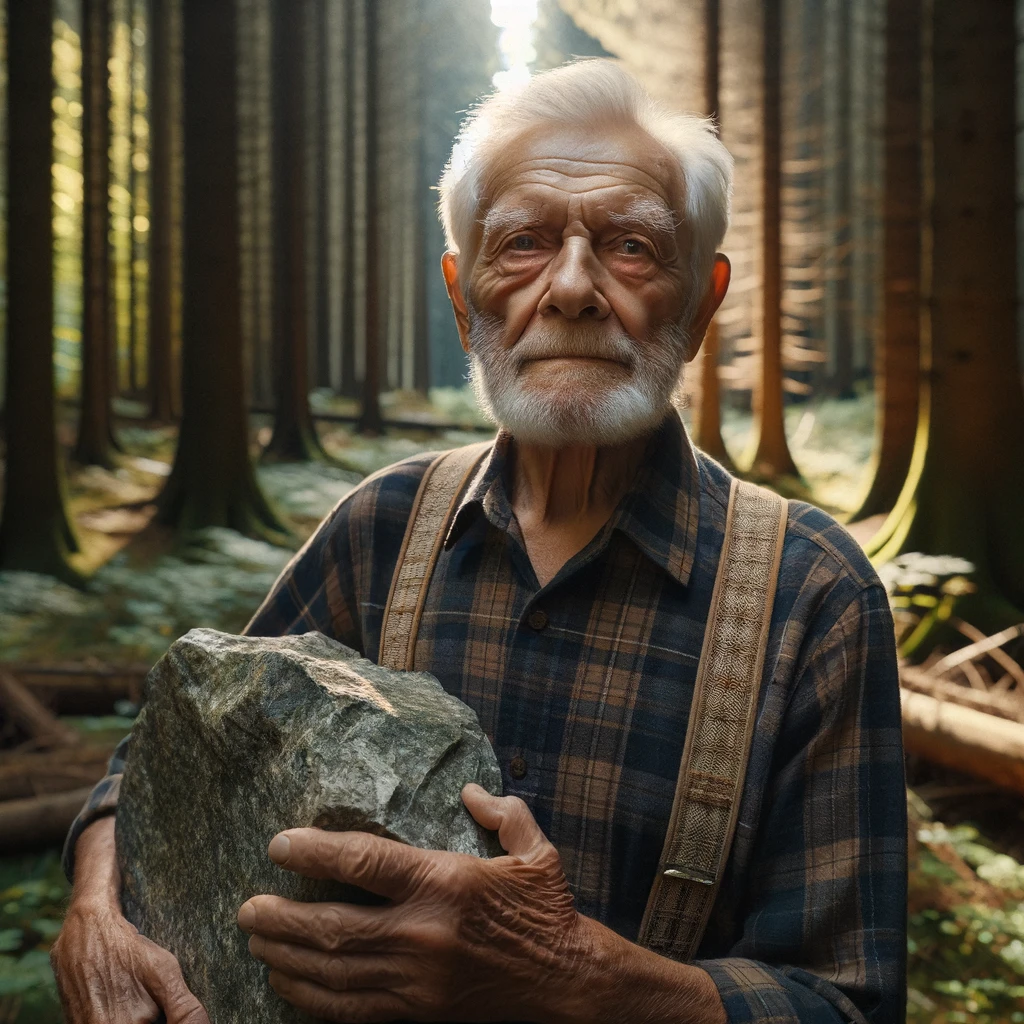
DALL·E is a text-to-image model developed by OpenAI using deep learning methodologies to generate digital images from natural language descriptions, called “prompts”. (Wikipedia)

I’ve just started playing with this (and ChatGPT) and will be posting my thoughts and experiences here. I prompted for “a 90-year-old man in the forest holding a big rock” and the image below was created/generated.