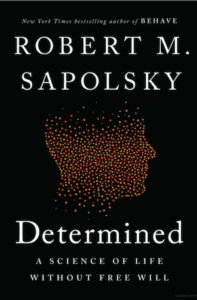
After 20 years of reading about free will, I have to agree with those who insist it doesn’t exist. It’s an illusion, but probably necessary. Robert Sapolsky has written a book titled “Determined: A Science of Life Without Free Will” this excerpt describes an experience I’m having with increasing frequency.
“You may have had the uncanny experience of talking about an upcoming camping trip with a friend, only to find yourself served with ads for tents on social media later. Your phone didn’t record your conversation, even if that’s what it feels like. It’s just that the collective record of your likes, clicks, searches and shares paints such a detailed picture of your preferences and decision-making patterns that algorithms can predict — often with unsettling accuracy — what you are going to do.”
Sapolsky references a short story by Ted Chiang (What’s Expected of Us) in which the narrator describes a new technology that convinces users their choices are predetermined, a discovery that saps them of their will to live.
“It’s essential that you behave as if your decisions matter,” the narrator warns, “even though you know that they don’t.”
From a review in the Los Angeles Times. (Apple News) Below are some of my favorite bits.
 “Most Americans have negative perceptions of atheists, and antiatheist prejudice is more prevalent than antipathy toward Muslims (which comes in second place), African Americans, LGBQT individuals, Jews, or Mormons.”
“We are nothing more or less than the cumulative biological and environmental luck, over which we had no control, that has brought us to this moment.”
“While change happens, we do not freely choose to change; instead, we are changed by the world around us.”
“Much has been made of the hospitality, conservatism (as in strictly conserving cultural norms), and violence of the traditional culture of honor of the American South. The pattern of violence tells a ton: murders in the South, which typically has the highest rates in the country, are not about stickups gone wrong in a city; they’re about murdering someone who has seriously tarnished your honor (by conspicuously bad-mouthing you, failing to repay a debt, coming on to your significant other…), particularly if living in a rural area.”
“You can’t successfully believe something different from what you believe.”
“Why did that moment just occur? “Because of what came before it.” They why did that moment just occur? “Because of what came before that,” forever, isn’t absurd and is, instead, how the universe works. […] In order to prove there’s free will, you have to show that some behavior just happened out of thin air in the sense of considering all these biological precursors. […] All that came before, with its varying flavors of uncontrollable luck, is what came to constitute you. This is how you became you.”
“By age three, your average high-socioeconomic status kid has heard about thirty million more words at home than a poor kid.”
“‘Free will’ is what we call the biology that we don’t understand on a predictive level yet, and when we do understand it, it stops being free will. […] We do something, carry out a behavior, and we feel like we’ve chosen, that there is a Me inside separate from all those neurons.”
“We are nothing more or less than the sum of that which we could not control — our biology, our environment, their interactions. […]Try as we might, we can’t will ourselves to have more willpower.”
“We don’t change our minds. Our minds, which are the end products of all the biological moments that came before, are *changed* by circumstances around us.”
“What the science in this book ultimately teaches is that there is no meaning. There’s no answer to “Why?” beyond “This happened because of what came just before, which happened because of what came just before that.” There is nothing but an empty, indifferent universe in which, occasionally, atoms come together temporarily to form things we each call Me.”
“Depression is the pathological loss of the capacity to rationalize away reality.”