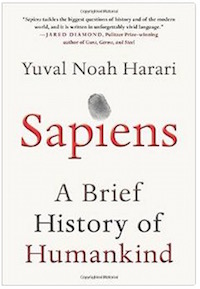
Sapiens: A Brief History of Humankind

sapiens-book-coverAmazon: “Most books about the history of humanity pursue either a historical or a biological approach, but Dr. Yuval Noah Harari breaks the mold with this highly original book that begins about 70,000 years ago with the appearance of modern cognition. From examining the role evolving humans have played in the global ecosystem to charting the rise of empires, Sapiens integrates history and science to reconsider accepted narratives, connect past developments with contemporary concerns, and examine specific events within the context of larger ideas.”

You can scan my favorite nuggets after the jump: Continue reading

The best thing about the present

“The most fantastic thing about the present time is that we’re actually still here. In the early ’80s, people who knew what their situation was with the Cold War and nuclear armament didn’t necessarily expect that we’d make it this far. We’ve kind of lost that knowledge. Once the threat was gone, it was like we disremembered it as a species. It seldom comes up anymore, which is really odd.”

“The future will probably know more about what we’re actually doing than we do. Because if it stays history long enough, it doesn’t have to be secret anymore.”

From interview with William Gibson

Something new is happening

As it becomes increasingly difficult to know what’s ‘true’ and ‘accurate,’ I find myself depending (not he right word but close enough) on how something is said. Am I just talking about style or tone here? Perhaps. Anyway, Bruce Sterling (On Social Media Jihads) never disappoints.

“People are gonna kill ISIS because they want those oil wells back, not because ISIS is sort-of okay at social media and pushing viral atrocity videos. […] When you’re a top terrorist, you don’t really want to “wreak havoc” anyway. Mostly, you want to create a failed state, a place like Afghanistan, Libya, Somalia, where you can take over at gunpoint and live it up in the narcotics, weapons, and oil biz.”

And this gem on U.S. foreign policy:

“It doesn’t matter how much data the U.S. military or U.S. intelligence has: They attack the wrong people for made-up reasons and they’re also [a] terribly ineffective occupation power.”

As for the Internet as a global brain uniting all of mankind…

“People don’t realize that the old-fashioned global Internet of the 90s is segregating into radicalized filter-bubbles, but it is, and fast. People are used to the Free World idea, they think the huddled masses behind the Chinese Firewall and the new Russian firewalls want to get out and be rich and happy at the West’s shopping mall. But the Chinese, Russians, and even the Greeks tried that, they don’t like it, and that’s not what is happening any more. Something new is happening.”

Rank websites according to their truthfulness

“A Google research team is adapting that model to measure the trustworthiness of a page, rather than its reputation across the web. Instead of counting incoming links, the system – which is not yet live – counts the number of incorrect facts within a page. “A source that has few false facts is considered to be trustworthy,” says the team. The score they compute for each page is its Knowledge-Based Trust score.”

“The software works by tapping into the Knowledge Vault, the vast store of facts that Google has pulled off the internet. Facts the web unanimously agrees on are considered a reasonable proxy for truth. Web pages that contain contradictory information are bumped down the rankings.”

“Knowledge Vault has pulled in 1.6 billion facts to date. Of these, 271 million are rated as “confident facts”, to which Google’s model ascribes a more than 90 per cent chance of being true. It does this by cross-referencing new facts with what it already knows.”

This seems too good to be true so I’ll start by assuming it is not. But NewScientest is, in my opinion, a reliable source. And I want this to be a real thing. Imagine how disruptive something like this would be. Would you keep going back to a site with a really low Knowledge-Based Trust score? Sure, there’d be lots of kicking and screaming but I could see this working. At lots of levels.

IBM Watson User Modeling Service

“The IBM Watson User Modeling service uses linguistic analytics to extract a spectrum of cognitive and social characteristics from the text data that a person generates through text messages, tweets, posts, and more.”

So I took one of my longer posts and had it analyzed. It identified my “Big 5” as follows:

Openness – 50%
Conscientiousness 4%
Extraversion 65%
Agreeableness 54%
Emotional range 86%

Then it breaks each of these broad areas down further. Continue reading

A new kind of presence

David Weinberger imagines an exciting technology future:

At the FlyEye site you scan a huge video wall that shows you a feed from every person out in the streets who is sporting a meshed GoPro or Google Glass wearable video camera. Thousands of them. […] Off on the left there’s a protestor holding a sign you can’t quite make out. So, you click on one of the people in the crowd who has a blue dot over her that means she too is wearing a meshed video camera. Now you see through that camera. The protestor’s sign isn’t as interesting as you thought. So you video surf through the crowd, hopping from camera to camera.

FlyEye provides a “Twitch Plays Pokemon” sort of interface that lets the remote crowd ask participating meshed camera-wearers to turn this way or that. You click furiously asking the person with the camera you’re “riding” to look backwards. No luck. So you hop to someone further back. […] The software enables a user to choose which camera to ride, as well as the sorts of services that would make it easier to choose which cameras to surf to. Plus some chat capabilities of some sort.


Is Earth a seeded planet?

“One possibility is that we will build 3D printers and create organic humans based on our software personalities just to experience reality through five senses. An organic creature can keep learning its entire life. So our future software selves might find a need to bring some of our minds back into organic form just to keep up the challenge and the learning. And you know where this is going. If the scenario I described might happen in the future, how can we know it didn’t already happen and we are the second-generation organic humans?”

Scott Adams thinks it is and makes his case here.