
“She wanted to know whether a person could die by spontaneous combustion. The odds against a letter slipped under the door slipping under the carpet as well. Ishmael’s real name. Who this “Reader” was, and why he rated knowing who married whom. Whether single men with fortunes really needed wives. What home would be without Plumtree’s Potted Meats. How long it would take to compile a key to all mythologies. What the son of a fish looked like. Where Uncle Toby was wounded. Why anyone wanted to imagine unquiet slumbers for sleepers in quiet earth. Whether Conrad was a racist. Why Huck Finn was taken out of libraries. Which end of an egg to break. Why people read. Why they stopped reading. What it meant to be “only a novel.” What use half a locket was to anyone. Why it would be mistake not to live all you can.”
Category Archives: Science & Technology
Lexicon by Max Barry
“At an exclusive school somewhere outside of Arlington, Virginia, students aren’t taught history, geography, or mathematics–at least not in the usual ways. Instead, they are taught to persuade. Here the art of coercion has been raised to a science. Students harness the hidden power of language to manipulate the mind and learn to break down individuals by psychographic markers in order to take control of their thoughts. The very best will graduate as “poets”, adept wielders of language who belong to a nameless organization that is as influential as it is secretive.” (Amazon)
I can’t say I thought Lexicon was a great read but the neurolinguistics thing was interesting. I kept hearing echoes from Neal Stephenson’s Snow Crash:
“As Stephenson describes it, one goddess/semi-historical figure, Asherah, took it upon herself to create a dangerous biolinguistic virus and infect humanity with it; this virus was stopped by Enki, who used his skills as a “neurolinguistic hacker” to create an inoculating “nam-shub” that would protect humanity by making it impossible to use and respond to the Sumerian tongue. This forced the creation of “acquired languages” and gave rise to the Biblical story of the Tower of Babel.”
If I read Wikipedia correctly, there’s a difference between Neurolinguistics and Neuro-linguistic programming (NLP). The notion of someone using words and language to “program” my thinking is disturbing. This came up again for me last year when Scott Adams begin writing a long series of posts about Donald Trump using Master Persuader techniques. I was skeptical at first now I’m not so sure.
Jim Jones talks his followers into drinking poison Kool Aide? Tony Robbins convinces folks to pay him for the privilege of walking on hot coals? David Koresh, Scientology, etc etc. Are we just “moist robots” (Scott Adam’s term) that can be programmed with a few well chosen words?
And while we’re on the subject of words… I don’t remember the last time I saw an NBC newscast that didn’t include repeated references to “devastation,” “tragedy,” “terror,” and similar fear words. I’m trying to stop watching and listening to network and cable news programs because I feel (physically) bad after watching/listening. Which I’ve concluded is the point.
Reading list: Consciousness
- The Big Picture: On the Origins of Life, Meaning, and the Universe Itself – Sean Carroll | My notes
- Consciousness and the Social Brain – Michael S. A. Graziano | My notes
- What Technology Wants – Kevin Kelly | My notes
- The Ego Trick – Julian Baggini | My Notes
- The Self Illusion: How the Social Brain Creates Identity – Bruce Hood | My Notes
- Thinking, Fast and Slow – Daniel Kahneman | My notes
- Incognito: The Secret Lives of the Brain – David Eagleman | My notes
- The Ego Tunnel: The Science of the Mind and the Myth of the Self – Thomas Metzinger | My notes
- Quantum Enigma: Physics Encounters Consciousness – Bruce Rosenblum | My notes
- Biocentrism: How Life and Consciousness Are the Keys to Understanding the True Nature of the Universe – Robert Lanza | My notes
The Big Picture
The Big Picture: On the Origins of Life, Meaning, and the Universe Itself. By Sean Carroll
 Life is a process, not a substance, and it is necessarily temporary.
For a long time, there has been a shared view that there is some meaning, out there somewhere, waiting to be discovered and acknowledged. There is a point to all this; things happen for a reason. […] Gradually, our confidence in this view has begun to erode.
“Life” and “consciousness” do not denote essences distinct from matter; they are ways of talking about phenomena that emerge from the interplay of extraordinarily complex systems.
At a fundamental level, there aren’t separate “living things” and “nonliving things,” “things here on Earth” and “things up in the sky,” “matter” and “spirit.” There is just the basic stuff of reality, appearing to us in many different forms. […] We will ultimately understand the world as a single, unified reality, not caused or sustained or influenced by anything outside itself. That’s a big deal.
The only reliable way of learning about the world is by observing it. Continue reading
The Inevitable
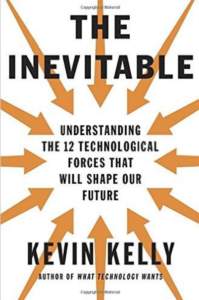 “Thousands of years from now, when historians review the past, our ancient time here at the beginning of the third millennium will be seen as an amazing moment. This is the time when inhabitants of this planet first linked themselves together into one very large thing. Later the very large thing would become even larger, but you and I are alive at the moment when it first awoke. Future people will envy us, wishing they could have witnessed the birth we saw.”
“This very large thing (the net) provides a new way of thinking (perfect search, total recall, planetary scope) and a new mind for an old species. It is the Beginning. […] At its core 7 billion humans, soon to be 9 billion, are quickly cloaking themselves with an always-on layer of connectivity that comes close to directly linking their brains to each other. […] By the year 2025 every person alive — that is, 100 percent of the planet’s inhabitants — will have access to this platform via some almost-free device. Everyone will be on it. Or in it. Or, simply, everyone will be it.”
While reading Kevin Kelly’s The Inevitable, I underlined passages so I could post them here for future reference. I do this with each book I read. I’m not going to do that for this book because my highlights filled 11 pages The Inevitable (Kevin Kelly) (PDF)