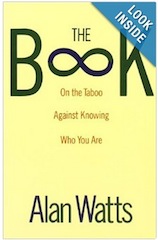
 The Book: On the Taboo Against Knowing Who You Are (1966). I like the way Alan Watts writes. Some of the sixties jargon sounds a little quaint but, hey, that’s the way we talked back then. If you haven’t read this book (and don’t intend to), you can skip this post. Won’t make any sense at all out of context. Admittedly, some of the ideas are hard to grasp within context. Posts like this one (excerpts from a book) are archival. A place for me to come back and locate an idea I could never find by flipping through the book.
He pretends that he is you and I and all the people in the world, all the animals, all the plants, all the rocks, and all the stars. In this way he has strange and wonderful adventures, some of which are terrible and frightening. But these are just like bad dreams, for when he wakes up they will disappear. […] It takes him a long time to remember where and how he hid himself. […] We are God in disguise, pretending not to be himself.
God is the Self of the world, but you can’t see God for the same reason that, without a mirror, you can’t see your own eyes.
He isn’t really doing this to anyone but himself. […] In the Vedanta philosophy, nothing exists except God. […] But Vedanta is much more than the idea or the belief that this is so. It is centrally and above all the experience, the immediate knowledge of its being so.
You don’t die because you were never born. You had just forgotten who you are.
All information will come in by super-realistic television and other electronic devices as yet in the planning stage or barely imagined. In one way this will enable the individual to extend himself anywhere without moving his body— even to distant regions of space. But this will be a new kind of individual— an individual with a colossal external nervous system reaching out and out into infinity. And this electronic nervous system will be so interconnected that all individuals plugged in will tend to share the same thoughts, the same feelings, and the same experiences. […] If all this ends with the human race leaving no more trace of itself in the universe than a system of electronic patterns, why should that trouble us? For that is exactly what we are now!
No one thing or feature of this universe is separable from the whole, the only real You, or Self, is the whole.
Most people think of themselves as separate from their thoughts and experiences.
Memory is an enduring pattern of motion, like the whirlpool, rather than an enduring substance, like a mirror, a wax tablet, or a sheet of paper.
Society is our extended mind and body.
(You are) one particular focal point at which the whole universe expresses itself. […] Every individual is a unique manifestation of the Whole,
The death of the individual is not disconnection but simply withdrawal. The corpse is like a footprint or an echo— the dissolving trace of something which the Self has ceased to do.
The only real “I” is the whole endless process.
Every organism is a process: thus the organism is not other than its actions. To put it clumsily: it is what it does. More precisely, the organism, including its behavior, is a process which is to be understood only in relation to the larger and longer process of its environment. […] The whole is a pattern, a complex wiggliness, which has no separate parts. Parts are fictions of language.
Apart from your brain, or some brain, the world is devoid of light, heat, weight, solidity, motion, space, time, or any other imaginable feature.
This little germ with its fabulous brain is evoking the whole thing, including the nebulae millions of light-years away. […] A structure of such fabulous ingenuity that it calls the whole universe into being.
No valid plans for the future can be made by those who have no capacity for living now.
Making an effort to be ego-less is like “beating a drum in search of a fugitive.”
You are nothing at all apart from everything else. […] Each organism is the universe experiencing itself in endless variety.
Don’t try to get rid of the ego-sensation. Take it, so long as it lasts, as a feature or play of the total process — like a cloud or wave, or like feeling warm or cold, or anything else that happens of itself. Getting rid of one’s ego is the last resort of invincible egoism! It simply confirms and strengthens the reality of the feeling. But when this feeling of separateness is approached and accepted like any other sensation, it evaporates like the mirage that it is.
Meditate just to meditate.
When this new sensation of self arises, it is at once exhilarating and a little disconcerting. It is like the moment when you first got the knack of swimming or riding a bicycle. There is the feeling that you are not doing it yourself, but that it is somehow happening on its own, and you wonder whether you will lose it— as indeed you may if you try forcibly to hold on to it. In immediate contrast to the old feeling, there is indeed a certain passivity to the sensation, as if you were a leaf blown along by the wind, until you realize that you are both the leaf and the wind. The world outside your skin is just as much you as the world inside: they move together inseparably, and at first you feel a little out of control because the world outside is so much vaster than the world inside. Yet you soon discover that you are able to go ahead with ordinary activities— to work and make decisions as ever, though somehow this is less of a drag. Your body is no longer a corpse which the ego has to animate and lug around. There is a feeling of the ground holding you up, and of hills lifting you when you climb them. Air breathes itself in and out of your lungs, and instead of looking and listening, light and sound come to you on their own. Eyes see and ears hear as wind blows and water flows. All space becomes your mind. Time carries you along like a river, but never flows out of the present: the more it goes, the more it stays, and you no longer have to fight or kill it.
The universe is at root a magical illusion and a fabulous game, and that there is no separate “you” to get something out of it, as if life were a bank to be robbed. The only real “you” is the one that comes and goes, manifests and withdraws itself eternally in and as every conscious being. For “you” is the universe looking at itself from billions of points of view, points that come and go so that the vision is forever new. What we see as death, empty space, or nothingness is only the trough between the crests of this endlessly waving ocean.
The Self is playing its most far-out and daring game— the game of having lost Itself completely and of being in danger of some total and irremediable disaster.
We are merely bolting our lives— gulping down undigested experiences as fast as we can stuff them in— because awareness of our own existence is so superficial and so narrow that nothing seems to us more boring than simple being.
How is it possible that a being with such sensitive jewels as the eyes, such enchanted musical instruments as the ears, and such a fabulous arabesque of nerves as the brain can experience itself as anything less than a god?
It seems to be the special peculiarity of human beings that they reflect: they think about thinking and know that they know.
For so long as I am trying to grasp IT, I am implying that IT is not really myself.
I return in every baby born. […] It matters not whether the interval be ten seconds or billions of years. In unconsciousness all times are the same brief instant.
In looking out upon the world, we forget that the world is looking at itself— through our eyes and IT’s.