
“All you need to be a world-class hacker is a computer and a cool pair of sunglasses. And the computer is optional.” — The Masked Avengers: How Anonymous incited online vigilantism from Tunisia to Ferguson.
Category Archives: Quotable & Notes
TV is for old people
“The median age of a broadcast or cable television viewer during the 2013-2014 TV season was 44.4 years old, a 6 percent increase in age from four years earlier. Audiences for the major broadcast network shows are much older and aging even faster, with a median age of 53.9 years old, up 7 percent from four years ago. The median age of viewers who watch CBS is 58.7 years old. Fox has the youngest broadcast audience, with a median age of 47.8 years. Live television viewing (is) down 13 percent for all ages except for viewers 55 years and older.”
Source: Research by media analyst Michael Nathanson of Moffett Nathanson Research. (WashingtonPost.com)
The Way of Zen by Alan Watts
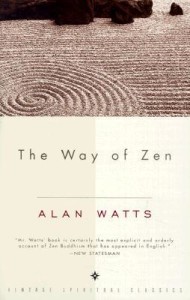
Excerpts from The Way of Zen
I have no other self than the totality of things of which I am aware.
I have somehow become the empty space in which everything is happening.
TAO
The vague, void-seeming, and indefinable Tao is the intelligence which shapes the world with a skill beyond our understanding. … Whereas God produces the world by making, the Tao produces it by “not-making” (growing).
The Tao’s principle is spontaneity. But spontaneity is not by any means a blind, disorderly urge, a mere power of caprice. … A philosophy restricted to the alternatives of conventional language has no way of conceiving an intelligence which does not work according to plan, according to a (one-at-a-time) order of thought.
Hsuan – A metaphorical darkness; the sheer inconceivability which confronts the mind when it tries to remember a time before birth, or to penetrate its own depths.
If the ordinary man is one who has to walk by lifting his legs with his hands, the Taoist is one who has learned to let the legs walk by themselves.
The eye’s sensitivity to color is impaired by the fixed idea that there are just five true colors.
BUDDHISM
Reasonable men will always be capable of compromise, but men who have dehumanized themselves by becoming the blind worshipers of an idea or an ideal are fanatics whose devotion to abstractions make them enemies of life.
The value of emptiness lies in the the movements it permits or in the substance which it mediates and contains. But the emptiness must come first. This is why Indian philosophy concentrates on negation, on liberating the mind from concepts of Truth.
The basic reality of my life is not any conceivable object.
Maya: Things, facts, and events are delineated, not by nature, but by human description, and the way in which we describe (or divide) them is relative to our varying points of view.
–
The formal world becomes the real world in the moment when it is no longer clutched, in the moment when its changed fluidity is no longer resisted.
It is precisely (the) realization of the total elusiveness of the world which lies at the root of Buddhism.
SELF
Any attempt to conceive the Self, believe in the Self, or seek for the Self immediately thrusts it away.
It is fundamental to every school of Buddhism that there is no ego, no enduring entity which is the constant subject of our changing experiences. For the ego exists in an abstract sense alone, being an abstraction from memory. The past from which our ego is abstracted has entirely disappeared.
To one who has self-knowledge, there is no duality between himself and the external world.
(Zen on the Round of birth-and-death) The process of rebirth is from moment to moment, so that one is being reborn so long as one identifies himself with a continuing ego which reincarnates itself at each moment in time.
Nirvana can only arise unintentionally, spontaneously, when the impossibility of self-grasping has been thoroughly perceived.
Buddhism does not share the Western view that there is a moral law, enjoined by God or nature, which is man’s duty to obey.
Smriti (recollectedness) is a constant awareness or watching of one’s sensations, feelings, and thoughts – without purpose or comment. It is a total clarity and presence of mind, actively passive, wherein events come and go like reflections in a mirror: nothing is reflected except what is.
Through such awareness it is seen that the separation of the thinker from the thought, the knower from the known, the subject from the object, is purely abstract. There is not the mind on the one hand and its experiences on the other: there is just a process of experiencing in which there is nothing to be grasped, as an object, and no one, as a subject, to grasp it.
The object itself is just thought. A thought cannot see itself.
Dharmadhatu – The proper harmony of the universe is realized when each “thing-event” is allowed to be freely and spontaneously itself, without interference.
Logic and meaning, with its inherent duality, is a property of thought and language but not of the actual world.
As the sound “water” is not actually water, the classified world is not the real world.
Instead of trying to purify or empty the mind, one must simply let go of the mind – because the mind is nothing to be grasped. Letting go of the mind is also equivalent to letting go of the series of thoughts and impressions which come and go “in” the mind, neither repressing them, holding them, nor interfering with them.
PRINCIPLES AND PRACTICE
The fondest illusion of the human mind: in the course of time everything may be made better and better.
The power of thought enables us to construct symbols of things apart from the things themselves. This includes the ability to make a symbol, an idea of ourselves apart from ourselves. We learn to identify ourselves with our idea of ourselves.
All ideas of self-improvement and of becoming or getting something in the future relate solely to our abstract image of ourselves.
In Taoist and Buddhist thought there is no conception of a God who deliberately and consciously governs the universe. [The Tao, without doing anything leaves nothing undone]
It is part of the very genius of the human mind that it can, as it were, stand aside from life and reflect upon it, that it can be aware of its own existence, and that it can criticize its own processes.
When human beings think too carefully and minutely about an action to be taken, they cannot make up their minds in time to act.
From (such) memories, reflections, and symbols the mind constructs its idea of itself. … The identification of the mind with its own image is paralyzing because the image is fixed — it is past and finished.
The attempt to act and think about (an) action simultaneously is precisely the identification of the mind with its idea of itself.
Whatever we do, and whatever “happens” to us, is ultimately “right.”
To act “without second thought,” without double-mindedness, is by no means a mere precept of our imitation. For we cannot realize this kind of action until it is clear beyond any shadow of doubt that it is actually impossible to do anything else.
There is no necessity for the mind to try to let go of itself, or to try not to try.
“Brushing off thoughts which arise is just like washing off blood with blood.” – Japanese master Bankei
Social conditioning fosters the identification of the mind with a fixed idea of itself as the means of self-control, and as a result man thinks of himself as “I” – the ego. Thereupon the mental center of gravity shifts from the spontaneous or original mind to the ego image. Once this has happened, the very center of our psychic life is identified with the self-controlling mechanism.
As soon as I recognize that my voluntary and purposeful action happens spontaneously “by itself,” just like breathing, hearing, and feeling, I am no longer caught in the contradiction of trying to be spontaneous. There is no real contradiction, since “trying” is “spontaneity.”
One stops trying to be spontaneous by seeing that it is unnecessary to try, and then and there it can happen. … One does not realize the spontaneous life by depending on the repetition of thoughts or affirmation. One realizes it by seeing that no such devices are necessary.
Zen lies beyond the ethical standpoint, whose sanctions must be found, not in reality itself, but in the mutual agreement of human beings.
Zen does not confuse spirituality with thinking about God while one is peeling potatoes. Zen spirituality is just to peel the potatoes.
Zen is neither self nor Buddha to which one can cling, no good to gain and no evil to be avoided, no thoughts to be eradicated and no mind to be purified, nobody to perish and no soul to be saved.
The practice of Zen is not the true practice so long as it has an end in view, and when it has no end in view it is awakening — the aimless, self-sufficient life of the “eternal now.”
As muddy water is best cleared by leaving it alone, it could be argued that those who sit quietly and do nothing are making one of the best possible contributions to a world in turmoil.
To see the world as it is concretely, undivided by categories and abstractions, one must certainly look at it with a mind which is not thinking — which is to say, forming symbols about it. … A quiet awareness, without comment, of whatever happens to be here and now. This awareness is attended by the most vivid sensation of “nondifference” between oneself and the external world, between the mind and its contents — the various sounds, sights, and other impressions of the surrounding environment. … It just comes by itself when one is sitting and watching without any purpose in mind — even the purpose of getting rid of purpose.
The basic position of Zen is that it has nothing to say, nothing to teach. The truth of Buddhism is so self-evident, so obvious that it is, if anything, concealed by explaining it.
Awakening almost necessarily involves a sense of relief because it brings to an end the habitual psychological cramp of trying to grasp the mind with the mind, which in turn generates the ego with all its conflicts and defenses.
What we are, most substantially and fundamentally, will never be a distinct object of knowledge. Whatever we can know — life and death, light and darkness, solid and empty — will be the relative aspects of something as inconceivable as the color of space.
Awakening is to know what reality is not.
So long as one thinks about listening, one cannot hear clearly, and so long as one thinks about trying or not trying to let go of oneself, one cannot let go. Yet whether one thinks about listening or not, the ears are hearing just the same, and nothing can stop the sound from reaching them.
Because the world is not going anywhere there is no hurry. Hurry, and all that it involves, is fatal. For there is no goal to be attained.
The purposeful life has no content, no point. It hurries on and on, and misses everything. It is only when there is no goal and no rush that the human senses are fully open to receive the world. People in a hurry cannot feel.
Making an effort to concentrate on the instantaneous moment implies at once that there are other moments.
Scott Adams: The user interface to reality
“The so-called ‘truth’ of the universe is irrelevant because our tiny brains aren’t equipped to understand it anyway. […] Our human understanding of reality is like describing an elephant to a space alien by saying an elephant is grey. That is not nearly enough detail. And you have no way to know if the alien perceives color the same way you do. After enduring your inadequate explanation of the elephant, the alien would understand as much about elephants as humans understand about reality. […] Today when I hear people debate the existence of God, it feels exactly like debating whether the software they are using is hosted on Amazon’s servers or Rackspace.”
What you believe
Your beliefs become your thoughts,
your thoughts become your words,
your words become your actions,
your actions become your habits,
your habits become your values,
your values become your destiny.
Mahatma Gandhi, as quoted in Hope in the Age of Anxiety