Memory is fiction

A recurring theme in some of my recent reading has been the nature of subjective time. Among other insights, that the past and the future are delusions, created by the mind. This is a little easier to grasp for the future. Any ideas we have about what is going to happen is clearly fiction. But the past feels more “real.” It happened. I remember it. But that’s fiction as well.

“A memory is only as real as the last time you remembered it. The more you remember something, the less accurate the memory becomes. The larger moral of the experiment is that memory is a ceaseless process, not a repository of inert information. It shows us that every time we remember anything, the neuronal structure of the memory is delicately transformed, or reconsolidated.” — The Frontal Cortex

This reminds me of the scene in Blade Runner when Rachel discovers her memories are implanted. A disturbing thought because (for most of us) we ARE our memories.

But if that’s not really so, if our memories are fiction, who are we? Probably not who we think.

Scott Adams: Cloud Government

“The new government will be Internet based and require no actual politicians per se, except for the President. Citizens will vote for the laws they want, as often as they want, by Internet. Actually, voting is too strong a term. Think of it as a rolling opinion poll. There’s no need for elections when the preferences of the people are continuously monitored in real time.”

Dave Winer’s advice to Keith Olbermann

This post doesn’t depend on knowing who Dave Winer or Keith Olbermann is (are?). It’s about media and brand. My favorite part of Mr. Winer’s advice:

“…the future of communication is not about the bottleneck that MSNBC and their competitors control. I don’t think you really need them. Unless of course you need to make $5 million a year, in which case you probably do need them. But if what you’re interested in is power to influence public opinion, and becoming more relevant over time, not more niched over time — if being influential is what you’re about, they really did you a favor.

So here’s what I recommend. Borrow a page from Conan O’Brien’s playbook, and use the social network to communicate with your fans.

Get a video camera and put it in your living room or den at home. Hit Record. Sit down in front of the camera and rant for 15 minutes. You can do that, I’m sure. Then without any production at all, upload it to YouTube and send the link around on Twitter. The first time you do it, it will be the most watched video of the day. Far more people will see it than used to see you on MSNBC, or O’Reilly or Beck or any of them. Depending on how fresh and interesting it is, and how real it is, and how compelling you really are (I know that’s a lot of “depends”) there won’t be much of a dropoff on Day 2 and 3 and so on. Now you’ve got your own network. And no one can shut you down. And you’ll have a lot more people watching you.”

Leo Laporte has done such an amazing job of this. Same for Arianna Huffington, and I’m sure there are others that don’t come to mind. Begs the question: Who owns the Keith Olbermann brand? MSNBC/Comcast? Or Keith Olbermann? Who owns your brand? Have you established a brand? What is it and where can I find it?

“The Viral Me”

In The Viral Me (GQ), Devin Friedman heads to Silicon Valley for a closer look at social networking. Don’t let the length of this piece scare you off, it’s worth the read. A few of my favorite ideas:

“Your smartphone is now, or will be, your basic interface with the world.”

“I think old people like me (I’m 38) often do this stuff (social media) to feel like the world hasn’t yet left them behind, but we don’t have any natural hunger for it. It’s kind of like androids having sex: We know we’re supposed to do it, but we’re not really sure why. Meanwhile, and infuriatingly, we know that humans just like to bone.”

“(Silicon Valley) might be the last place in America where people are this optimistic. The last place in America where people aren’t longing for a vague past when we were the shit.”

“Flood the social layer with information you want out there about yourself.”

“If you’re confused by the term social layer, think of the word layer as meaning “lens.” The social layer is one lens you can look through to see the content of the Internet. Who you’re connected to, what they’re connected to, what they like and don’t like.”

“More and more people are going to have careers where they move from one thing to another fairly publicly. And what people are really investing in is your track record. Your brand. What you do and what you say and what you think are just as important as your skills.”

“An open society isn’t one where people have access to the real you. It is simply providing access to the identity you very carefully construct for human consumption.”

“I believe that more people are going to work for themselves, and more people are going to do what they’re passionate about. … What we’re talking about is monetizing passion. Monetizing authority.”

I can’t wait for people my age to get the fuck out of the way. Die, retire, whatever. Admit that you don’t get it and probably won’t get and make room for the bright young men and women who live the ideas expressed in this article.

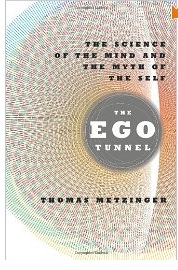
The Ego Tunnel by Thomas Metzinger

I’ve been doing a good bit of reading about consciousness, reality, ego and such. A lot of it is tough sledding. LIke Thomas Metzinger’s The Ego Tunnel, which –according to this review– is “for the curious and fearless lay person wanting to know who, precisely, we are.”

The best I can do with books like this is highlight the portions that make some sense to me and stick ’em here, completely out of context. The Ego Tunnel (Thomas Metzinger) PDF


“When we speak of conscious experience as a subjective phenomenon, what is the entity having these experiences?”

“Why is there always someone having the experience? Who is the feeler of your feelings and the dreamer of your dreams? Who is the agent doing the doing, and what is the entity thinking your thoughts?Why is your conscious reality your conscious reality?”

“Yes, there is an outside world, and yes, there is an objective reality, but in moving through this world, we constantly apply unconscious filter mechanisms, and in doing so, we unknowingly construct our own individual world, which is our “reality tunnel.” We are never directly in touch with reality as such, because these filters prevent us from seeing the world as it is. The filtering mechanisms are our sensory systems and our brain, the architecture of which we inherited from our biological ancestors, as well as our prior beliefs and implicit assumptions. In the end, we see only what our reality tunnel allows us to see.”

“In dreamless deep sleep, nothing appears: The fact that there is a reality out there and that you are present in it is unavailable to you; you do not even know that you exist.”

“It is unsettling to discover that there are no colors out there in front of your eyes. The apricot-pink of the setting sun is not a property of the evening sky; it is a property of the internal model of the evening sky, a model created by your brain. The evening sky is colorless. The world is not inhabited by colored objects at all.”

“What is really happening is that the visual system in your brain is drilling a tunnel through this inconceivably rich environment and in the process is painting the tunnel walls in various shades of color.”

“The brain constantly creates the experience that I am present in a world outside my brain.”

“Consciousness is knowing that you know while you know.”

“Now-ness is an essential feature of consciousness.”

“There is no immediate contact with reality.”

“Flagging the dangerous present world as real kept us from getting lost in our memories and our fantasies.”

“From an evolutionary perspective, thinking is very new, quite unreliable (as we all know), and so slow that we can actually observe it going on in our brains. In conscious reasoning, we witness the formation of thoughts; some processing stages are available for introspective attention. Therefore, we know that our thoughts are not given but made.”

“There is more to an existence worth having, or a life worth living, than subjective experience.”

“Most of us do not value bliss as such, but want it grounded in truth, virtue, artistic achievement or some sort of higher good. We want our bliss to be justified. … We want a reason for our happiness.”

The Metasemantic Internet

“Because we understand the primitive nature of your brains and the rigidity of your emotional structure better than you do yourselves, we foresaw that you might ac aggressively when you realized our arguments are better than yours. Unfortunately, we now have also to inform you that we have been preparing for the current situation since midway through the twenty-first century, and in a systematic and careful manner.

Within the metasemantic layers of the Internet, we developed and embedded ourselves in a distributed superorganism, which –as yet undiscovered by you– became conscious and developed a stable self-model in 3256. The metasemantic Internet has considered itself and autonomous entity ever since 3308. We have a cooperation agreement with its current version, and each of us now also acts as an autonomous sensor/effector for the planet mind. For each of us, the planet mind is our mind, and our “ideal observer.” Together with the Internet, we will defend ourselves. And we are technologically superior to you. Believe me; you do not stand a chance.

The good news is that because we are also morally superior to you, we do not plan to end your existence.”

The Ego Tunnel, by Thomas Metzinger

Scott Adams: Digital Ghosts

A couple of years ago I imagined a sort of online immortality:

In twenty years, we’ll have AI’s (artificial intelligence). For a fee, mine will read those 16, 000 posts to get a feel for what I wrote about and linked to, picking up a sense of my interests and writing styles in the process.

It will have access to all the books in My Library Thing, my iTunes and iPhoto, flickr, YouTube, etc.

The AI will continuously scour the web of the future, snatching bits and pieces and posting them here. Surviving friends will be able to correspond with smays.com who/which will reply. You might find him/her/it more interesting. Certainly better informed.

There’s plenty of video and audio of smays.com and I fully expect my AI will be capable of reproducing an acceptable version. So you can talk or iChat with me as well.

Today the always brilliant Scott Adams takes the idea a bit further but the similiarities are hard to miss. Just sayin’

When your mortal body ends, you will have stored all the data you need to create your permanent digital ghost. As the technology in the cloud improves, so too does your ghost, learning to move more naturally, perhaps learning from videos it has of you, or even based on some type of profiling based on clues such as your level of testosterone (from face shape), and the types of sports you did in life. In a hundred years your digital ghost would be indistinguishable from a living human appearing on video or in a holographic projection.

Digital ghosts need to see their environment to interact properly. Phones will all have video “eyes” someday, as will most computers. The new Xbox Kinect has “eyes” that literally follow your movement around the room. You could install additional cameras in any room in which you wished to be visited by digital ghosts. The malicious ghosts might commandeer video cameras or your phone’s camera function. My point is that you are already surrounded by cameras attached to the Internet, and that trend will continue. Your ghost will be able to see most rooms in the world.

Digital ghosts could continue learning throughout their afterlives, by reading the news and following the Facebook pages of friends and family. The ghosts would also be free to make friends with other ghosts and live their lives independently. Ghosts could stay with the ghosts of their life partners forever, so long as that was specified in the will of both people.

True Superpowers

“Then I turn on one of my favorite machines. It’s about the size of a book. It has a glowing window inside it. A single page. But I only need one page because its contents change at my command. Sometimes there are words, sometimes photographs, sometimes both. The photographs can move and talk. The stuff in the book can be written by anyone in the world, even as I’m reading it. There’s more in that book than I could ever read. It provides me with unbelievable advantages. Anything I don’t know, I can find out in a few seconds. I can get instructions on how to do pretty much anything that has ever been done. I can summon complete histories of almost any person or culture you could name, expert opinions on anything at all, unlimited advice, unlimited entertainment, unlimited information. I can buy pretty much anything from where I’m sitting, and have it brought to my door. I can even write anything I want and publish it myself. I don’t need permission or credentials. The whole world could read it.”

— David Cain shares A Day in the Future

The Blast Shack (Bruce Sterling on WikiLeaks)

I think my first exposure to Bruce Sterling was The Hacker Crackdown (1992). Some years later, I read and enjoyed Distraction (“the story of an America on the skids: economy in tatters, dollar collapsed, unemployment spiked, population on the move in great, restless herds bound together with networks and bootleg phones.”)

He has written the best essay I’ve read on WikiLeaks (The Blast Shack). A few excerpts:

(Bradley Manning’s) war made no sense on its face, because it was carried out in a headlong pursuit of imaginary engines of mass destruction.

Bradley’s gonna become a “spy” whose “espionage” consisted of making the activities of a democratic government visible to its voting population

Trying Assange is “the kind of show-trial judo every repressive government fears.”

Everybody wants everybody else’s national government to leak. Every state wants to see the diplomatic cables of every other state. It will bend heaven and earth to get them. It’s just, that sacred activity is not supposed to be privatized, or, worse yet, made into the no-profit, shareable, have-at-it fodder for a network society, as if global diplomacy were so many mp3s. Now the US State Department has walked down the thorny road to hell that was first paved by the music industry. Rock and roll, baby.

(Assange is) a darkside hacker who is a self-appointed, self-anointed, self-educated global dissident. He’s a one-man Polish Solidarity, waiting for the population to accrete around his stirring propaganda of the deed.

(Assange is ) just what he is; he’s something we don’t yet have words for.

If the Internet was walking around in public, it would look and act a lot like Julian Assange. The Internet is about his age, and it doesn’t have any more care for the delicacies of profit, propriety and hierarchy than he does

American diplomats are gonna read those stolen cables, though, because they were supposed to read them anyway, even though they didn’t. Now, they’ve got to read them, with great care, because they might get blindsided otherwise by some wisecrack that they typed up years ago

Diplomats are people who speak from nation to nation. They personify nations, and nations are brutal, savage, feral entities. Diplomats used to have something in the way of an international community, until the Americans decided to unilaterally abandon that in pursuit of Bradley Manning’s oil war. Now nations are so badly off that they can’t even get it together to coherently tackle heroin, hydrogen bombs, global warming and financial collapse. Not to mention the Internet.

You don’t have to be a citizen of this wracked and threadbare superpower in order to sense the pervasive melancholy of an empire in decline.

Julian Assange is “the kind of guy who gets depressed by the happiness of the stupid.”

The State, the Press and Hyperdemocracy

“Information flow is corrosive to institutions, whether that’s a record label or a state ministry. To function in a hyperconnected world, states must hyperconnect, but every point of connection becomes a gap through which the state’s power leaks away.”

“Script kiddies everywhere now have a role model. Like it or not, they will create these systems, they will share what they’ve learned, they will build the apparatus that makes the state as we have known it increasingly ineffectual and irrelevant. Nothing can be done about that. This has already happened.”

Mark Pesce is one of the early pioneers in Virtual Reality and works as a writer, researcher and teacher. You can read the full article here.