First iPad on (and before) Missouri Supreme Court

Missouri Supreme Court Judge Mary Russell received an iPad for Christmas and she stopped by the Coffee Zone on Saturday to get some tips on apps. In this photo Mac God George Kopp is showing her something on his iPhone (that’s my Barb in the middle).

Judge Mary is rightly proud of being the first member of the court to have a iPad and mentioned that one of the attorneys arguing before the court this past week used an iPad for notes. Another first.

I’m telling you, these things are going to be everywhere

Matt Taibbi: “It was good times in America for a while”

“Back when America was still a feared international bully that was flush with borrowed Saudi and Chinese cash and could stand to blow a few hundred extra billion in public funds every year on budget-padding deals — back in the Bush years — John Boehner was the perfect candidate for congressional leadership, a lifetime company man who didn’t give a shit about most Americans but could shed tears on national television on behalf of Jamie Dimon’s (CEO of JP Morgan) bottom line.”

“Things are different now. America is so broke, there’s no longer really any money in the Treasury to give away — the job of overseeing corporate handouts that used to belong to the leaders of Congress has now moved to the Federal Reserve, which itself is so broke that it has to invent dollars out of thin air before it can give them away to influential billionaires. This leaves congressional leaders with nothing to do but their ostensible jobs — i.e., fixing the country’s actual problems — and few of the current leaders have any experience with that, Boehner being a prime example. The new speaker represents an increasingly endangered class of Beltway jobholders who know how to raise money and get elected, but not much beyond that. He now finds himself the party’s last line of defense against millions of angry voters who, for the first time in recent memory, are at least attempting to watch what Congress is up to.”

Matt Taibbi on John Boehner (Rolling Stone)

The State, the Press and Hyperdemocracy

“Information flow is corrosive to institutions, whether that’s a record label or a state ministry. To function in a hyperconnected world, states must hyperconnect, but every point of connection becomes a gap through which the state’s power leaks away.”

“Script kiddies everywhere now have a role model. Like it or not, they will create these systems, they will share what they’ve learned, they will build the apparatus that makes the state as we have known it increasingly ineffectual and irrelevant. Nothing can be done about that. This has already happened.”

Mark Pesce is one of the early pioneers in Virtual Reality and works as a writer, researcher and teacher. You can read the full article here.

How the bailout program works

It is a slow day in a damp little Irish town. The rain is beating down and the streets are deserted. Times are tough, everybody is in debt and everybody lives on credit. On this particular day a rich German tourist is driving through the town, stops at the local hotel and lays a €100 note on the desk, telling the hotel owner he wants to inspect the rooms upstairs in order to pick one to spend the night. The owner gives him some keys and, as soon as the visitor has walked upstairs, the hotelier grabs the €100 note and runs next door to pay his debt to the butcher. The butcher takes the €100 note and runs down the street to repay his debt to the pig farmer. The pig farmer takes the €100 note and heads off to pay his bill at the supplier of feed and fuel.

The guy at the Farmers’ Co-op takes the €100 note and runs to pay his drinks bill at the pub. The publican slips the money along to the local prostitute drinking at the bar, who has also been facing hard times and has had to offer him “services” on credit. The hooker then rushes to the hotel and pays off her room bill to the hotel owner with the €100 note. The hotel proprietor then places the €100 note back on the counter so the rich traveller will not suspect anything.

At that moment the traveller comes down the stairs, picks up the €100 note, states that the rooms are not satisfactory, pockets the money and leaves town. No one produced anything. No one earned anything. However, the whole town is now out of debt and looking to the future with a lot more optimism.

Source unknown

Worried Nation

“Millions of Americans are currently worried about two things that are, in their minds, emotionally related. The first of these is the prospect that white people will no longer be the majority in this country, and the second is that the United States will be just one among many world powers.”
— Christopher Hitchens

Live with the WikiLeakable world or shut down the net. It’s your choice

“What WikiLeaks is really exposing is the extent to which the western democratic system has been hollowed out. In the last decade its political elites have been shown to be incompetent (Ireland, the US and UK in not regulating banks); corrupt (all governments in relation to the arms trade); or recklessly militaristic (the US and UK in Iraq). And yet nowhere have they been called to account in any effective way. Instead they have obfuscated, lied or blustered their way through. And when, finally, the veil of secrecy is lifted, their reflex reaction is to kill the messenger” — via guardian.co.uk

The chickens just called. They’re running late but will be back at the roost shortly.

Scott Adams: Online voting

“Our current system, which features massive traditional advertising aimed primarily at older voters, would become obsolete. With online voting, the average age of voters would shift dramatically lower. The young are less susceptible to advertising because they use technology such as DVRs and ad-blocking software to avoid ads. And they avoid traditional print media altogether.  When big advertising budgets become less effective, special interests become less powerful because their money can’t help politicians get elected.”

“I started this post by claiming online voting would solve almost every problem in the world. My observation is that our planet doesn’t suffer from a lack of resources, just a lack of competence in managing those resources. Online voting could replace a broken government with one that allocates resources efficiently. And that one change, in time, could stimulate and release the economy to solve almost every problem in the world.”

Scott Adams: Eliminating Political Parties

“Now imagine what would happen to campaign funding if political parties didn’t exist. In our current system, a union can give a million dollars to the Democratic Party and it doesn’t seem too wrong because the party represents about half of the voters in the country. But if political parties didn’t exist, unions or corporate interests would have to donate to individuals. And a large donation to an individual campaign would either be illegal or it would look so much like a bribe that it would be counter-productive.

I think political parties made sense in pre-Internet times. It was a good way to organize and to produce candidates who had a legitimate chance of getting elected. Now it’s easy to imagine the Internet being a better platform for electing the right people. The problem is that there’s no way to get to a different type of system from here. The major parties are too entrenched to give up power, and belonging to organizations is a fundamental freedom.”

Does my vote really matter?

All my life I have been told that it does. The candidates have told me that. The news anchors told me that. My civics teacher told me that. And like many such givens, I beleived it must be true.

But this thoughtful post by David Cain has made me reconsider. I’m just pulling a graf to keep this short so if you give a shit one way or the other you really should read his entire post:

“Many people are uncomfortable with the idea of not voting because they feel like they would then be forfeiting the only power they have over who governs. But your vote contains no power. It is a virtually inert token of your participation, which does carry some sentimental value to some people. But it has no election-swinging ability. There are plenty of actions that can make a difference but casting your vote isn’t one of them.”

For some bizarre reason, Mr. Cain’s post caused me to flash on the carnival midway. One of the “games” involved trying to toss a wooden hoop around a small fishbowl that contained a goldfish. The bowl was just two feet away and you could almost lean over and drop the hoop on the bowl. But not quite. The carney guy understood something that I didn’t. Even if I got the goldfish, he wins.

Mr. Cain also argues that if the election is really important to you, you’ll do more than vote. You’ll knock on doors and work your ass off in other ways. I can find no flaw in that logic.

Before you dismiss the idea that your vote doesn’t really make a difference, read the post.

Covering election returns

Election night was a big night for radio station news departments. Or, they were back in the 70’s in the little town where I worked.

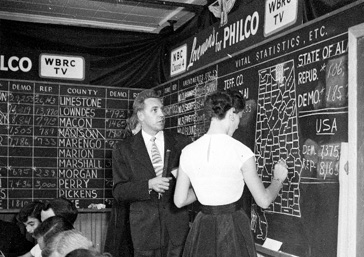
The candidates would crowd into the county clerk’s office and watch as the votes were written on a big chalk board. The radio station news guy would setup a small transmitter and send back updates that were broadcast live. You were either there… listened to us… or heard the results the next morning at the local coffee shop.

When I started working with The Missourinet (a statewide radio network) in the mid-80’s, it wasn’t that different. One of our reporters would set up at the Secretary of State’s office with a dedicated land-line (before cell phones). Maybe they used one of the state’s phones, I don’t recall. But the reporter would phone in regular updates to the network newsroom where they’d go out to affiliate stations around the state.

Sometime in the 90’s technology improved to the point where we could Telnet into the the state computers (via very slow modem’s) and access the numbers directly. And then report them over the network.

Fast forward to the Web. No more Telnet but those early websites were very glitchy. And slow. But they got better every election. It was a wonderful thing. Anyone with internet access could see the returns as they were tabulated. But it was still easier for radio stations (and their listeners) to take our reports than produce their own.

Last week one of our news directors stopped by my office to talk about what we would do online for the upcoming election. Missouri’s Senate race is the Main Event and we’ll have reporters at both candidates venue. They’ll do interviews and feed those back to the network where reporters will be working the Secretary of State’s website.

One the other end of the information pipe, people will still be listening to the radio and watching TV but I expect Twitter and Facbook to be where many get their first information. (Does the Secretary of State have a Twitter feed?). And most of it will be mobile.

Eventually we’ll all vote electronically, without standing in line. And we’ll see the results in near real time.

Will this elections more susceptible to fraud? Girl, please! Is the TSA making flying safer?