
Category Archives: Politics & Government
TED TALK “Economy of influence”
Lawrence Lessig’s July 29, 2010, TEDxBoston talk. Why your vote matters less.My election day gift to the readers of smays.com
“Why network news hasn’t mattered since the seventies”
Matt Taibbi opens up a family-size can of whup-ass on CBS Chief Foreign Correspondent Lara Logan. Here are a couple of grafs:
“Anyone who wants to know why network television news hasn’t mattered since the seventies just needs to check out this appearance by Logan. Here’s CBS’s chief foreign correspondent saying out loud on TV that when the man running a war that’s killing thousands of young men and women every year steps on his own dick in front of a journalist, that journalist is supposed to eat the story so as not to embarrass the flag. And the part that really gets me is Logan bitching about how Hastings was dishonest to use human warmth and charm to build up enough of a rapport with his sources that they felt comfortable running their mouths off in front of him. According to Logan, that’s sneaky — and journalists aren’t supposed to be sneaky.”
“As to this whole “unspoken agreement” business: the reason Lara Logan thinks this is because she’s like pretty much every other “reputable” journalist in this country, in that she suffers from a profound confusion about who she’s supposed to be working for. I know this from my years covering presidential campaigns, where the same dynamic applies. Hey, assholes: you do not work for the people you’re covering! Jesus, is this concept that fucking hard? On the campaign trail, I watch reporters nod solemnly as they hear about the hundreds of millions of dollars candidates X and Y and Z collect from the likes of Citigroup and Raytheon and Archer Daniels Midland, and it blows my mind that they never seem to connect the dots and grasp where all that money is going. The answer, you idiots, is that it’s buying advertising! People like George Bush, John McCain, Barack Obama, and General McChrystal for that matter, they can afford to buy their own P.R. — and they do, in ways both honest and dishonest, visible and invisible.”
I’ve stopped watching television news for the same reason I’ve stopped donating to political campaigns and answering our land-line phone. Almost all bullshit.
“The Spill, the Scandal and the President”
That’s the title of a damning story in Rolling Stone by Tim Dickinson. The sub-title sums it up: “The inside story of how Obama failed to crack down on the corruption of the Bush years – and let the world’s most dangerous oil company get away with murder”
There are so many depressing aspects to this story I don’t know where to begin.
“As BP was cutting corners aboard the rig, the Obama administration was plotting the greatest expansion of offshore drilling in half a century. In 2008, as prices at the pump neared $5 a gallon, President Bush had lifted an executive moratorium on offshore drilling outside the Gulf that had been implemented by his father following the Exxon Valdez. On the campaign trail, Obama had stressed that offshore drilling “will not make a real dent in current gas prices or meet the long-term challenge of energy independence.” But once in office, he bowed to the politics of “drill, baby, drill.” Hoping to use oil as a bargaining chip to win votes for climate legislation in Congress, Obama unveiled an aggressive push for new offshore drilling in the Arctic, the Southeastern seaboard and new waters in the Gulf, closer to Florida than ever before. In doing so, he ignored his administration’s top experts on ocean science, who warned that the offshore plan dramatically understated the risks of an oil spill and petitioned Salazar to exempt the Arctic from drilling until more scientific studies could be conducted.”
As a contributor to the Obama campaign in 2008, I’m on a shit-load of mailing lists and frequently get calls to contribute. I told the last guy, “No.” He asked why and I told him I was disappointed in so many of the president’s decisions (or lack of decisions). The young man asked for specifics, ready with a screen-full of talking points and responses, but I declined.
He said something like, “In a democracy, nobody is going to agree with everything the president has to do. If you approve of 75% of his actions, that would be pretty good.” Not for me. Not if that 25% is symptomatic of the same old political shit that Obama promised to move beyond. Uh uh.
Am I sorry I voted for Obama? Not given the McCain-Palin option. Is Obama a better president that W? Yeah, probably, but so what. That aint much of a bar.
[For some reason this story is no longer available on the Rolling Stone website]
“Generic Angry Slogan!”
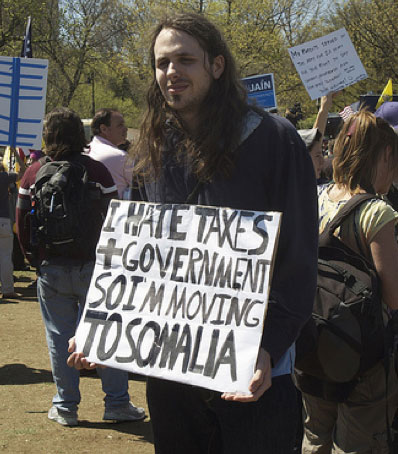
Best Fake Teabagger Signs at the Boston Common Tea Party » Via PlanetNelson.com
Letters to the President
From The Huffington Post: “In his first week as president, Obama asked his staff to select 10 letters a day for him to read from among the tens of thousands that were flooding into the White House. … Fourteen months later, Obama still takes 10 letters (including e-mails and faxes) with him when he heads upstairs at the end of each weekday. He personally writes back to three or four.”
My suggestion posted here in March of 2008:
“President Obama reads, answers and acts on one email –from an American citizen– every week. Let’s say, on Friday. Here’s how it might work:
Anybody can email the president once a week. Yes, people will try to find ways to scam this but you can deal with that. On Friday morning, 10 emails are selected at random and forwarded to President Obama’s in-box. He looks through them, picks one and responds –personally– to the sender. If action is required, the email is forwarded to the appropriate subordinate who has to DO something because the president –and the country– will be watching.
My suggestion goes a bit further but the two are eerily close. And, yes, I did email my suggestion to the Obama campaign.
Truth 2.0
Arianna Huffington makes some predictions of what comes next for the Internet and I sure hope she’s right. A few excerpts:
- “An online tool that makes it possible to instantly fact-check a story as you are reading it — or watching it on video. Picture this: It’s last summer and you are reading or watching a story about health care, and Sarah Palin or Betsy McCaughey is prattling on about death panels. Instantly, a box pops up with the actual language from the bill or a tape rolls with a factual explanation of what the provision in question really does. And this is a non-partisan tool. So when, in the midst of the legislative debate, President Obama says “I didn’t campaign on the public option,” the software will fire up and instantly show you where support for the public option appeared in his campaign plan, and clips of all the times he mentioned it in public after he got elected.
- A .com innovation that immediately provides a reader or viewer with the background knowledge needed to better understand the data and information being delivered as news. The powers-that-be — both political and corporate — have mastered the dark art of making information deliberately convoluted and indecipherable. For them, complexity is not a bug, it’s a feature.
- Our future tool will also automatically simplify needlessly complicated laws, contracts, and linguistic smoke screens. So when a politician or Wall Street CEO performs the usual verbal gymnastics in an attempt to befuddle and bamboozle us, his words will immediately be translated into clear and precise language. It will be Truth 2.0.
- In the future, software will be created that allows us to pull the curtain back on the corridors of power and see who is really pulling the levers. A great early iteration of this was provided by the Sunlight Foundation during the recent health care summit. During its live streaming of the discussion, the Foundation offered a dose of transparency by showing, as each of our elected officials was speaking, a list of his or her major campaign contributors. It was simple, powerful, and spoke volumes about the extent to which many players in the summit were bought and paid for.
I think this will happen because it can happen. I hope this scares the shit out of the politicians and power-brokers.
Spoofing Rove’s book
Matt Taibbi: Shorting America
“It’s weird enough living in a country where a man can legally own an arsenal of machine guns, but his neighbor growing a pot plant will send a team of DEA agents kicking his door in with a no-knock warrant. But this goes even beyond that. If I go online today to HaveNoLifeAndBetOnSports.com and bet fifty dollars on the Bucks against the Celtics tonight, I’m a criminal. But some gazillionaire firm in New York can legally bet against the United States of America in unlimited amounts in a trade that has nothing to do with anything, but a guess about how many other people will make the same bet.”
Streaming video of committee hearing
I took the little BT-1 Bluetooth webcam back to the Missouri capitol yesterday for a hearing. Used twitcam to stream. The audio was poor to marginal and the video about what you’d expect from a $150 camera. It was basically a final field test and I was pleased.
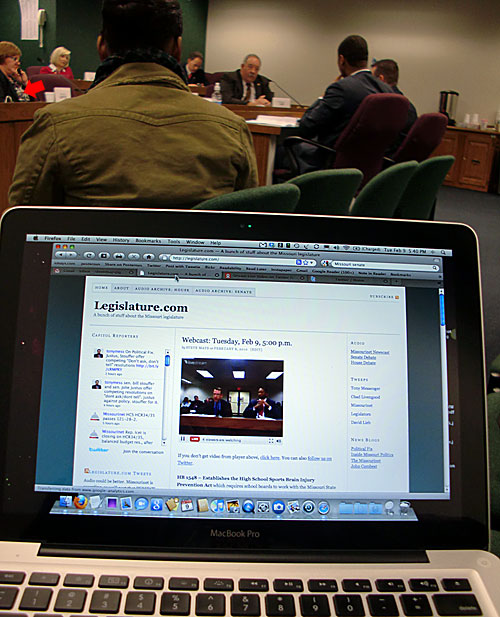
If you look closely (red arrow) in the top left corner of the photo above, you can see the aluminum legs of the small tripod holding the camera. I was about 20-25 feet away. The camera was very unobtrusive and it was convenient to be untethered and out of the way.
One of these days there will be a high-profile news conference we’ll want to stream live and I’ll just grab the BT-1 and the MacBook Pro. We don’ need no stinkin’ satellite truck.
PS: I have no idea why Wilfred Brimmley is on the committee (top center)