
PageCast: Short, sweet and real

There are just so many things I like about The PageCast, I’m not sure where to begin. First, what is The PageCast.

It’s a 60 second video by Time Magazine’s Mark Halperin, previewing the three stories that he thinks you should be watching for today. You’ll find it on the top/right of The Page. Big whoop, right? Okay, here’s some of the things I like about this simple idea (and this particular PageCast):

  • It maximizes the reach of a popular, plugged-in political reporter.
  • It’s short. One minute. Easy to watch, easy to produce.
  • It’s real. Or at least it appears real. Today’s PageCast was recorded in what appears to be Mr. Halperin’s hotel room in South Dakota (prior to Tuesday’s primary). And he obviously just came from the gym or a run. (Note to TV and Hollywood directors: THIS is what real sweat looks like. Not the little spritz you put under your star’s arms and on his chest. Save this image for future reference). And Mark hasn’t shaved yet. The guy looks like we all do on a Sunday morning.
  • Zero production. If I had to guess, I’d say he recorded this with his Mac Book sitting on the hotel desk. Probably in one take. He emails the file to some web monkey who uploads to The Page and it’s done. No crew, no director, no editing.

The news directors of our radio networks would be great at this. And their listeners/readers/viewers would eat it up.

UPDATE: My buddy Kay reports that Mark Halperin records PageCast between 7-9 a.m. (usually), wherever he happens to be and in whatever he happens to be wearing. If he’s on the West Coast, he usually records them at night. He thinks of what he wants to say just before he begins recording (or in the shower or at the gym), on his MacBook Pro (edits with iMovie).

The idea was prompted by the desire to put video on The Page, while keeping it easy to produce and watch. Just as I suspected. Simple idea, well executed.
New report calls podcasting growth “massive”

The guys at Podcasting News share highlights from a new report by Universal McCann that suggests new media is becoming mainstream media. Among the research highlights:

“Blogs are a mainstream media world-wide and a collective rival to traditional media (184m bloggers world-wide, China has the largest blogging community in the world with 42m bloggers) – 73% have read a blog, 45% have started a blog.”

Key social platforms mentioned in the report: Blogging; Micro Blogging; RSS; Widgets; Chat Rooms; Message Boards; Podcasts; Video Sharing; Photo Sharing.

If you’re in media now and these terms are foreign to you, or seem silly and pointless, the Cluetrain doesn’t stop here anymore.

Apple wants to be your news and information station


“An Apple patent reveals that the company is working on a podcast aggregator that would dynamically collect the news that you are interested in and deliver a personalized news podcast. In other words – Apple wants to be your news and information station. The system would allow you to:

* Subscribe to and personalize a podcast with software like iTunes;
* Select news segments selected from a variety of categories; and
* Automatically download the personalized podcast to your Apple TV, iPod or iPhone.

The custom news show could consist of a 5 minute segment from CNN on the day’s national news, a 5 minute segment from a local news station, and a 10 minute segment on sports highlights from ESPN.

Once you select the playlist of content that you’re interested in, Apple’s servers would request the latest podcast content from content creators, stitch the segments together and then deliver the personalized podcast to iTunes or other podcast software. As part of this process, Apple could insert targeted advertising dynamically.” – Apple Insider via Podcasting News

Hmmm. A listener in the states served by our networks could include one of our 4 minute state newscasts, a three minutes sports report and a farm report. That “stitching segments together” part is what I find intriguing. Terry Heaton wrote about the “unbundling” of media. Is this a “re-bundling” of media?

If I were programming a local radio station, I’d be damned sure I had a killer local newscast/podcast up on iTunes.

Public radio and podcasting

Mark Ramsey points us to an interesting piece by “The Long Tail’s” Chris Anderson on how his listening behavior to public radio has been transformed by podcasting.

“I realized that I don’t really support my local affiliate. I love some of the shows it broadcasts and hate others. My attachments are to individual shows, not to a broadcast station. My engagement with public radio is at a more granular level than the affiliate.

Now that I get my radio via podcast, I don’t have to take the bad shows with the good. I’ve got an a la carte menu, and I assemble my own schedule with what I want and when I want it.

But look at the arc of history here. The podcast model is getting cheaper and more ubiquitously available (who doesn’t have a cellphone?), and it serves individual needs and taste better. Meanwhile the broadcast model, which is all about one-size-fits-all taste, is based on human labor costs and costly transmission equipment and is only getting more expensive. You can see how this story ends.”

I’ve had the same guilty thoughts about my own listening habits. I like a lot of NPR programs but listen to them as podcasts. And I would be willing to pay for the best shows (This American Life, for example).

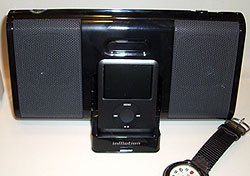
IpodspeakerAnd my morning listening routine has improved with the purchase of a small speaker/doc for my iPod nano. Each evening iTunes downloads any new podcasts to which I’m subscribed, and syncs to the nano. In the morning I pop the nano into the speaker dock and listen to a perfectly customized line-up of progams.

Dave Winer podcasts “because I want to say something”

“There’s a mini-debate going on about whether podcasting is a success or worth it, or whatever, I’m not sure exactly what the issue is, but it’s framed this way –> if you can’t get advertisers to hitch a ride on your podcast then podcasting is not worth much if anything.

My phone doesn’t have a business model. Neither does my porch. I still like having a phone and a porch because they help me meet new people and communicate with people I know. Same with my blog and podcast.

I do a podcast from time to time because I want to say something. Whether I can run an ad on my podcast means nothing to me because I would never do it. … I would never burden my podcasting with the task of supporting me. It’s not why I podcast. … Blogging and podcasting exist independent of a professional’s ability to eek out a living using the tools of blogging and podcasting.”

You can read Mr. Winer’s full post here.

My colleague David is helping a number of clients with blogs and podcasts and none are ad supported. They exist solely to help tell the client’s story. Blogs and podcasts are inexpensive, effective, easy and fun.

For my part, nothing ruins a good hobby like trying to make money with it.