Try to play the hits

I came of age in the era of push-button radios (in cars). If a station played a song I didn’t care for… (chunk!) I hit the button for another station. Commercials or news? (chunk!) If going through my presets didn’t get me a song, I’d keep punching. When I got a job as a DJ an awareness of that ever-so-brief window was hard-wired. You only had a listener until you aired something they didn’t like. Which was inevitable, of course, especially in a small market like ours. But you tried to play the good stuff and keep the tune-outs to a minimum.

I’ve always (instinctively?) approached online with this in mind. Blogging in the early days and social media later. Will my share ‘hold’ the reader… or tune them out? After all, few of my ‘followers’ know who I am (or care). They’re waiting for the next nugget and if it doesn’t come (often enough) why would they hang around.

I have a theory that most on social media imagine a relationship that doesn’t exist. “They follow me because they care about what’s happening in my life, even the most trivial thought or event.” Maybe. I’m gonna keep playing the hits (or try to).

Kennett’s Flying Bank Robber

In January of 1976 I was on the air (noon hour?) at KBOA in Kennett, MO, when the police scanner in the studio went nuts. Someone (dispatcher? patrolman?) was yelling that someone had robbed the bank and “took off in an airplane!”

I grabbed a cassette recorder and dashed out of the station, yelling for someone to go up and take over the live studio. I got to the small motor bank before the police and got a few minutes of audio with the teller who had been robbed.

Police showed almost immediately and made me get out. I was pumped because I had some good stuff. When I pulled the cassette from the recorder it was hopelessly wound around the roller and gears and shit. No way to salvage. I nearly wept. Instead, I hung around long enough to get a little more information and then headed back to the station where I did a quick ad lib report live and then started writing up the story.
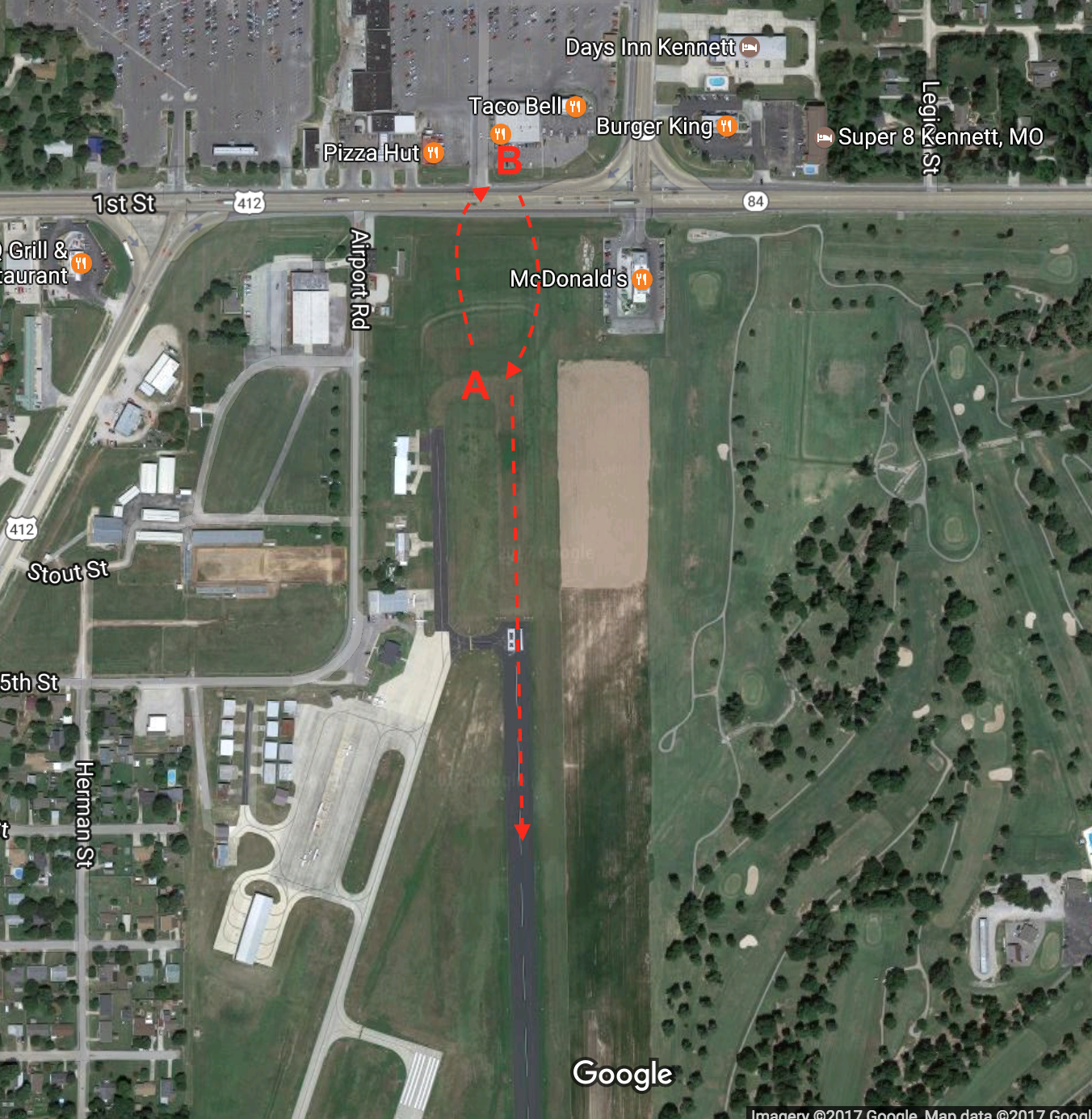
The satellite image above tells you most of what you need to know. The pilot taxied the small plane out to A where pilots always stopped to let their engines warm up before take off. He slipped out and ran across the highway to the small motor bank (Bank of Kennett). This was a tiny little facility. Room for maybe two tellers and a little lobby (6×10?) separated by glass and a door. The way I remember the story, he asked the teller for a chair and she opened the door to hand him one (he said he was waiting for a friend). He stuck a gun in her face, got the cash ($24K) and boogied back across highway (about 100 yards) and took off into the sunset. He was also charged with “interstate flight.” The FBI arrested 39 year old Dennis R. Holmes a few weeks later in Phoenix.

According to a story in the St. Louis Post-Dispatch, Joseph Appleyard, chief pilot at Dolphin Aviation in Sarasota, taught Holmes to fly a few months earlier. “He didn’t see like my average bank robber,” Appleyard said. Holmes rented the plane (in Sarasota) on the Thursday before the robbery, flew to Kennett on Saturday.

The plane was tracked on radar by the nearby Air Force base in Blytheville, AR, but lost him when it put it on the deck and disappeared. He had a range of about 700 miles.

Mr. Holmes was also arrested for holding up a bank in Arcata, CA in February. He fled in a car but quickly transferred to a small plane. He was also a suspect in a $55K stickup the previous October in Michigan. In that one the robber held up the bank just as the high school homecoming parade was about to begin, and he melted into the crowd.

If you’re out there, Dennis… if you’re reading this… how about an interview to make up for the one that got away?

Miss Martha Turner

In 2009 Joe Bankhead retired — at the age of 92 — from a 60 year career in and around radio. One of the first things he did was bang out a 20 page history of his time at KBOA in Kennett, Missouri. It’s a long read. A twenty-page core dump of Joe’s recollections. He apologizes a couple of times for his rambling, haphazard style but Joe wrote exactly the way he talked. (Lots of exclamation marks!)

I don’t think Joe really expected anyone to read 20 pages of memories (nor do I) but there’s some good stuff, especially for anyone interested in the early days of radio. So I’m going to share some of those stories here from time to time.

“I’ve got to tell you about Miss Martha Turner. Martha was a clean cut black lady from Hayti who purchased a 15-minute segment to be aired each Saturday morning. On her program she would sing an a cappella song and read all the cards and letters she would receive during the week. She’d arrive at the station three or four hours before her airtime and type out her dialogue (word for word) that she’d recite while on the air I kept a copy of Martha’s script on hand for years and I’m sorry I can’t provide it for you now. That it was unique and entertaining is a huge understatement. Miss Martha Turner deserves her spot in the history of KBOA. I don’t recall her ever trying to sell anything, or ask for donations from listeners. It appears she just wanted to be on the air and accommodate her fans by reading their letters.”

Joe died in 2011 and took with him a lifetime of great memories. I’m still amazed at his ability to recall so much detail at the age of 92. Joe’s son, Jim Bankhead, was kind enough to let me include Joe’s history on KBOA383.com (as a PDF). I transcribed the original and added a few links. It’s also searchable.

Timeline of computer stuff

I’ve got a thing about calendars. That’s not quite right. I’ve got a thing about remembering knowing when things happened and I’m really bad at remembering stuff. Even important stuff. So I kept a journal for a while and when DayTimers came along I kept one with me all the time for meetings and notes and all the rest. I think I mentioned my DayTimer purge. These days Google Calendar is my tool-of-choice for keeping up with everything. With links to Google Drive. I came across the computer related list below while working on another project.

  • 1985 – First computer. Zenith with two 7.5 in floppy drives (no HD)
  • 1/6/89 – Jefferson City Computer Club meeting
  • 10/31/89 – Bought computer made by CompuAdd?
  • 12/6/89 – Rick Williams, MSC, Columbia, MO (1st ref?)
  • 4/21/92 – Purchased computer for $3,525.86. 33/386 4 meg; 101/VGA Samsung; 16 SCSI controller
  • 11/16/93 – Computer Concepts demo (?)
  • 11/16/92 – Switched to AmiPro (word processor/desktop publishing) on office computer
  • 6/20/94 – First “notebook” computer; purchased from Bill Bahr (Iowa) for $1700. Made by Toshiba. Base price: $1400; Fax/modem PCMCIA card: $300
  • 11/21/94 – MCI Internet service – $49.95 for software; $19.95/mo – 7 hours free; $3.00 per hour after that. 9600 baud/14400
  • 12/1/95 – Gateway 2000 computer, $3,100
  • 4/24/95 – Comdex, Atlanta, GA
  • 5/8/95 – New ISP (Internet Service Provider). Summit Information Services, Holts Summit, MO. $30/mo
  • 6/3/96 – Comdex, Las Vegas NV
  • 6/10/96 – Ordered IBM ThinkPad
  • 8/23/96 – Ordered ACT 3.0 (contact manager)
  • 4/20/98 – Comdex, Chicago, IL
  • 4/19/99 – Comdex, Las Vegas, NV
  • 7/1/99 – Shut down Straylight
  • 4/21/04 – Signed up for Gmail
  • 5/7/04 – First home wifi
  • 4/17/06 – First MacBook
  • 1/6/11 – Bought Google and Apple stock. 35 shares Google @ $569; 54 shares of Apple @ $368.03. Our investment guys talked us into selling some. “Too heavy in tech”
  • 6/15/11 – Google sent me a Chromebook to evaluate. Sent two for some reason.
  • 10/28/11 – Closed PayPal account
  • 6/15/12 – MacBook Pro delivered
  • 9/20/13 – First iPhone (5s?)
  • 11/14/14 – Began using Dropbox as primary cloud storage
  • 7/9/16 – Experimented with Evernote for notes/journaling
  • 3/20/20 – First Zoom call (COVID lockdown)
  • 7/18/21 – Subscribed to Spotify/Apple Music. CDs officially dead
  • 11/9/22 – First sustained use of ChatGPT. Blog posts begin
  • 5/12/23 – Retired Dropbox; consolidated into iCloud/Google Drive
  • 9/14/24 – TaxoPress plugin for blog taxonomy overhaul
  • 8/15/25 – BookBuddy library export (1,054 titles); taxonomy mega-project

My first BBS

I joined my first BBS (bulletin board system) on November 18, 1994. It was called Fun City and was operated by Kevin Diehl.

(Wikipedia) A bulletin board system, or BBS, is a computer server running software that allows users to connect to the system using a terminal program. Once logged in, the user can perform functions such as uploading and downloading software and data, reading news and bulletins, and exchanging messages with other users through email, public message boards, and sometimes via direct chatting. Many BBSes also offer on-line games, in which users can compete with each other, and BBSes with multiple phone lines often provide chat rooms, allowing users to interact with each other. Bulletin board systems were in many ways a precursor to the modern form of the World Wide Web, social networks and other aspects of the Internet. Low-cost, high-performance modems drove the use of online services and BBSes through the early 1990s. Infoworld estimated there were 60,000 BBSes serving 17 million users in the United States alone in 1994, a collective market much larger than major online services like CompuServe.

College theater days

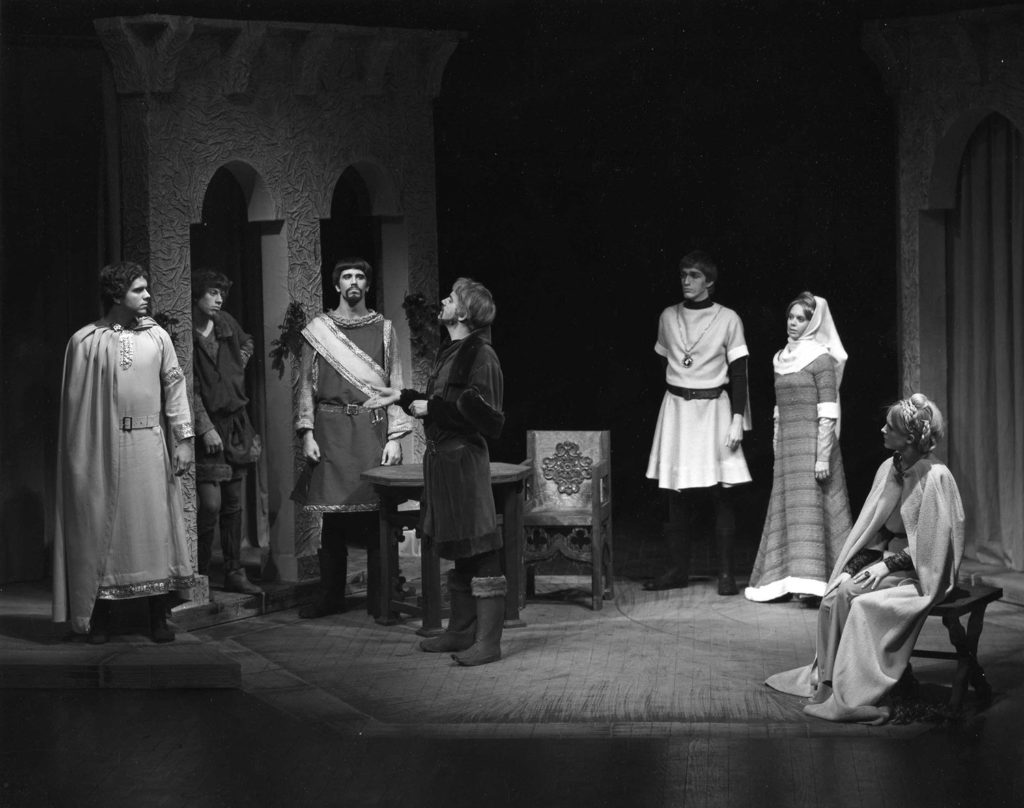
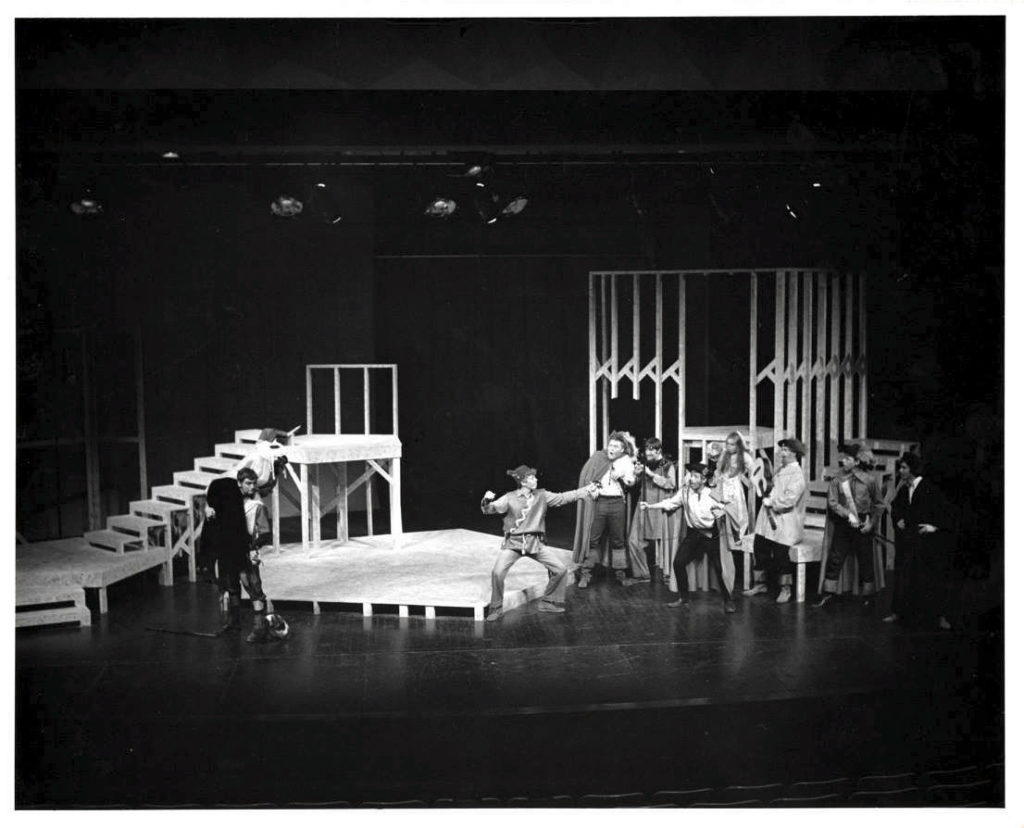
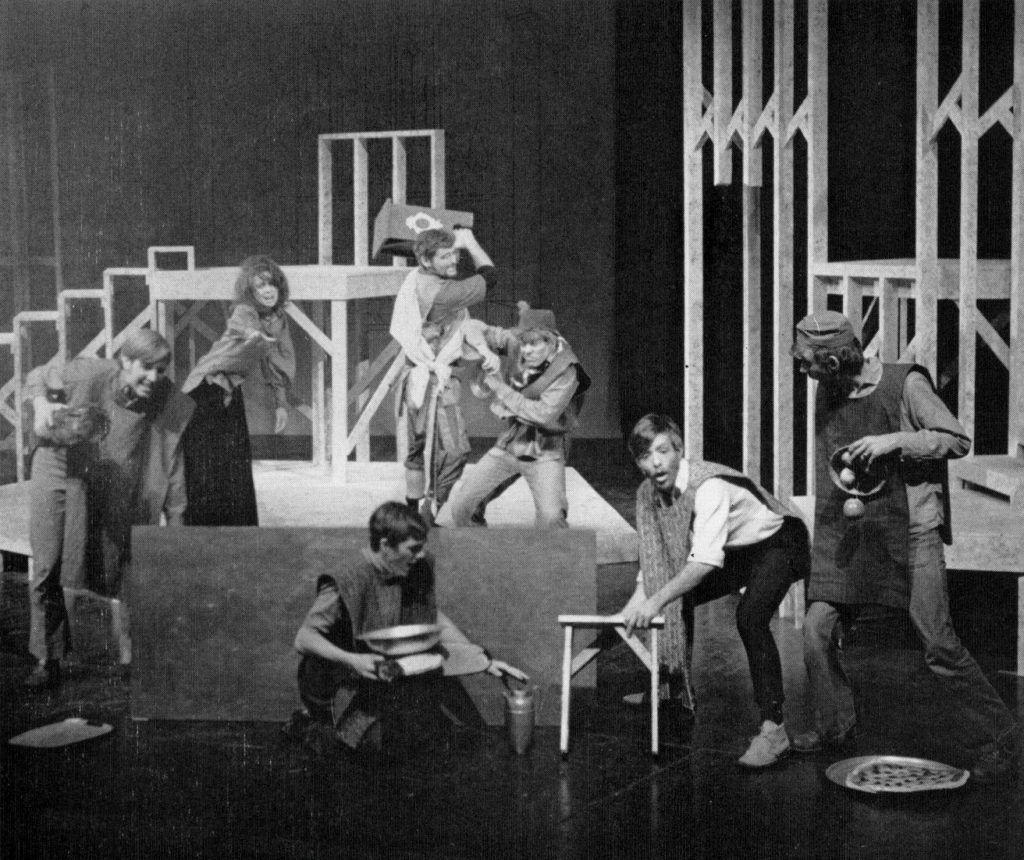
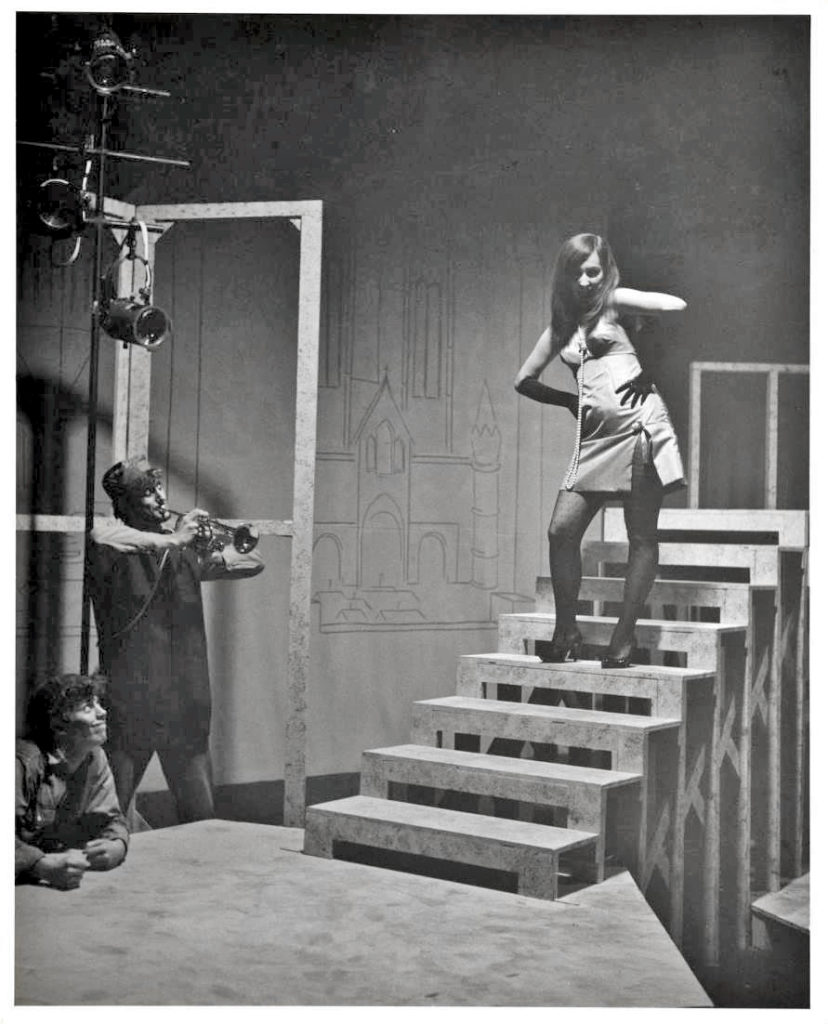
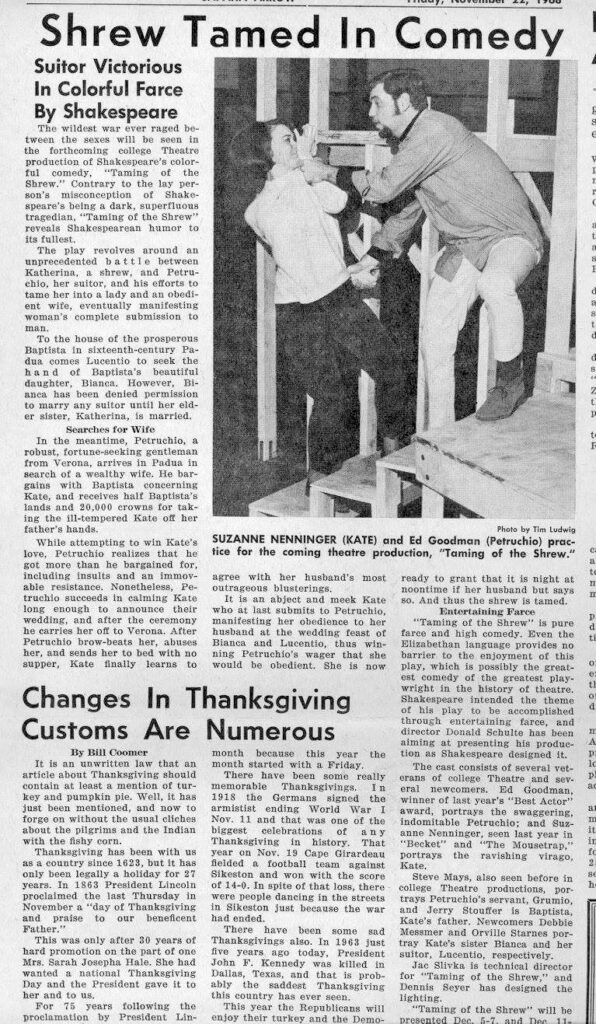
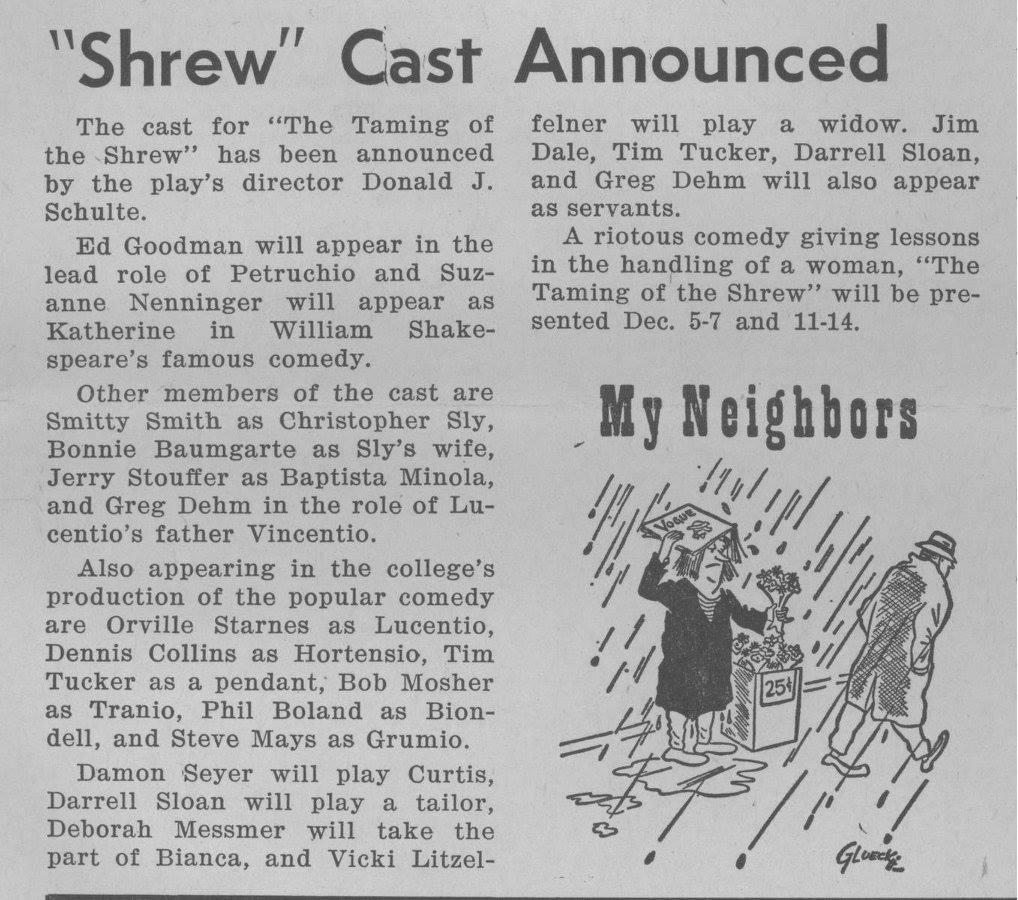
I spent my first two years of college trying to keep my draft deferment and quickly figured out I could do that better as a Speech/Theater major than as a Business major. I got a small part in Taming of the Shrew (below) my junior year which earned me a tiny scholarship ($500 a semester?). In my senior year I played the idiot son John in Lion In Winter. From the review (PDF): “Mays, in an attempt to convey his awkwardness, at times overdid John’s walk.” (Reviews below).

I loved the theater crowd. It was as cliquish as any fraternity or sorority but we didn’t have to dress as nice. As much as I enjoyed it, I never developed an interest in community theater. I still have a recurring nightmare in which I have to go onstage before a huge audience but I have never been to a rehearsal. In the dream, I’m trying to figure out how I can have a script in my hand without the audience noticing. Or come up with a way to adlib through the whole thing.