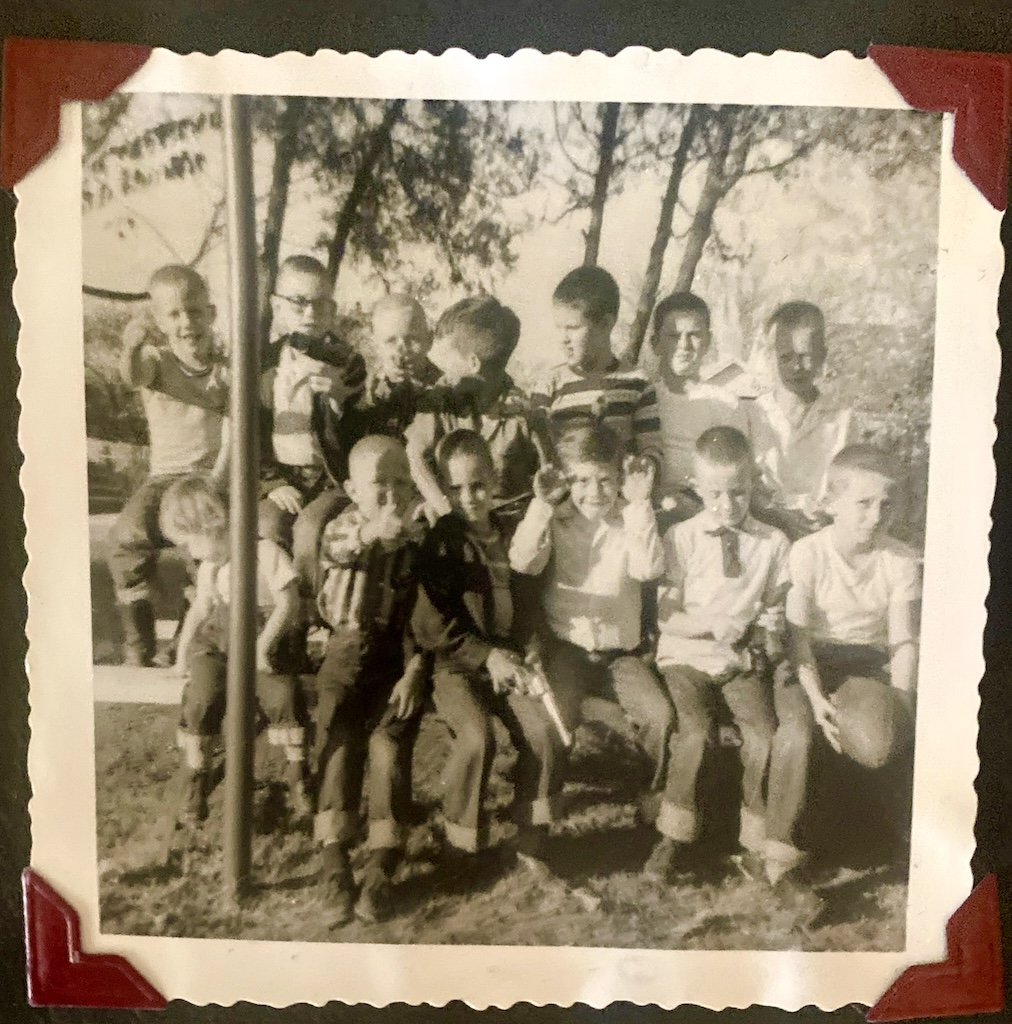
The mother of my friend John was a dedicated scrapbooker. I believe this photo actually appeared in the local newspaper (it was that kind of small town). It was taken at John’s birthday party, probably 1957.
Top row, R-L: Chris Jones, Otis Mitchell, Joe Browning, Jim Blankenship, unknown, David Covey, Steve Watson Bottom row, R-L: Jim Robison, John Robison, Steve Mays, Terry Hunter, unknown, Jane Robison
My friend John discovered a bunch of old scrapbooks in a dusty closet of the church he attends. As he poured over yellowed newspaper clippings, faded photos and church bulletins and directories, he became obsessed with the idea of preserving these. At some point he called me for advice because I had helped him make the transition from an ancient Windows PC to a Google Chromebook.
I suggested he use an app on his iPhone to scan the scrapbooks and save them as PDFs and then organize them in his iCloud account using the Files app. I explained how he could set up a folder structure put these in some sort of order. As the number of folders and files grew it became more and more difficult to do on his phone so I brought up the idea of moving this content to his Google Drive so he could manage it all on his laptop.
Somewhere along the way John asked ChatGPT for help and it mentioned Google Sites as a useful tool for making these files available. Over the years, I think I’ve used most of the better known website tools, going back to FrontPage and up through Blogger, Typepad, Posterous and, finally, WordPress. But I don’t think I was aware of Google Sites. So I started playing around and came up with this, mostly as a demo. The links on the website go to one of the folders or files in John’s Google Drive. Continue reading →
I recently came across my high school transcripts (my mom saved EVERYTHING). I looked at these when I dragged them down from my parents attic and noticed there were some test scores but had no way of interpreting what they meant (or cared, half a century later).
I remember the entire Junior (?) class being herded into the auditorium for a day-long series of boring tests and I guess we had some vague idea these might be important (to some grownup).
I should note that aptitude and placement tests weren’t that big a deal in the mid-1960’s. Nothing like the life-or-death weight they’re given today. Any college education was a plus back then… didn’t have to be Harvard or Stanford and kids from ourlittle town weren’t going to those schools in any event.
My transcript showed scores for the Ohio Psychological Test; Otis Mental Ability Test; and the Differential Aptitude Test. Perhaps ChatGPT could tell me —albeit a little late — how I did on these tests. Continue reading →
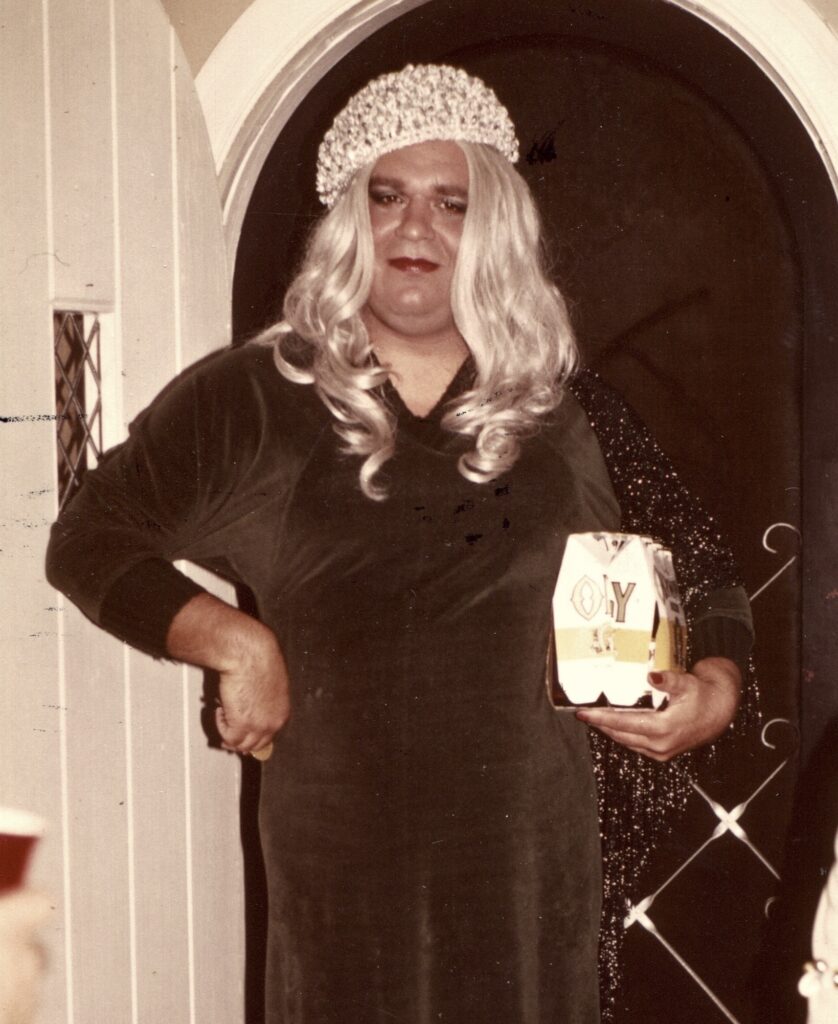
There must be plenty of them but nothing comes to mind. The question popped into my head after seeing photos of J. D. Vance in a blond wig and floral print skirt. A halloween photo from his college days. And former U. S. Congressman George Santos wasn’t camera-shy during his drag queen days.
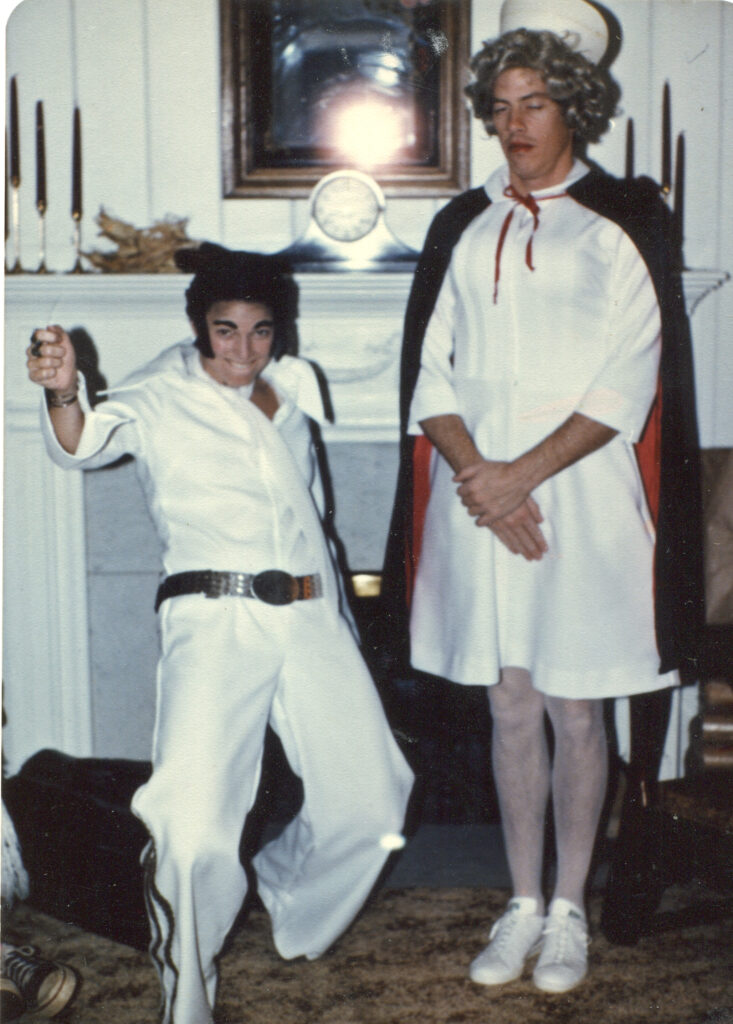
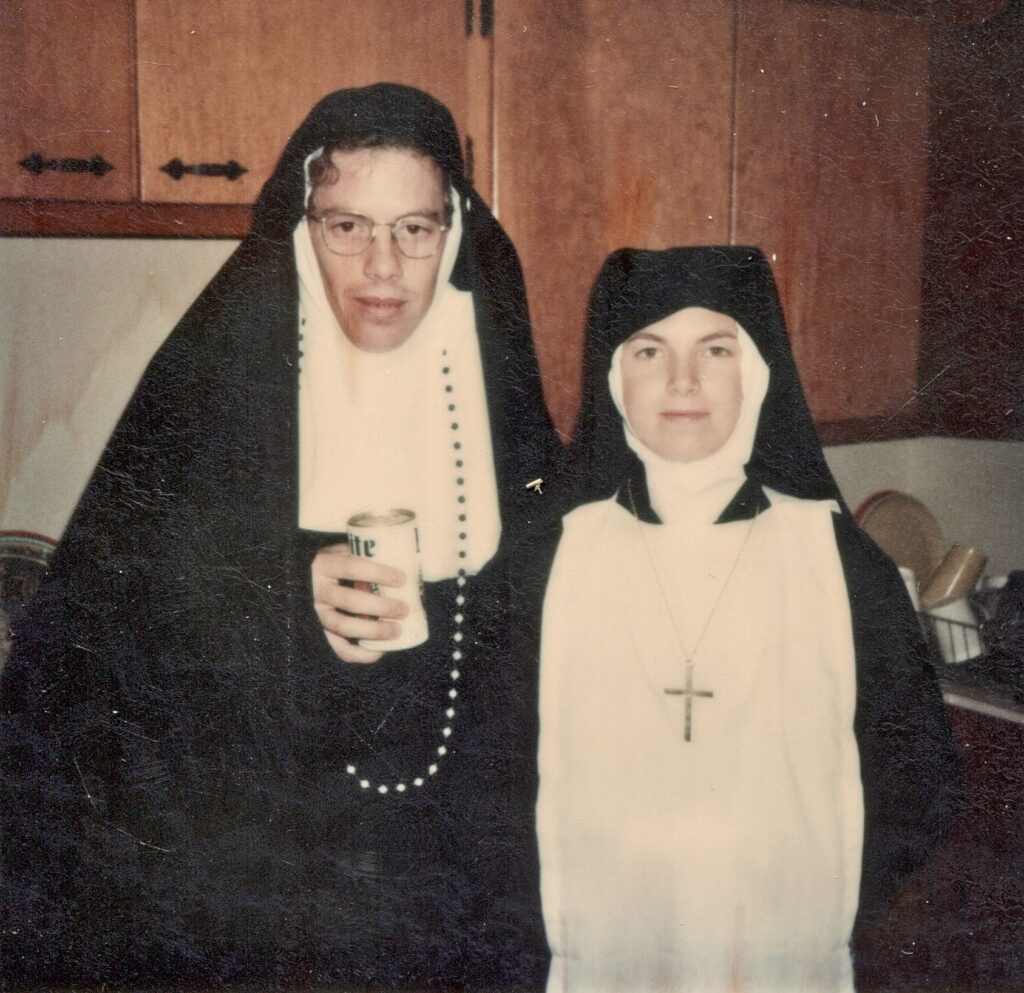
Our annual Halloween parties were the social event of the year and I showed up dressed as a woman at least two of those parties. Once as a nurse, the other time as a nun.
The nun photo is memorable because Barb and both came as nuns (from different orders it would appear). Neither of us aware of the other’s costume.
Once I saw just how good a man could look in a dress and wig, I gave up on that costume idea.
While searching for my most embarrassing photo, it occurred to me that it wouldn’t be in my collection. It would almost certainly be a photo someone else took and that I didn’t know existed. If you have such a photo, I’d very much like to see it. (My embarrassment bar is pretty hight these days.)
In my youth, people didn’t walk around with a camera in their hand (or pocket). And if it was nighttime you’d need a flash. And then the wait for the film to be developed and on and on. It was just too much trouble. So there just weren’t as many photos. And if you had a good one, sharing it meant a trip to the post office. And what is an “embarrassing photo” in an age when teenagers text each other pictures that can only be described a pornographic?
The photos of Vance are only a problem (if it is a problem) because of his homophobic anti-trans comments on the campaign trail. And I’m not sure George Santos minded at all.
I’ll keep looking for my most embarrassing photo and update this post if I come up with something.
I’ve got a thing about calendars. That’s not quite right. I’ve got a thing about remembering when things happened. I’m not good at that, even important stuff. My primary objective in starting this blog was to have some place I could write things down and find them later. Favorite lines from movies or a TV show. Excerpts from books. I keep a pen handy when ready a book so I can underline favorite passages and/or make notes in the margins. Did this mostly in novels but as I started reading more non-fiction, I found those books tended to get more notation. When I finished the book I transcribed those passages to a file and saved them. Once I started blogging those notes became blog posts. (Index page)
In my younger —pre-web— years, my notes were written or typed. I wasn’t very consistent with my journals but I did manage to save mosts of them (now as PDFs)
When I started working at Learfield Communications in 1984 I had to keep a calendar. This is my desk calendar from June of that year, my first full month on the job. If you hover over a date you might see the entry. I quickly moved to a spiral-bound calendar.
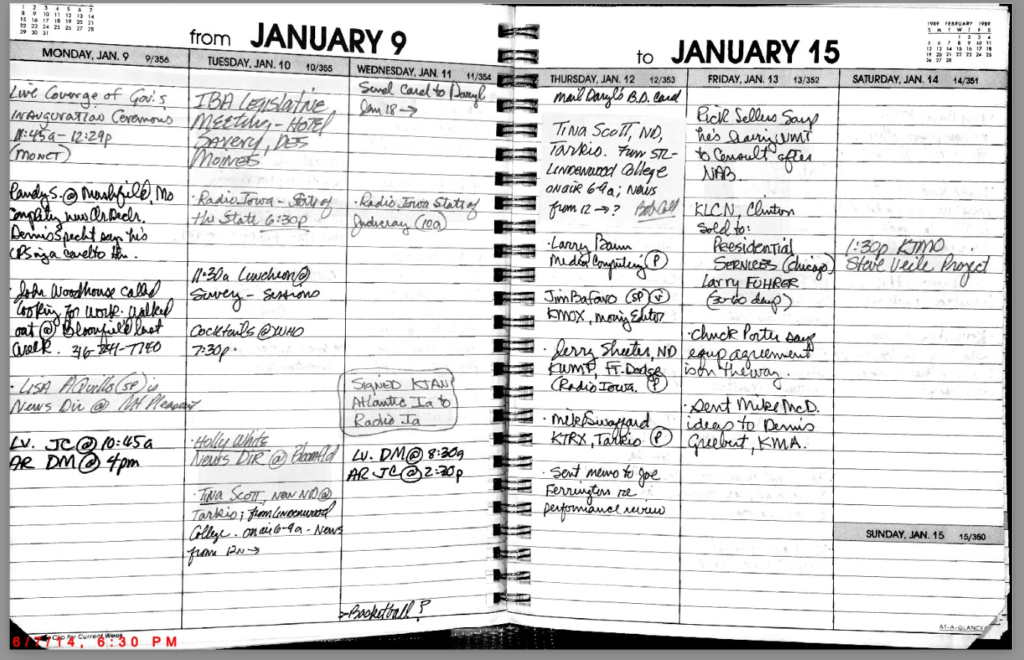
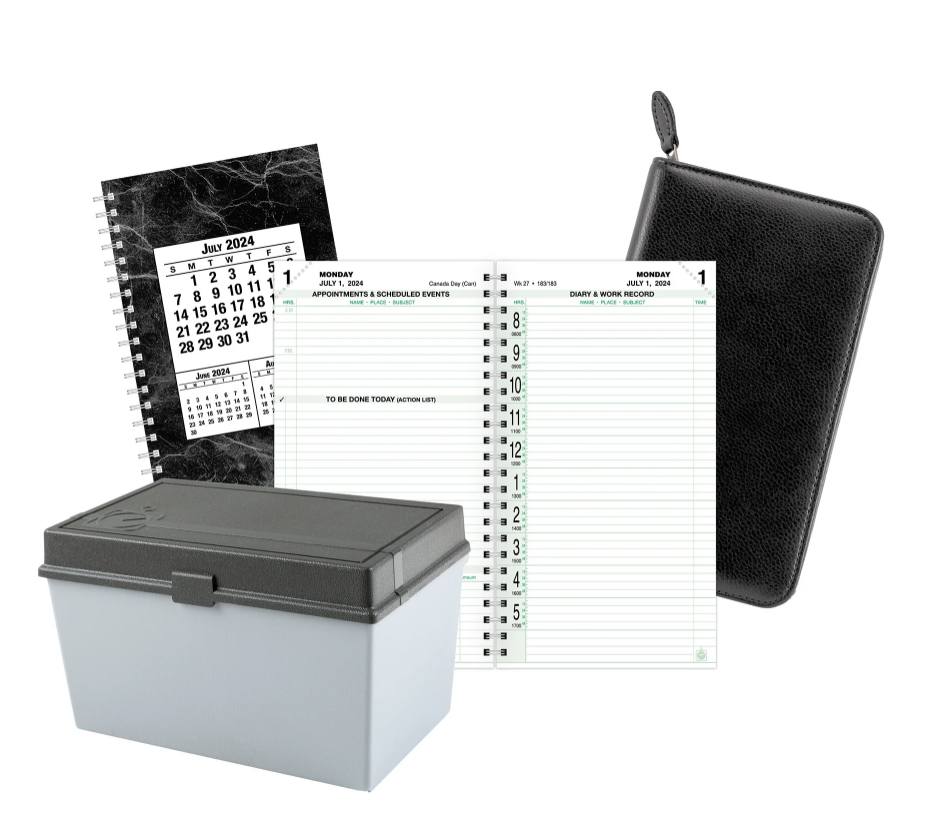
And eventually to the Day-Timer Calendar (of various sizes). I used those for the next few years, even after we had computers on our desktops.
I started using Google Calendar when it launched in the summer of 2009 and used it for almost everything, linking to relevant files (pdf, jpg, mov) in Google Drive. Google Calendar quickly became my daily diary.
In November of 2014 — a couple of years after I retired— I decided to get rid of a shelf-full of Day-Timers to make room for books. Before burning them I went through each day from 1984 to 1999, creating a corresponding entry in my Google Calendar. Flipping through those old pages brought back some physical sensations. A little stomach clinch over some bad news… tightness in the neck muscles as some unpleasantness unfolded. As I recall, this process took weeks going day-by-day, week-by-week.
I included the word “reprise” in the title of this post because I just completed this process for the second time. A few weeks back I made the decision to migrate from Google apps to the Apple ecosystem. Email, calendar, cloud file storage…everything. I want to be able to take advantage of “Apple Intelligence” when it comes along later this year or early next. I want Apple apps to have access to all of my data.
“Where calendars led people to think in terms of history, clocks led people to think in terms of productivity. Only after the proliferation of the clock did the word ‘speed’ (spelled spede) enter the English vocabulary.”
My calendar is now as complete a history of my last 30 years as I’ll ever have. And I enjoy having it. Being able to find stuff that I had forgotten existed.
“Years from now you might be looking back, wondering if you were as happy or as sad as you remember during this time. […] We so often make big decisions in life based on predictions of how we think we’ll feel in the future, or what we’ll want. Your past self is your best indicator of how you actually felt in similar situations. So it helps to have an accurate picture of your past. […] You can’t trust distant memories. But you can trust your daily diary. It’s the best indicator to your future self (and maybe descendants) of what was really going on in your life at this time.”
If you care about your thoughts, keep them. Exactly.