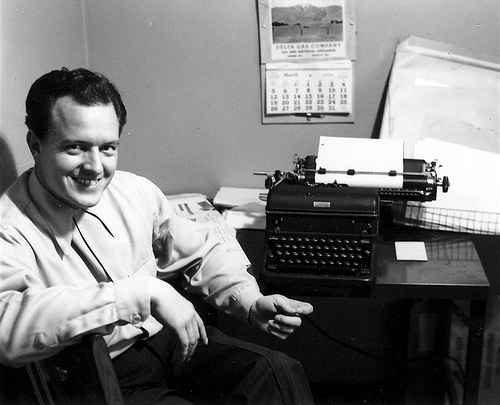
What does “Being Local” mean, anyway?

“I think the term “local” dates to a time when communities could only be served by media which originated within them – the local newspaper, TV, or radio. Today, communities continue to have local pride, interest, and concern, but their means of expressing and sharing in those things are no longer limited to the media which so happen to be around the corner.”

“There is no longer any such thing as “local” as we traditionally use the term. The definition of “local” is both expanding (interests are broader than geographies) and shrinking (I am the ultimate “local”) at the same time.”

“If the Internet makes the world “local,” then what’s is your (radio) advantage?”

— Mark Ramsey at Hear 2.0

The Tower of Power

This week I ran into a long-time broadcaster I called on back in my affiliate relations days. We chatted for a few minutes and the subject of towers came up (I have no idea). He mentioned that he had tried to sell his AM tower but got no takers. Then he tried to give it away. Nope. Now he’s paying someone to take it down and haul it off. As far as I know, that is nothing unusual. But it struck me as somehow… foreboding?

A radio station tower is …iconic. Usually the tallest structure in small towns throughout America. You didn’t need much of a studio but you had to have that transmitter and a tower. The bigger the better.

Every radio guy I know has at least one tower story.

Like the DJ who pulled his UHaul truck into the parking lot of the station where he was to start working the next day. In the downpour, he didn’t realize he’d snagged the truck’s trailer hitch on a guy wire and pulled the tower down. And he didn’t get fired.

Or a story about the insane guys who did tower maintenance, climbing four or five-hundred feet to paint or change a bulb.

[Momentary aside: If someone drops a wrench from 400 feet above you, is it better to remain still or to run? Discuss]

What once took studios filled with control boards and tape decks and cart machines… can now be done with a couple of laptops.

The equation once was:

Good programming (content) + big transmitter + big tower + good frequency = big audience

Now it’s:

Good programming (content) + big transmitter + big tower + good frequency = big audience

I’m sorry I never interviewed one of those tower guys.

One in five radio execs social networking

How many US radio industry executives (from the 50 largest companiues) are on Facebook or Linkedin? Here’s what the folks at McVay New Media discovered:

“Out of 116 radio executives, running the fifty largest USA radio companies, 14 of them had Facebook accounts and 19 of them had LinkedIn accounts. The most common member of the executive team to have a presence on either website was the Chief Operating Officer.”

While less than scientific –some executives are online under different names– the results raise the question:

“How can we embrace the digital direction of the industry if our leaders are not even participants themselves? Think of it this way. If it were exposed that less than one in five of radio’s C-level executives owned radios, we would significantly doubt their confidence and personal investment in the radio industry.”

“If today’s radio companies are to evolve into the digital media world, wouldn’t it first make sense for radio’s leaders to evolve into the digital media world? Clearly, many leaders in the media industry are still learning the language of digital. Yet, the fastest way to learn a new language is immersion.”

“Tools like Facebook, LinkedIn, and Twitter can offer any C-level executive a simple and efficient direct forum with employees, shareholders, and customers. In fact, a strong executive could use social networking to improve their company’s image, foster positive communication, and directly confront market feedback.”

Is our (Learfield) industry “headed in a digital direction?” I believe it is. Are our leaders participating themselves? Only a few and in very limited ways. I might rephrase the question:

If only 1-in-5 of our senior managers regularly attended college sporting events, would we “doubt their confidence and personal investment” in collegiate sports marketing?

Mel Karmazin interview: “Fucking with the magic”

Mel Karmazin is the CEO of Sirius Satellite Radio. Before that he was head of CBS Radio. For most of his career he has been known as a “Wall Street darling” for his ability to drive up the price of his various companies’ stock. Don Imus frequently referred to him as the Zen Master. Let’s just say he knows a lot about radio and advertising. I was struck by his description of advertising and frank assessment that Google was “fucking with the magic.”

“I loved the model that I had then. At that point I had… I was the CEO of  CBS and I had a model where you buy a commercial… if you’re an advertiser you buy a commercial in the Super Bowl and, at that time, you paid two-and-a-half million dollars for a spot and had no idea if it worked. I mean, you had no idea if it sold product… did any good… I loved that model! That was a great model! And why …if I can get away with that model… if I’m in the business where I can sell advertising that way, why wouldn’t I want to do it?

No return on investment. And you know how everybody looks for return on investment? We had a a business model that didn’t worry about return on investment and then here comes Google. They screwed it up. They went to all these advertisers and said, we’ll let you know exactly what it is.”

Oooh. Reminds me of the old saw, “I know that only half of my advertising works, I just don’t know which half.” The full interview is worth a watch and confirmed my feeling that a real sea change (in advertising) is taking place.

“Radio Days: the celluloid afterlife of real radio”

“In the movies, radio is a mythic force: local, rebellious, life-changing. This hardly describes the reality at commercial radio stations today, but it does tell us something about how radio was—and about how we want it to be.

The Clear Channel consolidations of the 1990s and the streaming revolutions of the last decade have given us change and innovation, but they haven’t forged the kind of cultural radio that thrilled and united 20th-century audiences. Sure, we’ve got talkers who excel at dividing us. And we’ve got little machines that let us become our own DJs. But we haven’t replicated the “real people” kind of radio that speaks and sings to us better than we can speak and sing to ourselves. Our new broadband-powered landscape hasn’t empowered that level of talent—yet. But don’t worry. It will. Until then, see you at the movies.

I stumbled across this piece by Matthew Lasar on ars technica. It brought back many fond memories from my days at KBOA (’70s). We said pretty much anything within reason and the same went for the music we played (on turn-tables). And I loved movies about DJ’s and radio stations. I’ll be forever grateful I didn’t miss “real radio.”

“Taking a break from the news”

The following anecdote won’t mean much to anyone who has never worked at a small town radio station covering local news stories. And I don’t share this to embarrass or disparage anyone still doing so. It’s just a sign of the times.

One of our network reporters called an affiliate in a small town, asking for a feed of a story about a bank robbery and the capture (and tasing) of the stickup guy. Our reporter was informed the station news person was on vacation and since they couldn’t find anyone to do the news in his absence, “they’re taking a break from the news this week.” Our reporter’s reaction?

“The bridge is too far away for me to walk to it and jump.  Our bluffs are not high enough to guarantee a fatal descent if I were hurl myself off one of them and I do not want to spend years as a paraplegic watching for more of these signs.   My Norelco razor will not cut through any arteries and the only scissors I am allowed to have are the school scissors my children left behind when they grew up.

My only recourse is to continue working in this industry until it reduces me to complete incoherence, upon which time I can be placed in a padded room where I shall be safe from the apocalypse.”

Philosopher and poet-journo Bob Priddy:

“Radio began to lose its soul when stations became “properties,” when communities became “markets,” and when staff became “human resources.”

Bomb shelters or spaceships

If you were recruiting for someone to manage a news organization in 2009, what skills or experience should you be looking for? What would the job description look like? (Since I know nothing about print, I’ll limit my questions to broadcast)

In my experience, most people who make it to “the top,” come from the sales side of the business. The men and women who made their bones in the newsroom occasionally wind up running the show but they are the exceptions. So we’re looking for sales and marketing experience, yes?

Someone who can figure out how to sell the advertising that funds company. Someone who can recruit and train people to sell 30 second radio and TV commercials?

What about this Internet thing? Do our sellers need to know how to sell banner ads (or whatever), too? Or does our manager have to manage two distinct type of sales departments? “Traditional” and online?

Strategically, do we manage the business we have today and hope it lasts a long time? Or, do we try to anticipate what our business will become in three, or five, or ten years? No easy task.

Clay Shirky says the advertising model that has defined and driven news organizations worked because advertisers didn’t have alternatives. Now they do.

But I’m getting away from my original question. Do we need a manager that is real good at “where we’ve been?” Someone with a good handle on where we’re headed? (if such a person exists) Or both? (tall order)

What if advertising –as we have come to know it– plays little or no part in funding news organizations in the future? Uh, let’s not go there. Too murky and scary.

As you can see, I have no answers… just questions. And I’m not sure they’re even the right ones.

Maybe it comes down to finding someone who knows how to build a spaceship, verses someone who knows how to build a bomb shelter. The spaceship has to get us to a very different place. The bomb shelter will protect us for as long as our food and water hold out.