
Update: Google Audio Ads

From Inside AdWords blog: “Over the last year, we’ve been working hard to integrate the dMarc advertising platform into Google AdWords. We’re happy to announce that the integration is now complete and we’ve recently begun a U.S. beta test of Google Audio Ads with a small group of AdWords advertisers.”

If you haven’t been keeping up, here’s how Google describes their Audio Ads:

“Google Audio Ads brings efficiency, accountability, and enhanced ROI to radio advertising by providing advertisers with an online interface for creating and launching radio campaigns. You’ll be able to target your customers by location, station type, day of the week, and time of day. After the radio ads are run, you will be able to view online reports that tell you exactly when your ad played.”

A couple of days ago, Mark Ramsey (Hear 2.0) pointed us to an application page on the Google website.

Ad Specialist Application — Thank you for your interest in joining the Google Ad Creation Marketplace. We’re looking for some of the top audio ad specialists to join our Ad Creation Marketplace – a searchable directory of talent to help AdWords advertisers to create radio advertisements. For advertisers new to the radio space, or who are starting a new campaign, the Marketplace provides an invaluable starting point for finding the talent they need.

So, I decide to buy some Google Audio Ads. I search the Google Ad Creation Marketplace database for someone to write and produce my spot. We agree on a price. I send some copy. They email back an MP3 file. I’m off to the races. Maybe. Mr. Ramsey is skeptical and I confess I am too. But if it works… it could have a profound change on how advertiser buy and place ads.

Update: According to News.com, the radio ads are running in more than 260 metropolitan markets, covering about 87 percent of the country

“Is it time to give up on radio?”

The sky is not falling!That’s one of the headlines in the latest issue of the StateNets newsletter. StateNets –formerly the National Association of State Radio Networks — is the marketing arm for most of the state radio networks in the country.
Jim Underwood of the Florida Radio Network wonders if it’s time to drop “radio” from their name.

“First of all, we are not really in the radio business, the broadcasting business or even the network radio broadcasting business. We are in the business of supplying information to people and charging clients a fee to include their message with that information.

We produce a lot of valuable, exclusive content about our states every day and we need to devise new ways to make that information available to people everywhere who may be interested in it. (We’re) working on software to make FRN – er rather maybe Florida Information Network – content available to websites of affiliates, then maybe newspapers. Why not supply State Government sites with the content?”

Such a rude question would have been considered heresy just a short time ago. Based on all that I’ve seen/heard, the future of state radio networks (including ours) is closely tied to that of the radio stations we serve. I’m convinced there are other markets for our content, but I still haven’t seen the business model that will replace –dollar for dollar– the revenue state networks have come to depend on. Stay tuned.

Clear Channel does deal with Reuters for web content

Clear Channel Radio’s online division has announced that it will add news and video content from Reuters to its News on Demand service on CC Web sites.

“Clear Channel Radio’s News on Demand product combines on-demand video and text feeds from Reuters with CCR’s 24/7 coverage of breaking news, business/financial stories, entertainment news and human-interest features. The product also allows CCR stations to upload their own local news to their sites, giving both local and national news coverage from station sites on demand.”

I’d love to see exactly what “on demand” means but I can’t argue with the strategy. I hope more of our affiliates will get their online act together and inlcude our our state news and sports content on their sites. And I wonder where AP was/is in this mix. Too pricey perhaps? I’d love to hear more about this. SteveMays at Gmail dot com [Radio and Records]

Will we see “local” radio again?

So Clear Channel is going to sell 400+ radio stations. Will these stations become more local? Mark Ramsey says it depends on who buys the stations and the “models of success” they try to follow:

1. Quality local talent with local connection and high entertainment value
2. Quality syndicated talent with high entertainment value
3. Low cost or no talent – regardless of its source (i.e., nothing matters but the music)

He concludes his post with the question: “Of those, which do you think is the toughest to achieve? And which is the cheapest?”

When I started in radio (1972), a lot of radio stations were still trying for #1. Not all of the local talent was “quality” and I’m not sure how “entertaining” we were. But syndicated programs were still a few years away and most communties weren’t ready to let you get away with juke box-ing the station.

But I think Ramsey sums up the options accurately and we’d see more station owners try #1 if #2 and #3 weren’t such attactive (short-term) options.

Ole Camp Meetin’ Time

Nostalgia Alert: We’re going back to 1947 in this post.

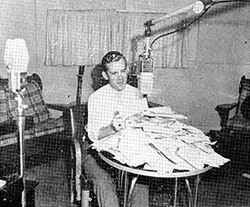
When KBOA went on the air (July 19, 1947), one of their first –and most popular– programs was “Ole Camp Meetin’ Time.” It was the creation of Ray Van (Hooser), the station’s first program director. The program featured hymns and gospel music but was far more than a “record show.” And it was immediately and immensly popular.

Sometime in the early ’50’s, Rudy Pylant (“Mr. Rudy”) took over Ole Camp Meetin’ Time and gave it his own special flavor (think Will Rogers-meets-Jerry Clower). The program continued to be hugely popular.

I was reminded of Ole Camp Meetin’ Time this week when my (life-long Kennett) friend Joann sent me one of the original Ole Camp Meetin’ Time Song Books. Published in late 1947, the radio staiton gave away thousands of these. Seems hopelessly quaint now but in 1947, these were like iPods.

If you grew up anywhere within a hundred miles or so of Kennett, Missouri, in the late 40’s or ’50s… you probably have memories of sitting at the breakfast table listening to Ole Camp Meetin’ Time. As I write this, I realize I don’t have the skill (or perhaps it is not possible) to convey how important this radio program was to the people that listened to it every monring. But, fortunately, I have some oral history that might come close.

You can read the introduction to the song book by station manager Paul C. Jones, after the jump.

So here we are sixty years later (gulp!) and it ain’t your father’s radio anymore. I have no illusions about returning to those days. But as I listen to the men that built KBOA talk about their love of radio (I’m not sure they would have said “the business” of radio)… I wonder if that same passion still exists today. I’m not in many stations these days so the flame might be burning brightly and I would not know. I’ve turned the comments on for this post for those than might.

Continue reading

Website: Expense or investment?

Mark Ramsey poses the following questions to broadcasters:

1. Is the purpose of your website just to put online what is already on the air, or is it something else?
2. Are we investing the necessary resources and talent in the development of our website, or are we having an intern update stuff in his spare time?
3. Are we giving people what they go to our station for in all its shapes and sizes on the web? Or are we offering one stream and a bunch of photos of our personalities?
4. If the content described in this article (Fast Company) can generate considerable traffic, can we convert that traffic to revenue? If so, why aren’t we investing for traffic instead of seeing our websites as expensive necessities?
5. If we keep crowing about how “local” our radio station is, exactly how does our website express that or service that?

Chicken LittleA couple of days ago, a broadcaster called me for advice on possible speakers/topics for an association meeting next spring. She wanted someone to come talk to them about “new media.” I asked her why?

“Uh, we need to figure out how to make some more money.” Or words to that effect.

I imagined thirsty villagers taking buckets and empty containers to a nearby well in hopes of finding water for their thirsty families.

I suggested that before you’d have anything to sell (to advertisers), you’d need to build an audience and that would take time and money. An investment.

“No, our owners won’t let us spend any money. We need to find some more money. That’s why we were thinking about the Internet.”

To completely exhaust the metaphor… if you don’t have the will or the resources to drill a new well… pray for rain.

Google (still) moving into radio

“Web search leader Google Inc. is hiring scores of radio sales people and is spending heavily in a bid to expand its position in the $20 billion radio industry. Google spokesman Michael Mayzel said this week that the company will begin a public test of Google Audio Ads by the end of the year. Advertisers will be able to go online and sign up for targeted radio ads using the same AdWords system they use to buy Web search ads.” — Reuters

Thirty years of election coverage

The first election covered by The Missourinet (a network owned by the company I work for) was in 1976. News Director Bob Priddy orchestrated that first election night and every one since. Prior to The Missourinet, radio stations throughout the state focused on local races and relied on the wire services for news and numbers from throughout the state.

The Missourinet brought the sounds of election night from the state capitol and campaign headquarters throughout Missouri to the hometown audiences of our affiliates.

The technology has changed… and is changing… but insight and understanding Missourinet reporters bring to their election night coverage remains the focus of their reporting. Bob reflects on the past 30 years in this 10 minute video.

Should Google buy Clear Channel?

Article in AdAge briefly explores that question. The phrase that jumped out of the story at me was, “automated sale of remnant ads.”

“Right now, through Google’s year-ago acquisition of dMarc, a radio systems company, it has been able to create an automated way to sell what is mostly remnant radio inventory, which remains unsold until the last minute. But, noted Mr. Bank, Google Audio is making several high-profile hires in the radio sales field in major radio markets. Now why, if Google Audio’s selling of remnant ad time is so automated, would there need to be so many high-priced radio ad sales folks.”

I’m pretty sure a big chunk of my salary for the past 20 years has come from acquiring and selling “remnant radio inventory.” Should companies that trade services for commercials on radio stations (we call it barter) be concerned about this? My guess is most station managers would rather have cash for his unsold commercials.

The Google-Clear Channel idea is an interesting one. CC has lot of stations and Google has figured some things out about advertising.

BBC looking for podcasters

BBCThe BBC is recruiting podcasters to help cover the US mid-term elections. They’re looking for:

  • Personal views of the race from people with an interesting perspective (perhaps you are a recent immigrant or an Iraq vet for example)
  • Bloggers, podcasters and vloggers who are covering their local race.
  • Anyone with a real interest in local politics and an ability to tell the story of the race in their town and state.
  • People from overseas with a real stake in the result.

The BBC blog post suggests some ways to contribute:

  • Phone or skype interviews
  • Emailing us an audio report
  • Emailing a short written report that we can read on air
  • Pointing us to a blog, podcast or vlog you’ve made covering the election.
  • Point us to a story you think we should be covering

The BBC says that “by enlisting your help we’ll have coverage that isn’t just about pundits and experts but gives us a real flavour of what the race is like for ordinary Americans that cuts through some of the stereotypes about politics in the US.”

One of the great strengths of our statewide radio networks has been the collaborative efforts of our affiliates. Radio station news directors throughout the states we serve would report on stories of statewide relevance, feed them back to the network, where we would uplink back to all stations on the network. Resulting in a whole that is greater than the sum of the parts.

But as radio station owners slashed their news operations (to reduce operating costs), a lot of “statewide” stories just didn’t get covered. It was all the local news folks could do just to keep on top of their “local” stories. No time to feed something to the network. (I should point out that many network affiliates still do an amazing job of contributing stories to our networks.) One can only hope that we’ll see a swing back toward strong, well-staffed local news departments.

But perhaps the next network will look more like what the BBC (and others) are putting together. Citizen Journalists (pick another name if you don’t like that tag) covering and sharing hyper-local news in an infinite variety of ways.

The tools already exist. A housewife in Joplin shoots 2 minutes of video outside her local polling place, including comments by those standing in line to vote. The Internet means distribution will never be a problem again. All that’s missing is some structure to pull it all together in some coherent manner. Perhaps something like the BBC effort.

“Yeah, but how do we make money with this model, smays?”

I’m not sure that is the right question but it’s a reasonable question.

First, the costs associated with setting up something like this are relatively small when compared to traditional broadcast networks with satellite trucks and producers and editors and so forth. But it would take time to grow (as did our networks). And you’d probably have competition since this is a game almost anyone can play.

So, is there enough profit in something like this to make it worth the investment of time and money? If you already have a cow that’s giving milk (cash), maybe not. If you don’t own a cow, this might seem like a good way to start building your herd. [via Podcasting News]