
Mark Ramsey (Hear 2.0) offers still more insight on Google Audio Ads, including some screenshots of pages where you specify the demographic and geographic details of your buy. For businesses that don’t need an “advertising consultant” to show up with a media kit and a coverage map, this might be an effective way to buy radio ads.
Category Archives: Radio
Radio Announcers
That’s what they called them when my father and Mr. Rudy (Pylant) were on the air at KBOA in Kennett, Missouri. Pop and Mr. Rudy have since made the transition to Pure Amplitude Modulation but the audio waves of their wonderful voices are still streaking through space.
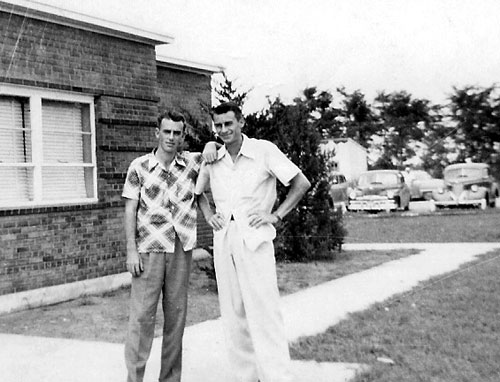
I had never seen this photo of John and Rudy standing in front of the KBOA studio but, based on the automobiles behind them, it could have been as early as ’49 or ’50. The station went on the air in July of 1947 and my father started in 1949. Any of you car freaks able to ID the year of the car at the right edge of this photo?
What happened to the news?
A scary little story in today’s USA Today about the findings of a study by the Project for Excellence in Journalism. According to Project Director Tom Rosenstiel,
“The dirty little secret of the information revolution is it has been more about repurposing or repackaging news than gathering it.”
In recent years, because of their own cutbacks, radio and television have increasingly been relying on newspapers and wire services to do their newsgathering for them.
If you think the news is thin on local radio and TV stations now, imagine what it would be if they didn’t have newspapers to rewrite. If,however, your local radio station long ago abandoned any pretense of news, you’ll be okay.
Google Audio will raise ad rates
Reply
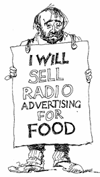 That’s the prediction of Google Audio national director of sales Drew Hilles tells Inside Radio “Our main goal is to draw new advertisers to radio” and when they do that’ll put pressure on inventory and result in higher rates for all buyers. The onetime CBS Radio exec says “our goal is to raise rates” and return the sector to double-digit growth. He says one way they help preserve a station’s rate card integrity is by allowing buyers to pick markets — but not individual stations. And Hilles says “stations have control of the throttle of how much of the inventory they open up or not.” Hilles says Google is working to attract some of its existing 100,000 advertisers who have found radio too tough to buy. Hilles says what attracts them is the “more Googley way” they sell radio that affords buyers more accountability and trackability. Google says “a large amount” of the advertisers are new to radio. [INISIDE RADIO]
Listeners of tomorrow are online today
Jerry Del Colliano, Professor of Music Industry at USC and founder of Inside Radio, offers still another warning to radio broadcasters:
“When universal WiFi or its equivalent is available and consumers can take the Internet with them then it’s all over for radio. Ditto for satellite radio. That is, of course, assuming that terrestrial radio broadcasters don’t have an epiphany soon and decide to get into the Internet radio business.
Radio and the merged satellite radio company need to get into the Internet radio business now because tomorrow Internet radio will be the next radio. Why? Because that’s where the listeners will be and universal WiFi will make it all possible.” [via RAIN]
I’m tempted to email Mr. Del Colliano and ask if this applies equally to small and large market broadcasters. But I’m afraid of the answer.
XM, Sirius merger?
The New York Post is reporting the long-awaited merger of Sirius and XM may be announced today. Combining Sirius and XM would result in a single satellite radio operator with more than 12 million total subscribers. A deal would also marry Sirius content, such as Howard Stern, Frank Sinatra and Nascar with XM’s Oprah Winfrey, Bob Dylan and Major League Baseball. More important, analysts widely predict that a deal would also save the two companies nearly $7 billion annually.
Total radio silence from XM Ben on this story. And XM and Sirius have to get this just right to keep me. I’m spending more time with the nano and less with my XM. If they don’t make the merged service better/cheaper… I’ll be gone at the end of the contract.
“NPR is not radio”
Jeff Jarvis, David Weinberger, Doc Searls, Jay Rosen and some other New Media thought leaders have been invited to Washington to talk/think about the future of National Public Radio. Mr. Jarvis shares some of his notes going in and I found myself substituting the names of our radio networks for NPR.
“NPR is not radio. If I tell newspapers they have to stop thinking on paper, so I’ll argue that NPR must throw off the limits of its medium. And I don’t just mean that the can go multimedia, adding photos or videos to their sound. I mean changing the culture, not thinking like a radio network anymore so they can see the options the internet opens up to work in every appropriate medium with entirely new kinds of content, from TV to data bases. So change the name: It’s National Public Media, except that Doc will scold me that this is more than media. It’s National Public Whatsis.”
Some of his other ideas: NPR should be a network of networks and a training ground for great media. They should add to their mission finding and nurturing new talent and help local affiliates become hyperlocal.
I surely would love to sit in a corner and listen to these guys. But it appears they will be blogging all or parts of the conversations so I’ll follow it there.
“Is radio still radio if there’s video?”
“The nation’s commercial radio stations have seen the future, and it is in, of all things, video. Across the country, radio stations are putting up video fare on their Web sites, ranging from a simple camera in the broadcast booth to exclusive coverage of events like the Super Bowl to music videos, news clips and Web-only musical performances.” – NYTimes.com
Okay, how about some bonus spots?
Betsy Lazar –Executive Director of Advertising and Media Operations at GM– gave a keynote at the rcent Radio Advertising Bureau conference in Dallas. According to INSIDE RADIO, she was pretty specific in her advice to broadcasters;
“…doing business the old way won’t cut it. Pitching schedules of :30s won’t do it. What GM wants is ideas that show involvement by the station. Things that come from mining the listener database and exploiting the station website in fresh ways.”
Ad Age reports that GM “slashed ad spending by more than $600 million last year, a drop so stunning it should convince even the staunchest doubters that the age of mass-media marketing is going the way of the horse and buggy.”
In that same issue of INSIDE RADIO: Bank of America analyst Jonathan Jacoby admits his survey of 34 industry pros last week in Dallas is not statistically significant. But he says 43% of them (14-15 people) said they’ve “used or plan to use Google/dMarcto sell airtime.”
dMarc founders leave Google
Looks like Google’s plans to reinvent the way radio ads are bought has hit a rough spot. Online Media Daily reports Chad and Ryan Steelberg, the founders of dMark, an automated radio ad placement company purchased by Google in January 2006, have left the company.
The brothers resigned amid reports of growing tension between dMarc, the company they founded, and Google over differing approaches to radio ad sales. There was also said to be tension over the limited remuneration dMarc could expect under the performance-based terms of its original deal with Google.