
NAB keynote: Broadcasters still don’t get the web

I keep looking for signs that broadcasters are beginning to understand the importance (an potential) of the Internet. I’m sorry to say, I’m just not seeing them. And, based on Steve Safran’s (lostremote) summary of the keynote at this year’s NAB (National Association of Broadcasters) meeting, I won’t find it there:

“The internet did get a shoutout at the National Association of Broadcasters keynote speech Monday morning in Las Vegas. David K. Rehr, CEO and President of the NAB, said “internet.” He mentioned it once. In passing. During his discussion of issues about radio. It came 47 minutes into the keynote session and was the only time anyone said “internet.” That’s really all you need to know about the keynote. The NAB is simply not interested in the potential of the web, and what little interest it may have is only in terms of saying how broadcasting is better.”

Working for a company that provides services to broadcasters, I really hope they have a bright future. Mr. Safran’s summary of the keynote is worth a read.
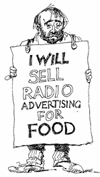
Google will sell ads on Clear Channel

Google has broken into radio with a multi-year advertising sales agreement with the largest U.S. broadcaster, Clear Channel Radio. Clear Channel said it has agreed for Google to sell a guaranteed portion of the 30-second spots available on its 675 radio stations in top U.S. markets, in a bid to expand the universe of local radio advertisers to Google’s online buyers.

A Clear Channel executive said Google has access to less than 5% of the radio broadcaster’s overall inventory of advertising air time. The U.S. radio industry generates $20 billion in annual sales. [USAToday]

Radio doing TV News

“At WDEL-AM in Wilmington, Delaware, our reporters produce stories using video cameras instead of cassette recorders,” news director Christopher Carl says in a comment on Poynter.org. “The audio is used on the radio. Reporters then produce video packages for out website – WDEL.com. WDEL.com users can then choose to watch individual video stories or a daily 10-minute video newscast. On weekends, users can watch a recap of the week’s big stories. Wilmington, DE is a a market with NO local commercial television station. [via CyberJournalist.net]

“Citizens” against satellite radio; Who’s got HD?

Mark Ramsey (Hear 2.0): “C3SR – the consumer group that was created to oppose the merger between XM and Sirius – is in fact supported by the NAB.”

Also at Hear 2.0: “…the average consumer is more likely to die by accidental drug overdose or by hanging, strangulating, or suffocating themselves than they are to own an HD radio.”

I’d love to hear from any smays.com readers who have HD radios. How’s it sound? What are you listening to? Use Comment link below.

Google Audio looking better to radio groups

“Google is finding some friends. There are plenty of critics of Google’s foray into radio — but we’re slowly seeing some group heads come out and say there may be a place for the Internet giant in radio sales. Regent tested the service in two markets and CEO Bill Stakelin says they sold “a tremendous amount of inventory” and the results “far exceeded our expectations.” He says the issue that remains to be worked out is pricing.

While Emmis CEO Jeff Smulyan says “if Google has the advertiser that we’re never going to call on at rates that make sense … then it’s business that we want to take.” Smulyan says Google’s efforts are especially welcome in “transactional” markets like New York and L.A. where radio has done a “marginal job” at attracting new advertisers.

Meanwhile — Border Media Partners CEO Tom Castro says many folks are focusing on HD and streaming. But the real technological breakthrough will come on the sales side. Castro says “it’s not very sexy — but it’s where we are going to make a lot of money in the future.” — INSIDE RADIO report from the Kagan Radio-TV Summit:

Google Audio Ads by the numbers

Mark Ramsey (Hear 2.0) offers still more insight on Google Audio Ads, including some screenshots of pages where you specify the demographic and geographic details of your buy. For businesses that don’t need an “advertising consultant” to show up with a media kit and a coverage map, this might be an effective way to buy radio ads.

Radio Announcers (John Mays and Mr. Rudy)

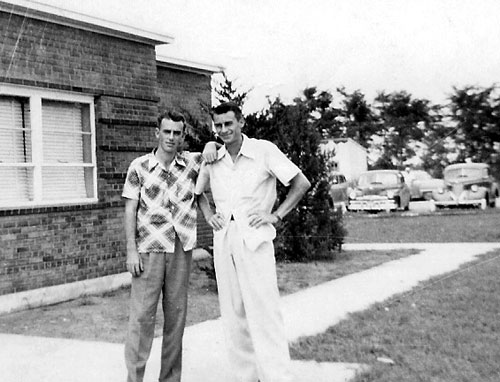
That’s what they called them when my father and Mr. Rudy (Pylant) were on the air at KBOA in Kennett, Missouri. Pop and Mr. Rudy have since made the transition to Pure Amplitude Modulation but the audio waves of their wonderful voices are still streaking through space.

I had never seen this photo of John and Rudy standing in front of the KBOA studio but, based on the automobiles behind them, it could have been as early as ’49 or ’50. The station went on the air in July of 1947 and my father started in 1949. Any of you car freaks able to ID the year of the car at the right edge of this photo?

What happened to the news?

A scary little story in today’s USA Today about the findings of a study by the Project for Excellence in Journalism. According to Project Director Tom Rosenstiel,

“The dirty little secret of the information revolution is it has been more about repurposing or repackaging news than gathering it.”

In recent years, because of their own cutbacks, radio and television have increasingly been relying on newspapers and wire services to do their newsgathering for them.

If you think the news is thin on local radio and TV stations now, imagine what it would be if they didn’t have newspapers to rewrite. If,however, your local radio station long ago abandoned any pretense of news, you’ll be okay.

Google Audio will raise ad rates

That’s the prediction of Google Audio national director of sales Drew Hilles tells Inside Radio “Our main goal is to draw new advertisers to radio” and when they do that’ll put pressure on inventory and result in higher rates for all buyers. The onetime CBS Radio exec says “our goal is to raise rates” and return the sector to double-digit growth. He says one way they help preserve a station’s rate card integrity is by allowing buyers to pick markets — but not individual stations. And Hilles says “stations have control of the throttle of how much of the inventory they open up or not.” Hilles says Google is working to attract some of its existing 100,000 advertisers who have found radio too tough to buy. Hilles says what attracts them is the “more Googley way” they sell radio that affords buyers more accountability and trackability. Google says “a large amount” of the advertisers are new to radio. [INISIDE RADIO]